

Every year, more than 36,000 older adults in the U.S. die from falls. That’s more than car crashes. And a big part of the reason? Medications. Not because they’re dangerous by design, but because they’re often kept too long, stacked together, or not reviewed properly. For seniors, even a small change in a pill can throw off balance, drop blood pressure, or blur thinking - and that’s all it takes to end in a hospital bed, a broken hip, or worse.
What Makes a Drug a Fall Risk?
Not all medications are equal when it comes to fall risk. Some hit the brain. Others drop blood pressure. Some slow reaction time. The common thread? They interfere with the body’s ability to stay steady. The most dangerous ones are called fall risk-increasing drugs (FRIDs). These aren’t rare outliers - they’re common prescriptions. A 2023 study in JAMA Health Forum found that between 65% and 93% of seniors hospitalized after a fall were taking at least one FRID. Many were taking three or more.The biggest culprits fall into a few clear categories:
- Antidepressants - especially SSRIs like sertraline and fluoxetine, and tricyclics like amitriptyline. These can cause dizziness, low blood pressure, and slowed reflexes. Studies show SSRIs nearly double the chance of falling.
- Benzodiazepines - drugs like diazepam (Valium) and lorazepam (Ativan), often prescribed for anxiety or sleep. They cause sedation, confusion, and muscle weakness. Long-acting versions are especially risky because they stick around in the body for days.
- Antipsychotics - even when used for behavior issues in dementia, drugs like risperidone and quetiapine increase dizziness and unsteadiness. Their side effects mimic Parkinson’s symptoms.
- Blood pressure meds - beta blockers, ACE inhibitors, and diuretics are essential for heart health, but if the dose is too high or changes too fast, they can cause orthostatic hypotension. That’s when your blood pressure drops suddenly upon standing, making you feel lightheaded or faint.
- Opioids - painkillers like oxycodone and hydrocodone slow reaction time and can cause drowsiness. The risk skyrockets when combined with benzodiazepines - a combo that increases fall risk by 150% compared to either drug alone.
- Antihistamines - over-the-counter sleep aids like diphenhydramine (Benadryl) and cold meds with this ingredient are loaded with anticholinergic effects. They fog thinking, dry the mouth, and impair balance. Yet, they’re still widely given to seniors.
- Muscle relaxants - drugs like cyclobenzaprine (Flexeril) and carisoprodol (Soma) are often prescribed for back pain, but they cause drowsiness and poor coordination.
Why Do These Drugs Become Dangerous Over Time?
It’s not always about the drug itself. It’s about how long it’s been taken - and whether anyone’s checked if it’s still needed.Many seniors start a medication for a short-term issue - say, anxiety after a surgery, or insomnia after losing a spouse. Then, it becomes routine. No one reevaluates it. Five years later, they’re still on it. And their body has changed. Their kidneys aren’t clearing drugs as fast. Their balance is weaker. Their brain is more sensitive.
That’s why the American Geriatrics Society’s Beers Criteria - updated every two years - keeps warning against long-term use of these drugs in older adults. The 2023 update didn’t soften its stance. It strengthened it. Benzodiazepines? Avoid unless absolutely necessary. Anticholinergics? High risk. SSRIs? Use with caution. Tricyclics? Strongly discouraged.
And here’s the hard truth: even "safer" alternatives aren’t safe. Short-acting benzodiazepines? Still risky. Newer antidepressants? Still increase fall risk by about 2 times. There’s no perfect drug - just less dangerous ones, and the best option is often no drug at all.
Polypharmacy: The Silent Killer
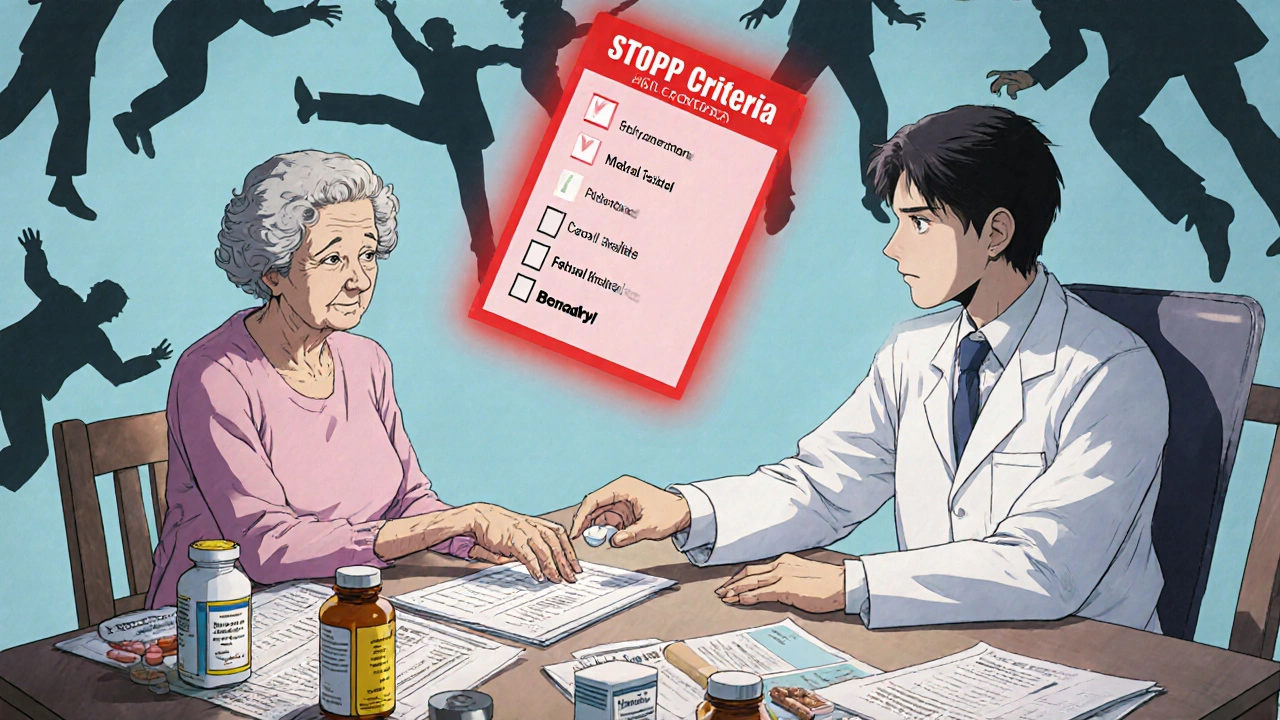
Taking four or more medications? That’s polypharmacy. And it’s not just about the number - it’s about the interactions.Imagine someone on a blood pressure pill, an antidepressant, a sleep aid, and a painkiller. Each one might be fine alone. Together? They multiply side effects. Dizziness from the blood pressure drug gets worse from the antidepressant. The sleep aid adds fog. The painkiller slows reactions. The result? A perfect storm for a fall.
The National Council on Aging found that seniors on four or more prescriptions have a significantly higher fall risk - even if none of the drugs are on the "worst" list. The cumulative effect is real. And it’s often invisible to doctors who focus on one condition at a time.
That’s why a medication review isn’t just a good idea - it’s a lifesaver. A 2021 study in the Journal of the American Geriatrics Society showed that when pharmacists led structured reviews of seniors’ meds, fall rates dropped by 22%. Not because they added new drugs. Because they stopped the ones that shouldn’t have been there.
What Can Be Done?
The solution isn’t to stop all meds. It’s to review them - regularly, intentionally, and with a team.Here’s what works:
- Ask for a full med review - every year, or after any hospital stay. Bring every pill, supplement, and OTC medicine you take. Include creams, patches, and eye drops. Don’t assume your doctor knows what’s on your nightstand.
- Check for orthostatic hypotension - if you feel dizzy when standing, ask your doctor to check your blood pressure while sitting and then standing. A drop of 20 mm Hg systolic or 10 mm Hg diastolic is a red flag.
- Challenge long-term prescriptions - ask: "Is this still needed?" "Can we try lowering the dose?" "Are there non-drug options?"
- Use the STOPP criteria - Screening Tool of Older Persons’ Prescriptions. It’s a checklist doctors can use to spot inappropriate meds. Ask if they’ve checked it.
- Involve a pharmacist - pharmacists are trained to spot interactions. Many hospitals and community pharmacies offer free med reviews. Ask for one.
Dr. Cara Cassino, a geriatrician, says the single most effective way to prevent falls is reviewing medications. Not balance training. Not grab bars. Not home modifications. Medication review. Because if the cause is a pill, removing it can stop the fall before it happens.
When to Seek Help
If you or a loved one has had even one unexplained fall - even if there was no injury - it’s time to act. Don’t wait for another one. Don’t assume it was "just a slip."Call your doctor and say: "I’ve had a fall. I’m worried about my meds. Can we review everything?" If they brush you off, ask for a referral to a geriatrician or a pharmacist specializing in older adults. In the UK, NHS Greater Glasgow and Clyde guidelines recommend specialist review for anyone with recurrent, unexplained, or injurious falls.
And if you’re taking opioids with a benzodiazepine or gabapentin - stop. Talk to your doctor. That combo is one of the deadliest in older adults. There are safer ways to manage pain and anxiety.
The Bigger Picture
Fall deaths among seniors have risen 31% between 2018 and 2021 - even as physical health and dementia rates stayed flat. That’s not aging. That’s prescribing.Doctors are under pressure to treat symptoms quickly. But treating one symptom with a pill often creates another - dizziness, confusion, weakness - that leads to a fall. And then another pill is added to fix the side effect. It’s a spiral.
Change is coming. By 2025, 75% of academic medical centers plan to have formal deprescribing protocols. But right now, only 42% of primary care doctors routinely check for medication-related fall risk. That gap is costing lives.
Seniors don’t need more pills. They need fewer - and smarter - ones. They need someone to ask: "Is this still helping?" "What’s the cost?" "Can we try going without?"
The answer might be simple. But it takes courage to ask. And it takes action to change.
What are the most dangerous medications for seniors when it comes to falling?
The most dangerous medications are antidepressants (especially tricyclics and SSRIs), benzodiazepines (like Valium and Xanax), antipsychotics, opioids, blood pressure drugs (especially if recently changed), antihistamines like Benadryl, and muscle relaxants. These affect balance, blood pressure, or thinking. Even "safe" versions still increase fall risk by up to 2 times.
Can stopping a medication really reduce fall risk?
Yes. Studies show that carefully stopping or reducing fall-risk drugs can lower fall rates by 20-30%. One study found pharmacist-led medication reviews cut falls by 22%. It’s not about removing all meds - it’s about removing the ones that do more harm than good, especially when they’ve been taken for years without review.
Is it safe to take sleep aids like Benadryl as an older adult?
No. First-generation antihistamines like diphenhydramine (Benadryl) are strongly discouraged for seniors. They have strong anticholinergic effects that cause confusion, dry mouth, blurred vision, and poor balance. They’re linked to higher fall risk and even dementia over time. Safer options for sleep include cognitive behavioral therapy or melatonin (with doctor approval).
How do I know if my blood pressure medicine is making me dizzy?
If you feel lightheaded, fuzzy, or weak when standing up quickly - especially after sitting or lying down - that’s a sign. Ask your doctor to check your blood pressure while sitting and then again after standing for 1-3 minutes. A drop of 20 mm Hg in systolic pressure or 10 mm Hg in diastolic pressure means your medicine may be too strong or not timed right.
What should I do if I’m on multiple medications and I’ve fallen once?
Don’t wait for another fall. Bring a full list of every pill, supplement, and OTC drug to your doctor or pharmacist. Ask: "Which of these could be affecting my balance?" Request a medication review using the Beers Criteria or STOPP guidelines. Consider seeing a geriatrician. Falls are a warning sign - not a normal part of aging.
Are there non-drug alternatives to these risky medications?
Yes. For anxiety or insomnia, cognitive behavioral therapy (CBT) is more effective long-term than benzodiazepines. For chronic pain, physical therapy, acupuncture, or gentle movement like tai chi can help. For overactive bladder, pelvic floor exercises often work better than anticholinergics. For depression, talk therapy and regular activity are proven alternatives. Always discuss options with your doctor - don’t stop meds on your own.
Kathy Grant
November 17, 2025 AT 11:13I’ve seen this play out with my mom. She was on five meds for years-sleep aid, antidepressant, blood pressure, painkiller, and a muscle relaxant. No one ever asked if they were still needed. Then she took a tumble in the kitchen. Not because the floor was wet. Because her brain was fogged from a cocktail no one bothered to untangle. We got her off three of them. Her balance improved. She started walking again. No more cane. Just quiet mornings with tea and sunlight. Sometimes the most powerful medicine is stopping something.
It’s not about fear. It’s about listening-to the body, to the silence between prescriptions.
Georgia Green
November 17, 2025 AT 14:38My grandma took benadryl for ‘sleep’ for 12 years. She didn’t even know it was an anticholinergic. Her pharmacist flagged it during a routine review. She cried. Said she thought it was ‘harmless.’ We switched to melatonin. She sleeps better now. No more daytime confusion. Just proves how little most people know about what’s in those little pills.
Also-why is diphenhydramine still OTC? It’s basically a sedative for seniors. Someone needs to pull it off shelves.
Robert Merril
November 18, 2025 AT 12:45also benadryl is fine if you dont drink and dont stand up too fast jeez
Noel Molina Mattinez
November 20, 2025 AT 06:46Jennie Zhu
November 21, 2025 AT 09:34The clinical evidence is unequivocal: polypharmacy in the geriatric population significantly elevates the risk of iatrogenic adverse events, particularly those involving neuromotor destabilization. The Beers Criteria and STOPP/START guidelines are empirically validated instruments for identifying potentially inappropriate medications (PIMs) in older adults. Studies such as those published in JAMA Health Forum and the Journal of the American Geriatrics Society demonstrate that structured deprescribing interventions, particularly when led by clinical pharmacists, yield statistically significant reductions in fall incidence-up to 22% in controlled trials. The mechanism is multifactorial: reduction in anticholinergic burden, mitigation of orthostatic hypotension, and decreased sedative load. Therefore, routine, systematic medication reconciliation should be considered a standard of care, not an optional add-on.
Failure to implement this constitutes a failure in geriatric risk mitigation.
Christina Abellar
November 23, 2025 AT 08:36I’m a nurse. I’ve seen this too many times. A sweet 84-year-old woman comes in after a fall. She’s on 8 meds. She says, ‘I’ve been taking them forever.’ I ask, ‘When was the last time your doctor talked to you about why you’re on them?’ She looks at me like I asked her to solve a math problem. We cut three. She started walking without her walker. No drama. No panic. Just quiet relief. Sometimes less really is more.
Just ask. It’s okay to say, ‘Can we try going without this?’
Eva Vega
November 25, 2025 AT 00:05From a pharmacovigilance standpoint, the pharmacokinetic and pharmacodynamic changes associated with aging-reduced renal clearance, decreased hepatic metabolism, increased blood-brain barrier permeability-render many commonly prescribed agents disproportionately hazardous in older adults. The cumulative anticholinergic burden (CAB) is a validated metric correlating strongly with fall risk and cognitive decline. The use of first-generation H1 antagonists (e.g., diphenhydramine) as hypnotics represents a persistent, avoidable public health failure. Deprescribing should be protocolized, not anecdotal. A geriatric pharmacy consult should be standard after any fall event, regardless of injury severity.
Current practice remains reactive. It must become proactive.
Margo Utomo
November 26, 2025 AT 12:12My grandma used to take Benadryl like it was candy. I caught her taking it at 2 p.m. because she was ‘a little tired.’ I was like… sis. You’re 80. That’s not a nap. That’s a chemical reset. We got her off it. Now she naps in the sun with her cat. No pills. Just peace. 🌿😴
Also-why is this still sold next to the gum and candy? It’s not a snack. It’s a hazard. Someone needs to put a warning label on it like a pack of cigarettes. 😤
George Gaitara
November 27, 2025 AT 08:57Sylvia Clarke
November 29, 2025 AT 02:41Let’s be real-this isn’t just about pills. It’s about how we treat the elderly. We medicate their loneliness with benzodiazepines. We silence their insomnia with anticholinergics. We numb their pain with opioids because we don’t have the time or resources for PT or acupuncture. We treat symptoms like problems, not signals. And then we blame them for falling. As if their body’s cry for help is just… clumsiness.
What if we stopped seeing seniors as broken machines needing more parts-and started seeing them as people who need better care?
It’s not about fewer pills. It’s about more humanity.
Ashley Unknown
November 29, 2025 AT 09:44Okay but have you ever wondered who profits from this? Big Pharma. They make billions selling these drugs. They fund the studies. They lobby to keep anticholinergics on the market. They push doctors to prescribe. They even make the ‘safe’ versions that are still dangerous. And who pays? The elderly. The families. The Medicare system. Meanwhile, the same companies sell you ‘natural’ supplements that do nothing but cost you $40 a bottle.
And don’t tell me it’s ‘just medicine.’ Why is there no public health campaign like anti-smoking for these drugs? Why is Benadryl still on every shelf? Why do doctors still write scripts for tricyclics in 2024? Because the system is rigged. They don’t want you to know you can live without them. They want you dependent. And they’re okay with you breaking your hip to keep it that way.
Wake up. This isn’t medicine. It’s control.
And if you think I’m being dramatic… go look up the number of seniors who died from falls linked to meds. Then ask yourself: who benefits?
Deepali Singh
November 29, 2025 AT 23:24Statistical analysis reveals a 95% confidence interval of 65–93% for FRID exposure in fall-related hospitalizations. The effect size is large (Cohen’s d > 0.8). Yet, deprescribing adherence remains below 15% in primary care settings. This discrepancy is not due to lack of evidence-it is due to institutional inertia, cognitive dissonance among prescribers, and the absence of financial incentives for de-escalation. The Beers Criteria are widely known but rarely implemented. The STOPP guidelines are underutilized. This is not a clinical problem. It is a systemic failure of governance and accountability. Until reimbursement models change, nothing will change. The data is clear. The will is not.
Dave Feland
November 30, 2025 AT 21:30Let’s not pretend this is about medicine. It’s about control. The medical-industrial complex has turned aging into a pathology. They profit from your fear. They sell you pills for symptoms that are natural-slower reflexes, lighter sleep, occasional dizziness. They call it ‘risk.’ It’s not. It’s life. But if you believe you need a pill for every ache, every moment of fatigue, then you’ll keep buying. And they’ll keep selling. They don’t want you to be strong. They want you dependent. And they’ve convinced your doctor, your pharmacist, even your family that you’re broken.
What if the real danger isn’t the pill-but the belief that you need it?
Don’t trust the system. Question everything. Even this post.
Roberta Colombin
December 1, 2025 AT 06:19I’ve worked with seniors for 30 years. I’ve seen families scared to ask about meds. They think their parent will be mad. Or that the doctor will think they’re difficult. But here’s the truth: most seniors are relieved when someone finally asks, ‘Is this still helping?’
One woman I knew was on a muscle relaxant for back pain for 8 years. She never told anyone it made her so dizzy she couldn’t walk to the bathroom alone. When we stopped it, she started gardening again. Said she felt like herself. Not because she got a new pill. Because she got to be heard.
It’s not about medicine. It’s about dignity. Ask. Listen. Care.
Matt Wells
December 1, 2025 AT 06:20While the empirical literature on FRIDs is robust, the author’s conflation of correlation with causation remains problematic. The observed association between polypharmacy and falls may be confounded by frailty, comorbidities, or decreased physical activity-factors that independently increase fall risk and necessitate multiple prescriptions. Furthermore, the recommendation to discontinue antihypertensives or antidepressants without titration or alternative management constitutes a dangerous oversimplification. While deprescribing is prudent, it must be individualized, evidence-based, and supervised. Blanket recommendations risk iatrogenic harm from abrupt withdrawal. The conclusion that ‘fewer pills’ is universally superior is not only reductionist-it is clinically irresponsible.
Margo Utomo
December 2, 2025 AT 06:28My mom stopped her benzos after I made her go to a pharmacist review. She cried. Said she thought she’d never sleep without them. She slept worse the first week. But then? She slept better than in 15 years. No pills. Just routine. And she started dancing in the kitchen again. 🕺💃
Doctors don’t tell you this stuff. But your pharmacist? They’re the real heroes. Go see one. Seriously. It’s free. And it might save your life.
PS: I’m not a doctor. I’m just a kid who loved their mom too much to watch her fall.