
Every year, millions of people around the world take prescription drugs without knowing if what they’re swallowing is real-or dangerous. Counterfeit medications are a growing threat, and they don’t just come from shady websites. They can slip into pharmacies, hospitals, and even your local drugstore through broken supply chains. The U.S. Food and Drug Administration (FDA) runs several public databases designed to help you check if a drug is legitimate. But these aren’t consumer apps you can download. They’re tools built for industry professionals-and with the right knowledge, you can use them to protect yourself and your loved ones.
What the FDA Databases Actually Do
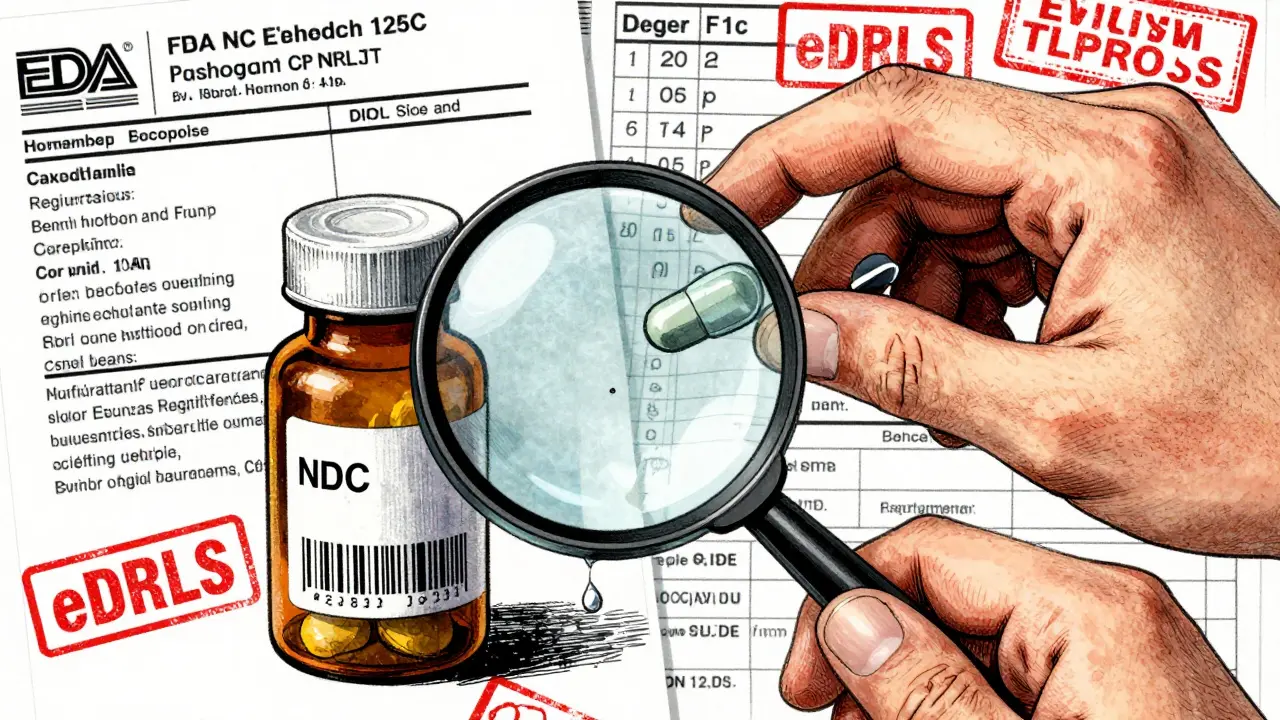
The FDA doesn’t just approve drugs. It tracks them from factory to pharmacy. Three key systems make this possible: the NDC Directory, the Drug Establishments Current Registration Site, and the Electronic Drug Registration and Listing System (eDRLS). Together, they form the backbone of drug verification in the United States.The NDC Directory is your most powerful tool. Every approved drug in the U.S. has a National Drug Code-a unique 10- or 11-digit number split into three parts: the labeler (who makes it), the product (what it is), and the package (how it’s sold). This code is printed on every pill bottle, box, and blister pack. If a drug doesn’t have a valid NDC, it’s not FDA-approved. That’s your first red flag.
The Drug Establishments Current Registration Site tells you who’s legally allowed to make or distribute that drug. It lists every company registered with the FDA, updated daily. If a pharmacy claims to sell a drug made by a company that’s not on this list, something’s wrong. The eDRLS is where those companies submit their data electronically, using a strict format called Structured Product Labeling (SPL). If a company doesn’t use SPL, their listing gets rejected.
How to Use the NDC Directory
You don’t need a degree in pharmacology to search the NDC Directory. Go to the FDA’s website, find the NDC search tool, and type in the drug name or the NDC number. The system will return the manufacturer, strength, dosage form, and packaging details. Cross-check this with what’s on your bottle. If the NDC on the label doesn’t match the FDA record, the drug is suspect.For example, if you buy metformin 500 mg and the bottle says NDC 0078-0542-10, paste that into the NDC Directory. The FDA will show you that this code belongs to Teva Pharmaceuticals and is approved for oral tablets. If the search returns no results-or a different manufacturer-you’re holding a fake. This isn’t rare. In 2021, nearly 40% of verification failures in the supply chain came from mismatched NDC codes.
Spotting Fake Drugs by the Packaging
Counterfeiters are getting better. They copy logos, use high-quality printing, and even include fake batch numbers. But they can’t replicate the FDA’s database. Look for these signs:- The NDC number is missing, smudged, or printed in a different font than the rest of the label.
- The bottle says “Made in India” or “Made in China,” but the FDA database shows the manufacturer is based in the U.S.
- The pill looks slightly off-color, has an odd smell, or dissolves too fast or too slow.
- The packaging has typos, inconsistent capitalization, or blurry barcodes.
Some fake drugs contain no active ingredient. Others have too much-or the wrong drug entirely. In 2020, the FDA found counterfeit versions of popular blood pressure meds that contained rat poison. That’s not a rumor. That’s a documented case.
Why the System Isn’t Perfect
The FDA’s system works well-when everyone plays by the rules. But here’s the problem: not everyone does. Foreign manufacturers make up about 40% of the drugs sold in the U.S., and only 35% of them fully comply with FDA registration rules. That’s a massive loophole.Compounded drugs-custom mixes made by pharmacies for specific patients-are another blind spot. They’re not required to have NDCs. That’s why fake versions of compounded insulin and painkillers are on the rise.
Even within the U.S., small pharmacies and mail-order distributors sometimes cut corners. A 2022 FDA report found that 35% of counterfeit drug incidents came from small, independent distributors who didn’t have the budget to implement full verification systems.
What You Can Do Right Now
You can’t fix the entire system. But you can protect yourself.- Always check the NDC number on your prescription bottle against the FDA’s database.
- Buy from licensed pharmacies. Look for the VIPPS seal (Verified Internet Pharmacy Practice Sites) or ask your pharmacist if they’re FDA-registered.
- Never buy pills from social media ads, Instagram sellers, or websites that don’t require a prescription.
- If your drug looks or tastes different than usual, call your pharmacist. Don’t assume it’s just a generic switch.
- Report suspicious drugs to the FDA’s MedWatch program. Even one report can trigger an investigation.
One woman in Ohio noticed her cholesterol pills were a different color than usual. She checked the NDC. The manufacturer listed didn’t exist. She called her doctor. The FDA traced the batch to a warehouse in Texas. It turned out to be a counterfeit ring selling fake Lipitor to over 1,200 people. Her report saved lives.
What’s Changing in 2026
The FDA is upgrading the NDC system. By 2026, all drug codes will be 12 digits long, standardized across the board. This will make it harder for counterfeiters to guess or fake valid codes. New rules also require every single pill, capsule, or vial to have a unique identifier-like a serial number on a phone. That means in a few years, you’ll be able to scan your medicine with your phone and instantly verify it against the FDA’s database.Right now, only big manufacturers can afford these systems. But by 2026, even small pharmacies will be required to use them. That’s good news. It means fewer fakes slipping through.
Final Thoughts
Counterfeit drugs aren’t a distant threat. They’re in the system. But the FDA’s databases are your best defense. You don’t need to be a pharmacist to use them. You just need to be curious. Take five minutes to check the NDC on your next prescription. It’s not paranoia-it’s protection. The system works. But only if you use it.Can I trust online pharmacies that offer cheap medications?
Only if they’re VIPPS-certified. Most online pharmacies selling drugs at 80% off are illegal. The FDA has shut down over 10,000 fake websites since 2015. If a site doesn’t require a prescription, doesn’t list a physical address, or won’t let you speak to a real pharmacist, walk away.
Do all generic drugs have the same NDC as the brand name?
No. Generics have their own NDCs, even if they contain the same active ingredient. For example, the NDC for brand-name Lipitor is different from the NDC for generic atorvastatin. But both should appear in the FDA’s NDC Directory. If a generic doesn’t show up, it’s not approved.
What if I can’t find my drug in the NDC Directory?
That means it’s not FDA-approved. It could be an unapproved foreign product, a compounded drug, or a fake. Call your pharmacist or doctor. Don’t take it. The FDA doesn’t approve all drugs sold in the U.S.-only those that meet safety and manufacturing standards. If it’s not in the directory, it’s not verified.
Are counterfeit drugs only a problem in developing countries?
No. The U.S. has seen a 18% annual increase in counterfeit drug incidents since 2018. Many fakes enter through international shipping channels or are made in labs overseas and shipped directly to consumers. The FDA intercepted over 2,000 shipments of fake drugs in 2022 alone.
Can I use the FDA databases to check over-the-counter (OTC) drugs?
Yes. The NDC Directory includes both prescription and OTC drugs. If you’re unsure about the safety of your allergy pills, pain relievers, or sleep aids, search the NDC. If it’s not listed, it may not meet FDA safety standards-even if it’s sold in a store.
sagar patel
December 25, 2025 AT 04:45The NDC system is the only real shield against fake meds. I checked my metformin last week. The bottle said one thing, FDA said another. I called my pharmacy. They apologized and replaced it. No drama, just facts. Don't wait until you're sick to care.
Linda B.
December 25, 2025 AT 23:05Of course the FDA has a database. But who really controls the data? The same corporations that lobby to keep foreign manufacturers off the hook. You think they want you to verify your pills? They want you to trust them. The real danger isn't counterfeit drugs-it's the system that lets them in.
Christopher King
December 27, 2025 AT 15:19Let me tell you something. The FDA doesn't protect you. It protects Big Pharma. That NDC directory? It's a facade. Every time they update it, they bury a scandal. I know a guy who worked at a compounding lab-he saw pills with no active ingredient labeled as insulin. He disappeared. The FDA called it a 'training error.' I call it murder by bureaucracy. And now they're pushing barcodes? That's not safety. That's surveillance. You think they're tracking pills? They're tracking YOU.
Bailey Adkison
December 29, 2025 AT 13:15People who check NDC codes are the only ones not dying from fake meds. Everyone else is just lucky or stupid. If you buy from a pharmacy without a VIPPS seal you're asking for a hospital trip. And no your 'natural remedy' from the gas station isn't FDA approved. That's not a suggestion. That's a death sentence waiting to happen.
Michael Dillon
December 31, 2025 AT 06:55I used to think this was overkill until my dad took a fake blood pressure pill. He ended up in the ER. Turned out the NDC was fake. Now I check every bottle. Takes two minutes. Could save your life. Seriously. Do it.
Gary Hartung
December 31, 2025 AT 20:58Let us not forget: the FDA is not a guardian angel. It is a bureaucratic apparatus, operating within the confines of corporate capture, regulatory capture, and legislative inertia. The NDC Directory, while ostensibly transparent, is merely a performative gesture-a digital altar to the illusion of safety. The 2026 upgrade? A distraction. The real issue is not counterfeit drugs-it is the collapse of public trust in institutions that have long ceased to serve the public good.
Ben Harris
January 1, 2026 AT 18:09Why are we even talking about this? You think your little NDC check is going to stop the flood? The drugs are coming through ports, through mail, through your neighbor's cousin who 'works at a warehouse.' I’ve seen it. I’ve held the bottles. They look real. They taste real. But the FDA? They don’t even inspect 1% of the shipments. You’re not protecting yourself. You’re just feeling better about being powerless.
Oluwatosin Ayodele
January 3, 2026 AT 02:23Actually, in Nigeria, we have a different problem. We don't even have access to the NDC database. Most of us buy from street vendors because hospitals are empty. The FDA system works in the U.S. because you have infrastructure. Here? We check pills by color, smell, and whether the person selling them looks scared. Your database means nothing to us. Stop preaching to the world like you're the only ones at risk.
Jason Jasper
January 4, 2026 AT 08:30I get why people are scared. But I also think we need to be careful not to turn every pill into a threat. Most meds are safe. The system isn’t perfect, but it’s the best we have. Checking the NDC? Fine. But don’t let fear replace trust entirely. Talk to your pharmacist. Ask questions. Stay informed, not paranoid.
Mussin Machhour
January 5, 2026 AT 15:37Just did my first NDC check on my Zoloft. Matched perfectly. Felt like I just unlocked a secret level in life. Seriously though, if you're on meds, do this. It's free, it's easy, and it might save your life. I'm telling my whole family to do it next refill. Spread the word, not the fear.