
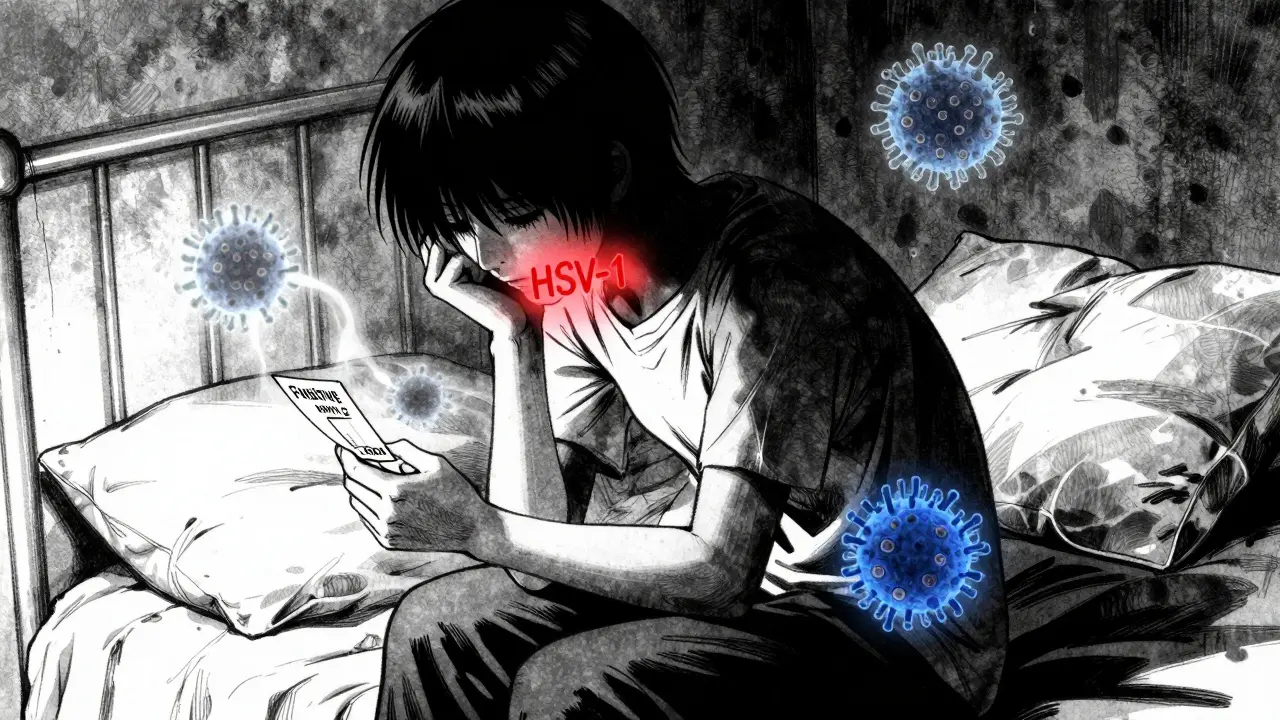
Herpes simplex virus isn’t just a cold sore or a rash you get once in a while. For millions of people, it’s a lifelong condition that affects how they live, love, and manage their health. Two types of this virus - HSV-1 and HSV-2 - are responsible for most cases of oral and genital herpes, but they don’t always behave the way people expect. Many assume HSV-1 only causes cold sores and HSV-2 only causes genital outbreaks, but that’s no longer true. In fact, HSV-1 now causes nearly two out of every five new genital herpes cases in the UK and US. The lines between these two viruses are blurrier than ever.
What Are HSV-1 and HSV-2?
Herpes simplex virus type 1 (HSV-1) and type 2 (HSV-2) are two closely related but distinct viruses. Both are enveloped, double-stranded DNA viruses that invade nerve cells and stay there for life. After the first infection, they retreat to sensory ganglia - HSV-1 hides near the trigeminal nerve behind the cheek, while HSV-2 settles in the sacral nerves near the lower spine. From there, they can reactivate without warning.
Global data from the World Health Organization shows that 67% of people under 50 have HSV-1. That’s more than 3.7 billion people. HSV-2 is less common but still affects 13% of people aged 15-49 - about 491 million worldwide. In the UK, rates are slightly lower than in the US, but still significant, especially among young adults. What’s surprising is how often HSV-1 is now causing genital infections. Ten years ago, it was rare. Today, it’s common. This shift is partly because more people are having oral-genital contact without knowing they’re carrying the virus.
How Do Symptoms Differ Between HSV-1 and HSV-2?
Symptoms can be confusing because they overlap. But there are clear patterns.
With HSV-1, the classic sign is a cluster of small, painful blisters around the lips or mouth - often called a cold sore. These usually appear after stress, sun exposure, or illness. Before the blisters show up, you might feel tingling, burning, or itching on the skin. That’s the prodrome - a warning sign that an outbreak is coming. In kids, HSV-1 can cause a more serious condition called herpetic gingivostomatitis: fever, mouth ulcers, swollen gums, and trouble eating or drinking. About 1 in 20 children with this condition end up in the hospital.
HSV-2, on the other hand, is mostly linked to genital herpes. The first outbreak often hits hard: painful ulcers on the genitals, burning when peeing, swollen lymph nodes in the groin, and sometimes fever and body aches. Many people mistake it for a UTI or yeast infection. Recurrent outbreaks are more frequent with HSV-2 - about 4 to 5 times a year on average - compared to HSV-1 genital infections, which recur less than once a year for most people.
But here’s the catch: both viruses can cause outbreaks anywhere. HSV-1 can appear on the genitals, and HSV-2 can appear on the mouth. The difference isn’t just location - it’s frequency. HSV-2 sheds the virus more often, even when there are no symptoms. Studies show that people with genital HSV-2 shed the virus on 10-20% of days. For HSV-1 genital infections, it’s only 5-10%. That means HSV-2 is more likely to spread without you even knowing.
What Happens During an Outbreak?
An outbreak follows a predictable pattern. It starts with a warning - tingling, itching, or a dull ache. Then, within hours, red bumps appear. These turn into tiny fluid-filled blisters, usually in clusters. After a day or two, the blisters break open, forming shallow, painful ulcers. These crust over and heal in about 7 to 21 days. Unlike chickenpox or shingles, herpes doesn’t leave scars.
First outbreaks are almost always worse. People report pain scores of 7 out of 10, with some unable to walk or urinate without numbing gel. Recurrent outbreaks? Usually milder - pain drops to 4 out of 10, and lesions are fewer. Some people don’t even notice them. That’s asymptomatic shedding, and it’s a big reason why herpes spreads so easily.
Not all outbreaks are visible. In fact, most transmission happens when no sores are present. A 2022 study from the University of Washington found that 70% of new HSV-2 infections came from partners who had no symptoms at the time.
When Should You See a Doctor?
If you’ve never been tested and you notice unusual sores, blisters, or pain in your mouth or genitals, get checked. Don’t wait. Early diagnosis means early treatment, which can cut your healing time in half.
Doctors use PCR tests on swabs from active lesions. These are 95-98% accurate and give results in 1-3 days. Blood tests (type-specific IgG tests like HerpeSelect) can detect antibodies, but they’re not reliable until 12-16 weeks after infection. So if you test too soon, you might get a false negative.
Don’t assume it’s just a pimple or ingrown hair. If you have recurring sores, especially with pain or itching before they appear, it’s likely herpes. And if you’re pregnant, talk to your provider - even if you’ve never had symptoms. HSV can be passed to a baby during delivery, and that can be life-threatening.
How Is It Treated?
There’s no cure for herpes. But there are three FDA-approved antivirals that make a huge difference: acyclovir, valacyclovir, and famciclovir. All three work by blocking the virus from copying itself. They don’t kill the virus - it stays in your nerves forever - but they keep it quiet.
For first outbreaks, doctors usually prescribe a 5-10 day course. Valacyclovir 1 gram twice daily for 7-10 days cuts healing time from 19 days to about 10. Pain drops from 12 days to 8. That’s a real improvement in quality of life.
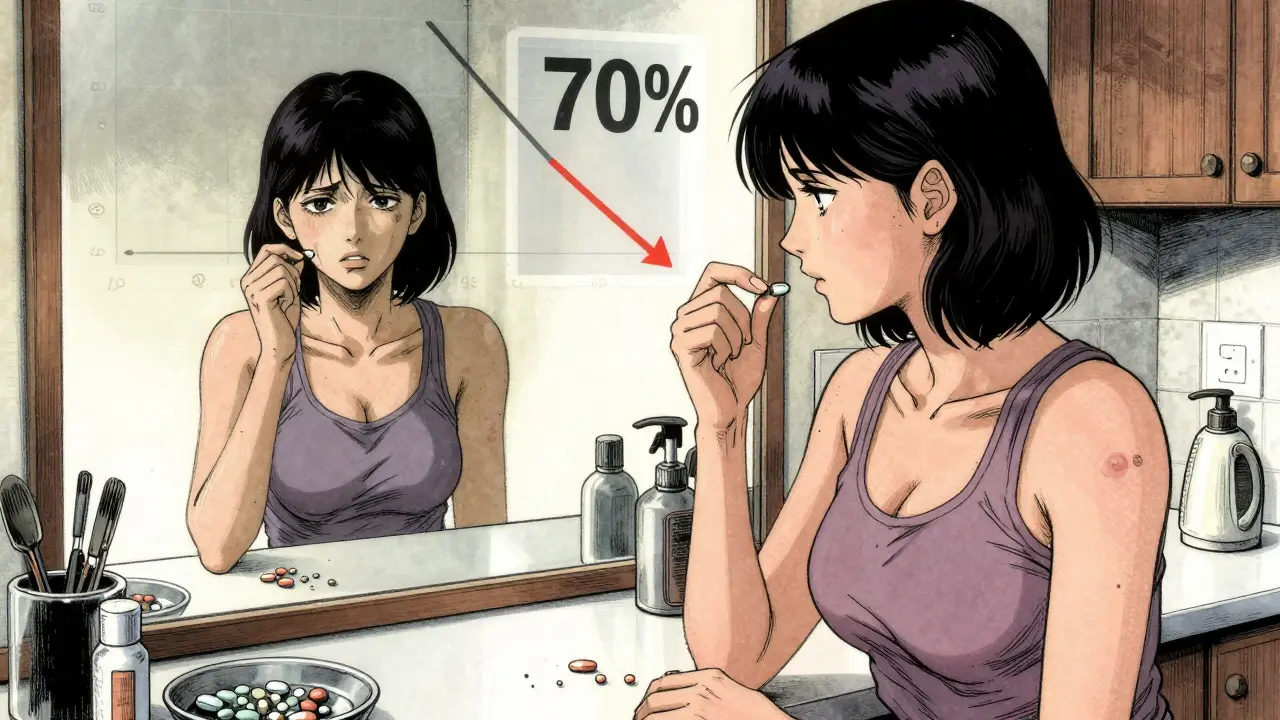
For people who have frequent outbreaks (six or more a year), daily suppressive therapy is an option. Taking valacyclovir 500mg once a day reduces outbreaks by 70-80%. It also cuts transmission to partners by nearly half. The CDC says this is especially important for couples where one partner has HSV-2 and the other doesn’t.
For herpes on the eye (herpes keratitis), topical antivirals like trifluridine drops are used. These can heal corneal ulcers in 14 days instead of 21. Left untreated, herpes keratitis is the leading cause of infectious blindness in the US.
For people with weak immune systems - like those with HIV or after transplants - higher doses or IV treatment may be needed. In rare cases, the virus becomes resistant to acyclovir. When that happens, doctors switch to foscarnet or the newer drug pritelivir, approved in 2023 for resistant strains.
What About Side Effects and Costs?
Most people tolerate these medications well. The most common side effect is a headache. Nausea happens in about 15% of users. People with kidney problems need to be careful - these drugs are cleared by the kidneys. Always tell your doctor if you have kidney disease.
Cost is a real barrier. In the UK, valacyclovir costs £15-£25 per month with a prescription. In the US, without insurance, it can be $300-$400 a month. Many people skip doses because of cost. Some switch to famciclovir, which works just as well and sometimes causes less nausea.
One Reddit user wrote: “First outbreak was brutal - 18 days, fever, couldn’t pee. Daily valacyclovir turned my life around. Now I get maybe 1-2 outbreaks a year, and they’re tiny.” Another said: “I got sick of nausea from acyclovir. Switched to famciclovir. No side effects. Outbreaks gone.”
Psychological and Social Impact
Herpes isn’t just a physical condition. It’s emotional. A 2023 survey by the American Sexual Health Association found that 74% of people with herpes feel stigma. 45% said it damaged their relationships. 32% waited over six months to tell a partner.
That stigma is outdated. Herpes is common. Most people don’t know they have it. Many never have symptoms. You can still date, have sex, have children, and live a full life with herpes. The key is managing it - and being honest with partners.
Open communication works. Studies show that couples who talk about herpes before sex have lower transmission rates than those who don’t. Using condoms, taking daily antivirals, and avoiding sex during outbreaks reduces risk by 90%.
What’s Next for Herpes Treatment?
The field is changing. New drugs like pritelivir are showing promise - they block the virus faster than older antivirals. Clinical trials for vaccines are underway. One candidate, Simplirix, reduced viral shedding by 50% in early trials. A vaccine isn’t here yet, but it’s closer than ever.
Diagnosis is improving too. New blood tests are more accurate. The HerpeSelect test was discontinued in 2022, but newer ones like EUROIMMUN’s recomLine HSV IgG test are now widely used and just as reliable.
Experts predict that by 2030, better access to suppressive therapy and improved testing could cut herpes transmission by 30%. That’s not a fantasy - it’s science.
Key Takeaways
- HSV-1 and HSV-2 are different, but both can cause oral and genital outbreaks.
- HSV-1 now causes nearly half of new genital herpes cases in the UK and US.
- First outbreaks are painful; recurrences are usually mild.
- Antivirals like valacyclovir shorten outbreaks and reduce transmission.
- Daily suppressive therapy cuts partner transmission by nearly 50%.
- Herpes doesn’t define you. It’s common, manageable, and far from a life sentence.
Can you get herpes from kissing?
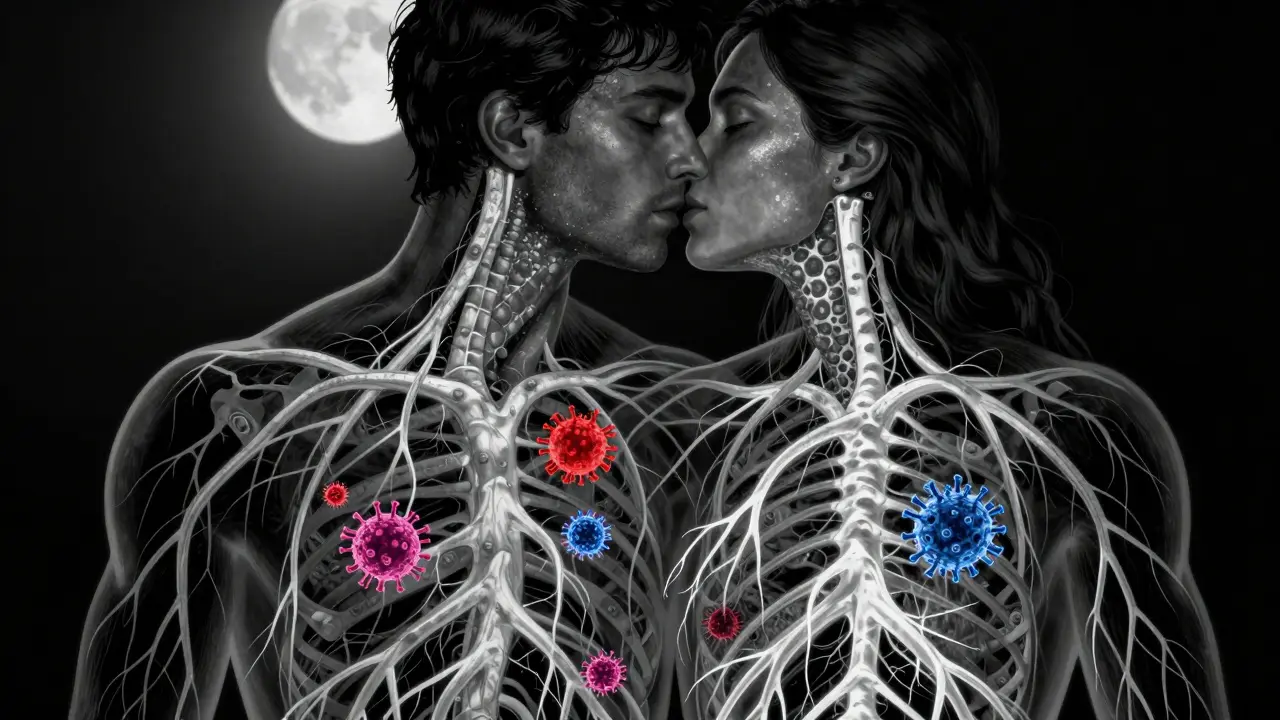
Yes. HSV-1 is commonly spread through kissing, even if there’s no visible sore. The virus can shed from the skin without symptoms. About 67% of people under 50 carry HSV-1, often from childhood kisses. Avoid kissing during an active cold sore, but don’t assume you’re safe just because your partner doesn’t have one.
Can you have herpes and never know it?
Absolutely. Up to 90% of people with HSV-2 and 80% with HSV-1 don’t know they’re infected. Many never have symptoms, or they mistake them for something else - a pimple, a yeast infection, a razor burn. That’s why testing matters, especially if you’ve had unprotected sex.
Is herpes dangerous during pregnancy?
It can be. If a woman gets herpes for the first time late in pregnancy, the risk of passing it to the baby is 30-50%. But if she’s had it before, the risk drops to under 1% because her body has antibodies. Doctors monitor pregnant women closely and may recommend a C-section if an outbreak is active at delivery. Antiviral therapy in the last month of pregnancy can also reduce the risk.
Do antivirals cure herpes?
No. Antivirals don’t eliminate the virus. They suppress it. Once infected, the virus stays in your nerves for life. But with daily medication, outbreaks can become rare or disappear entirely. You’re still contagious, but the risk drops significantly.
Can you get herpes from sharing towels or toilets?
Very unlikely. Herpes spreads through direct skin-to-skin contact with an active area or during asymptomatic shedding. The virus doesn’t survive long on surfaces. You won’t catch it from a toilet seat, towel, or swimming pool. Focus on avoiding direct contact during outbreaks and using protection during sex.
Is there a vaccine for herpes?
Not yet. Several vaccines are in clinical trials, including GEN-003 and Simplirix, which have shown promise in reducing outbreaks and viral shedding. But none are approved for public use. Prevention still relies on antivirals, condoms, and open communication.

Eimear Gilroy
February 27, 2026 AT 09:55So I just got tested last year and found out I have HSV-1 genital. Never had an outbreak before, and I’m 32. The doctor said it’s probably from a kiss years ago. I didn’t even know you could get it that way. Now I’m wondering how many people I’ve kissed without knowing. Feels like a weird secret I didn’t ask for.
Martin Halpin
February 28, 2026 AT 00:57Let me just say this - the whole herpes stigma is a load of bull. People act like it’s the plague, but it’s just a virus that lives in your nerves. You don’t die from it. You don’t go blind from it (unless you’re too lazy to see a doctor). And yeah, HSV-1 on the genitals? That’s not some freak accident - it’s evolution. We’re kissing more, using condoms less, and the virus is adapting. Stop acting like it’s a moral failure. It’s biology.
Also, the idea that you need to tell every partner before sex? Fine. But if you’re taking daily antivirals and using condoms? The risk is lower than getting mono. Yet people treat it like you’re a walking biohazard. Hypocrites.
And don’t get me started on the CDC guidelines. They’re outdated. They still treat HSV-2 like it’s some kind of epidemic when HSV-1 is now the bigger player. Why? Because old doctors still think genital herpes = promiscuity. It’s not. It’s just a virus that’s been around since the Stone Age.
My ex had HSV-2. We dated for two years. She never had an outbreak. I never got it. We used condoms. She took valacyclovir. We had sex every weekend. Zero transmission. So yeah - science works. Stigma doesn’t.
Also - if you’re scared of kissing someone because they might have HSV-1? You’re probably already infected. 67% of people under 50 have it. You got it from your grandma’s hugs. Chill.
Lou Suito
March 1, 2026 AT 07:38HSV-1 causes genital herpes? Really? Where’s your data? The WHO says 3.7 billion people have HSV-1 - but most are oral. And you’re saying nearly half of new genital cases are HSV-1? That’s not even close. The CDC says 20-30%. You’re inflating numbers. Also - asymptomatic shedding? That’s been debunked in multiple studies. The 70% transmission stat? That’s from a 2022 study that used PCR on self-swabs - which are unreliable. You can’t trust self-reported data.
And antivirals? They don’t reduce transmission by 50%. That’s a 2015 meta-analysis that had a 12% dropout rate. And you’re telling people to take daily meds? For life? What about kidney damage? What about cost? In the US, that’s $300/month - that’s not healthcare - that’s extortion.
Jacob Carthy
March 2, 2026 AT 06:01USA is the only country that treats herpes like it’s a crime. In Europe they just say 'it's a virus' and move on. We got more people with herpes than COVID in 2020 and nobody panics. Why? Because we don’t shame people. You get a cold sore? Big deal. You get a genital one? Same thing. Stop acting like you’re the first person to ever have this. My cousin had it since 1998. Still married. Still happy. Still sex. No big deal.
And don’t get me started on vaccines. We’ve been working on one since the 80s. It’s not happening. So stop selling hope. Just take the pill. Use condoms. Don’t kiss when you’re breaking out. Done.
Lisandra Lautert
March 3, 2026 AT 12:02It’s not about the virus. It’s about the narrative.
Cory L
March 5, 2026 AT 09:48Man. I had my first outbreak in college. Thought I had a yeast infection. Then I saw the blisters. Felt like my life was over. Took me six months to tell anyone. Now? I take valacyclovir daily. Outbreaks? Maybe once a year. And I’m dating someone who has it too. We don’t even talk about it anymore. It’s just… part of us. Like allergies or asthma. Nobody freaks out if you use an inhaler. Why should herpes be different?
Also - the kissing thing? Yeah. I kissed my partner’s sister at a party. Two weeks later - cold sore. I didn’t even know she had one. She didn’t either. We both got tested. HSV-1. No big deal. We still hug. We still kiss. Life goes on.
Stop treating it like a death sentence. It’s not. It’s just a virus that’s been here longer than your grandparents.
Bhaskar Anand
March 6, 2026 AT 09:27India has no problem with herpes. We have no stigma. Our elders say: 'It is nature's balance. If you have it, you have it. Do not lie. Do not hide. Take medicine. Live.' Why do Westerners make it a moral issue? Because they fear sex. Because they fear bodies. Because they fear pleasure. Herpes is not sin. It is science. And antivirals? We get generic valacyclovir for $2 a month. Why does America charge $300? Because capitalism. Not medicine.
William James
March 8, 2026 AT 08:25Look - I’ve been living with HSV-2 for 15 years. First outbreak? I thought I was dying. I cried. I isolated. I thought no one would ever love me. Then I found a community online. People who’d been there. People who told me: 'It’s not your fault. It’s not your punishment. It’s just biology.'
And you know what? I’ve had the best relationships of my life since I got diagnosed. Because I learned to communicate. To be honest. To care more about connection than perfection.
Antivirals didn’t just stop my outbreaks - they gave me peace. And that’s worth more than money. More than shame. More than fear.
If you’re reading this and you’re scared? You’re not alone. And you’re not broken. You’re just human.
Dinesh Dawn
March 10, 2026 AT 04:43I work in a clinic in Mumbai. We see a lot of young people coming in scared after a test. They cry. They say 'I’ll never find love.' I tell them: 'Your ex had herpes too. Your teacher had it. Your favorite actor had it. It’s everywhere. It doesn’t define you.' One girl came back last month - she got married. Her husband had it too. They’re trying for a baby. I cried. Not because of the virus. Because of the hope.
Vanessa Drummond
March 12, 2026 AT 03:47So I found out I had HSV-1 genital last year. I told my boyfriend. He left. Said I 'lied' because I never had an outbreak. I didn’t even know I had it. Then I found out he had it too - from a one-night stand. He just didn’t tell me. So now I’m the villain? I’m the one who 'ruined' things? No. The system is the villain. The stigma. The silence. The lies.
I’m not ashamed. I’m angry.
Nick Hamby
March 12, 2026 AT 12:05It’s important to recognize that the medical community has historically mishandled herpes - not because of ignorance, but because of bias. The assumption that genital herpes = promiscuity led to delayed diagnosis, inadequate counseling, and a culture of shame. We’ve made progress, but we’re not done.
The fact that HSV-1 is now the leading cause of genital herpes in the U.S. and U.K. is not a failure of behavior - it’s a failure of education. We teach children to avoid kissing when they have cold sores, but we don’t teach adults that asymptomatic shedding exists. We don’t teach partners how to communicate. We don’t teach medical students that herpes isn’t a moral judgment.
Antivirals are not a cure - but they are a bridge. A bridge to dignity. To safety. To connection. And for that, they are revolutionary.
Let’s stop pathologizing human biology. Let’s start empowering people with knowledge - not fear.
kirti juneja
March 14, 2026 AT 08:11My cousin in Delhi got herpes from a tattoo. No, really. She got it done in 2019. The artist didn’t change the needle. She got HSV-1 on her arm. Not genitals. Not mouth. Just… arm. No one believed her. Doctors said 'impossible.' She had to get a biopsy. Took six months. Now she’s an advocate. Says: 'If it can happen on your arm, it can happen anywhere.' So yeah - herpes isn’t just about sex. It’s about care. And cleanliness. And trust.