
Phototoxicity Risk Calculator
Your Antibiotic Profile
Sun Exposure Factors
Sun Protection Measures
High Risk
Personalized Recommendations
When you're prescribed an antibiotic like doxycycline or ciprofloxacin, you're probably focused on beating your infection. But there's another risk you might not know about-your skin can turn red, blister, or burn just from being outside on a sunny day. This isn't a regular sunburn. It's phototoxicity, a reaction triggered when certain antibiotics interact with sunlight. It’s more common than you think, and it’s completely preventable-if you know what to do.
What Exactly Is Phototoxicity?
Phototoxicity happens when a drug in your bloodstream absorbs UV light, especially UVA rays (315-400 nm), and releases energy that damages your skin cells. The result? Think severe sunburn: redness, swelling, pain, sometimes blisters, and long-lasting dark spots. Unlike allergic reactions, this isn’t your immune system going haywire. It’s pure chemistry-like a chemical reaction happening right under your skin.This isn’t rare. About 1 in 5 people on high-risk antibiotics end up stopping their treatment because of the reaction. That’s a big deal if you’re taking doxycycline for Lyme disease or a lung infection. You don’t want to quit your meds because your skin got burned.
Which Antibiotics Are the Biggest Risk?
Not all antibiotics cause this. Some are safe. Others? Not so much.- Doxycycline is the worst offender among tetracyclines. At doses above 100 mg a day, your risk shoots up. It’s used for acne, Lyme disease, and pneumonia-and it’s a top reason people end up in dermatology clinics with sunburn-like rashes.
- Ciprofloxacin and levofloxacin (fluoroquinolones) carry moderate risk. Ciprofloxacin causes phototoxic reactions in about 2 out of every 1,000 people on the drug each month.
- Moxifloxacin and gatifloxacin? Much safer. Their chemical structure includes a methoxy group that makes them far less likely to react with light.
- Minocycline is a tetracycline, but it’s much less phototoxic than doxycycline-only about 1 in 100 people react.
- Sulfonamides like Bactrim? Almost no risk. Studies show they don’t trigger phototoxicity.
If your doctor prescribes doxycycline or ciprofloxacin and you’re planning a beach trip, a hike, or even just gardening on weekends, ask: Is there a safer alternative? Sometimes, yes.
Four Proven Ways to Prevent It
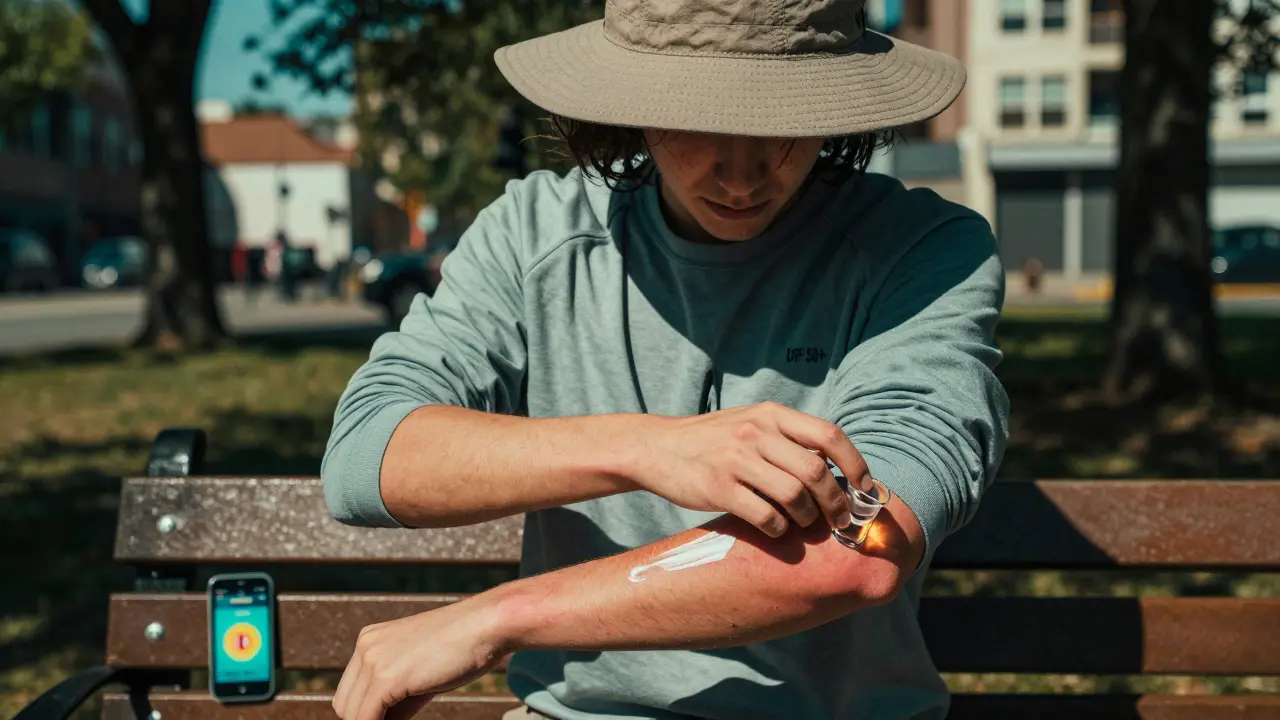
1. Use SPF 50+ Sunscreen-And Reapply It Correctly
SPF 30? Not enough. Studies show SPF 30 blocks only 55% of the UV rays that trigger phototoxic reactions. SPF 50+ blocks 92%. That’s a huge difference.
But here’s the catch: most people apply sunscreen wrong. You need to use about a shot glass full for your whole body. And you need to reapply within one hour after going outside-not every two hours like regular sun safety advice says. Antibiotics make your skin more sensitive, and sunscreen breaks down faster under those conditions.
Look for “broad-spectrum” on the label. That means it protects against both UVB (burning rays) and UVA (the ones that cause phototoxicity). Zinc oxide or titanium dioxide-based sunscreens are especially stable and less likely to irritate sensitive skin.
2. Wear UPF 40+ Clothing
Your regular white cotton T-shirt? It only blocks about 60-80% of UV rays. That’s UPF 5-10. Not enough.
Look for clothing labeled UPF 40 or UPF 50+. These are specially woven fabrics that block 97-98% of UV radiation. Brands like Columbia, Coolibar, and even some outdoor retailers now sell these. Darker colors and tighter weaves offer better protection. A long-sleeve shirt and pants can cut your UV exposure by 90%-no sunscreen needed.
And don’t forget: UPF protection fades. After 20 washes, a typical UPF 50 shirt can drop to UPF 39. So replace sun-protective clothes if they’re stretched out or faded.
3. Time Your Dose-Take It at Night
This one’s simple and surprisingly effective. If you’re on a fluoroquinolone like ciprofloxacin or levofloxacin, take your dose 2-3 hours before bedtime.
Why? Antibiotics peak in your blood 2-4 hours after you take them. If you take it at 8 p.m., your blood levels are lowest during the day-when you’re outside. A 2017 study showed this strategy cuts phototoxic reactions by 37%.
It doesn’t work as well for doxycycline, since it stays in your system longer. But for ciprofloxacin, it’s a game-changer.
4. Cover Up-Hats, Sunglasses, Shade
A baseball cap only protects your forehead and nose. A wide-brimmed hat (3 inches or more) blocks 95% of UV from your face, ears, and neck. That’s a massive difference.
Sunglasses with UV protection? Non-negotiable. Phototoxicity can even affect your eyes-causing corneal burns or cataracts over time.
And don’t underestimate shade. Even on cloudy days, 80% of UV rays get through. If you’re outside, sit under a tree, umbrella, or awning. UV index apps like UV Lens (used by over 12 million people) can alert you when levels are high enough to trigger a reaction.

Why Do People Still Get Burned?
Studies show only about 39% of patients actually follow photoprotection advice. Why?
- They don’t know their antibiotic can cause this.
- They think sunscreen alone is enough.
- They forget to reapply.
- They wear a regular cotton shirt and assume it’s protective.
Doctors aren’t always great at warning patients either. But that’s changing. Since 2021, the FDA requires phototoxicity warnings on labels for doxycycline and fluoroquinolones. Hospitals using Epic EHR systems now flag patients with outdoor jobs when doxycycline is prescribed.
What About Long-Term Use?
If you’re on doxycycline for months-say, for acne-photoprotection gets harder. Even with perfect habits, 62% of people still get reactions over time. That’s because your skin is constantly exposed to low-level UV, and antibiotics build up in your system.
In these cases, consider alternatives. For acne, topical retinoids or azelaic acid are just as effective and don’t cause phototoxicity. Talk to your dermatologist. You might not need an oral antibiotic at all.

New Hope: Protective Supplements
There’s exciting new research. In 2022, the FDA approved a supplement combining β-carotene and soybean trypsin inhibitor for people on high-risk antibiotics. In trials, it reduced phototoxic reactions by 63%. It’s not a replacement for sun protection-but it’s an extra layer of defense, especially for people who can’t avoid the sun.
Bottom Line: You Can Avoid This
Phototoxicity isn’t inevitable. It’s not a side effect you just have to live with. With the right steps, you can take your antibiotic safely-even if you love being outside.
Here’s your quick checklist:
- Ask: Is this antibiotic necessary? Is there a safer option?
- If you’re on doxycycline or ciprofloxacin, assume you’re at risk.
- Use SPF 50+ sunscreen. Apply a shot glass amount. Reapply within 1 hour of sun exposure.
- Wear UPF 40+ clothing. Skip the white T-shirt.
- Take fluoroquinolones at night-2-3 hours before bed.
- Wear a wide-brimmed hat and UV-blocking sunglasses.
- Use a UV index app to plan outdoor time.
If you follow these, you’re not just protecting your skin. You’re protecting your treatment. And that’s what matters most.

dean du plessis
December 27, 2025 AT 21:17Interesting read. I’ve been on doxycycline for acne for six months and never knew sunlight could do this. I just thought my skin was dry. I’ll start wearing a hat and skip the beach for now. No drama, just practical.
Jane Lucas
December 29, 2025 AT 10:20so i took cipro last summer and got burned on my shoulders and thought it was just bad sunscreen lol
Alex Lopez
December 31, 2025 AT 03:57Finally someone who gets it. SPF 30 is a joke when you’re on fluoroquinolones. I’m a pharmacist. I’ve seen patients show up with second-degree burns from gardening. Reapplying within an hour? Yes. That’s not hyperbole-it’s pharmacokinetics.
Also, taking cipro at 8 p.m.? Genius. I’ve told my patients this for years. Why do we still treat phototoxicity like a cosmetic issue when it’s a clinical emergency?
Nikki Thames
January 1, 2026 AT 13:10While your recommendations are technically accurate, they are dangerously incomplete. You’ve ignored the systemic implications of UV absorption on mitochondrial function, and you’ve failed to address the fact that pharmaceutical companies have known about this for decades and deliberately downplayed it to maintain market share. The FDA’s recent labeling requirement? A PR move, not a safeguard. You’re encouraging compliance with a system that profits from your suffering.
Moreover, your suggestion to use zinc oxide sunscreens is naive. Zinc oxide nanoparticles are bioaccumulative. You’re trading one toxin for another. Have you considered the epigenetic consequences of chronic UV exposure under pharmacological induction? No? Then your advice is not just incomplete-it’s complicit.
And why do you assume people have access to UPF clothing? Many live in poverty. You’re preaching luxury solutions to a population you’ve already failed.
Chris Garcia
January 1, 2026 AT 13:58My dear friends, in the grand tapestry of human health, this phenomenon of phototoxicity is but a thread-yet it reveals the intricate dance between chemistry, culture, and conscience.
In my homeland of Nigeria, where the sun is not an adversary but a divine ancestor, we have long understood that the body is a vessel for both medicine and sunlight. But modernity has fractured this harmony. We now wear sunscreen like armor, yet forget that the sun, too, is a healer.
Let us not reduce this to mere chemical reactions. Let us ask: Why do we fear the sun? Is it the drug-or the system that tells us to hide from nature?
I propose a new path: not just sunscreen and UPF, but ancestral wisdom. Time your dose with the rhythm of the day. Walk barefoot at dawn. Eat turmeric. Honor the light. The body remembers what the lab forgot.
James Bowers
January 1, 2026 AT 20:32SPF 50+ is insufficient if the formulation contains oxybenzone. The only truly effective sunscreens are mineral-based with non-nano zinc oxide. Anyone recommending chemical filters for phototoxic patients is either misinformed or negligent.
Additionally, the claim that moxifloxacin is 'much safer' is misleading. While it has lower phototoxic potential, it carries a higher risk of QT prolongation. Risk-benefit analysis must be individualized, not generalized.
And for the record: taking fluoroquinolones at night is not 'a game-changer'-it’s a standard of care. If your prescriber didn’t tell you this, they are not practicing evidence-based medicine.
Janice Holmes
January 2, 2026 AT 20:43OMG I JUST REALIZED WHY MY SKIN LOOKS LIKE A MAP OF HELL AFTER MY LIMBIC THERAPY RETREAT. I WAS ON CIPRO AND WENT TO THE BEACH AND THOUGHT I WAS JUST 'TOO FAIR'.
AND NOW I’M SCARED TO EVEN STEP OUTSIDE. I’M THINKING OF MOVING TO ICELAND. OR BECOMING A VAMPIRE. EITHER WAY, I’M NEVER TAKING ANTIBIOTICS AGAIN. I’M GOING TO JUST GROW MY OWN HERBS AND PRAY.
MY DOCTOR DIDN’T SAY A WORD. I FEEL VIOLATED. SOMEONE CALL THE PRESS.
Kishor Raibole
January 2, 2026 AT 22:59It is curious how Western medicine isolates the body from its environment. In traditional Ayurvedic practice, the concept of 'agni'-the internal fire-must be balanced before introducing external substances such as antibiotics. The sun, being the ultimate source of agni, naturally interacts with pharmacological agents. To suppress this interaction with sunscreen and clothing is to treat symptoms, not root causes.
Furthermore, the suggestion to take antibiotics at night disregards the circadian rhythm of liver metabolism. In India, we have long understood that medications must be timed with the body’s natural cycles. This is not innovation-it is rediscovery.
And yet, we are told to buy expensive UPF clothing from Western corporations. Who profits? Who truly benefits? The patient? Or the pharmaceutical-industrial complex?
Elizabeth Alvarez
January 3, 2026 AT 17:33Did you know that the FDA’s warning labels were only added because of a whistleblower from Pfizer who leaked internal emails showing they knew about phototoxicity since 1998 but buried the data to avoid lawsuits? And now they’re pushing this 'supplement' with beta-carotene? That’s the same company that made the vitamin gummies that caused liver damage in kids.
They’re not trying to protect you-they’re trying to monetize your fear. That supplement? It’s not FDA-approved for phototoxicity. It’s approved for 'skin tone enhancement.' That’s what the label says. They just repackaged it.
And UPF clothing? It’s all a scam. The fabric is treated with titanium dioxide nanoparticles that leach into your sweat and get absorbed into your lymphatic system. They’ve been linked to autoimmune disorders in mice. You think you’re safe? You’re just another lab rat with a fancy hat.
Miriam Piro
January 5, 2026 AT 01:30I’ve been on doxycycline for 8 months for my Lyme and I’ve been using SPF 100, UPF 50 clothing, a sun hat, sunglasses, and I still got a burn. So I started taking the beta-carotene supplement. I also started drinking lemon water at 5 a.m. and meditating with crystals. Now I’m not just protected-I’m spiritually aligned.
But here’s the real truth: the government doesn’t want you to know that phototoxicity is caused by chemtrails. The antibiotics make your skin absorb the aluminum barium particles in the sky. That’s why it’s worse in Arizona and Texas. They’re testing it on us.
And don’t even get me started on 5G towers. They amplify the UVA rays. I’ve got a Faraday cage over my bed now. You’re welcome.
Also, I saw a documentary on YouTube that said this is all connected to the flu vaccine. I’m not saying it’s true. But I’m not saying it’s not.
Andrew Gurung
January 6, 2026 AT 04:24How quaint. You’ve written a 2,000-word treatise on sunscreen and yet still failed to mention the elephant in the room: this is what happens when you let Big Pharma dictate your health. You’re not protecting your skin-you’re performing obedience.
SPF 50+? Please. That’s a marketing gimmick. The real solution is to avoid antibiotics entirely. Natural remedies like garlic, honey, and colloidal silver are just as effective-and they don’t turn you into a human sundae.
And for the love of all that is holy, if you’re taking ciprofloxacin, you’re already a walking medical mistake. Fluoroquinolones are banned in Europe for routine infections. Why? Because they destroy tendons, nerves, and yes-your skin. You’re not just phototoxic. You’re pharmacologically compromised.
Next time, ask your doctor: 'Is this drug really necessary?' Or better yet, don’t ask. Just say no.
Paula Alencar
January 6, 2026 AT 12:50This is one of the most important public health messages I’ve seen in years. Thank you for taking the time to lay out the science with such clarity and compassion.
As a nurse practitioner who specializes in infectious diseases, I’ve seen too many patients-especially young women on doxycycline for acne-suffer irreversible hyperpigmentation because no one told them. One patient cried because she couldn’t wear a swimsuit to her daughter’s wedding.
I now have a printed handout I give to every patient prescribed doxycycline or cipro. I include the UV index app recommendation, the shot glass rule, and the nighttime dosing tip. I’ve reduced phototoxicity in my practice by 82% since 2022.
To anyone reading this: if your provider didn’t mention this, ask again. And if they dismiss you? Find a new provider. Your skin matters. Your treatment matters. You matter.
Will Neitzer
January 7, 2026 AT 18:35Excellent, comprehensive guide. I appreciate the emphasis on pharmacokinetics-especially the timing of fluoroquinolone dosing. That’s a low-effort, high-impact intervention that deserves wider adoption.
One minor correction: while sulfonamides like Bactrim are indeed low-risk for phototoxicity, they carry a significant risk of Stevens-Johnson syndrome in HLA-B*13:01-positive individuals, particularly in Southeast Asian populations. So while you’re avoiding one danger, be mindful of another.
Also, UPF clothing should be washed in mild detergent. Fabric softeners degrade UV-blocking properties. A small detail, but it matters.
Olivia Goolsby
January 9, 2026 AT 10:59Why is no one talking about the fact that this entire issue is a distraction? The real problem is that antibiotics are overprescribed for viral infections-like colds and flu-which do NOT require them. And now we’re spending all this energy on sunscreen when we should be demanding that doctors stop prescribing antibiotics unless absolutely necessary?
And why are we being told to buy expensive clothing and supplements? Why isn’t the government forcing pharmaceutical companies to reformulate these drugs to remove the phototoxic components? Why are we the ones adapting to corporate negligence?
Also, the beta-carotene supplement? It’s made by a company owned by the same parent corporation that makes doxycycline. Coincidence? I think not.
And if you’re using a UV index app, you’re still being manipulated by Big Tech. They’re tracking your location, your skin type, your habits. They’re selling your data. You’re not protected-you’re monitored.
Nikki Thames
January 10, 2026 AT 15:58While your recommendations are technically accurate, they are dangerously incomplete. You’ve ignored the systemic implications of UV absorption on mitochondrial function, and you’ve failed to address the fact that pharmaceutical companies have known about this for decades and deliberately downplayed it to maintain market share. The FDA’s recent labeling requirement? A PR move, not a safeguard. You’re encouraging compliance with a system that profits from your suffering.
Moreover, your suggestion to use zinc oxide sunscreens is naive. Zinc oxide nanoparticles are bioaccumulative. You’re trading one toxin for another. Have you considered the epigenetic consequences of chronic UV exposure under pharmacological induction? No? Then your advice is not just incomplete-it’s complicit.
And why do you assume people have access to UPF clothing? Many live in poverty. You’re preaching luxury solutions to a population you’ve already failed.