
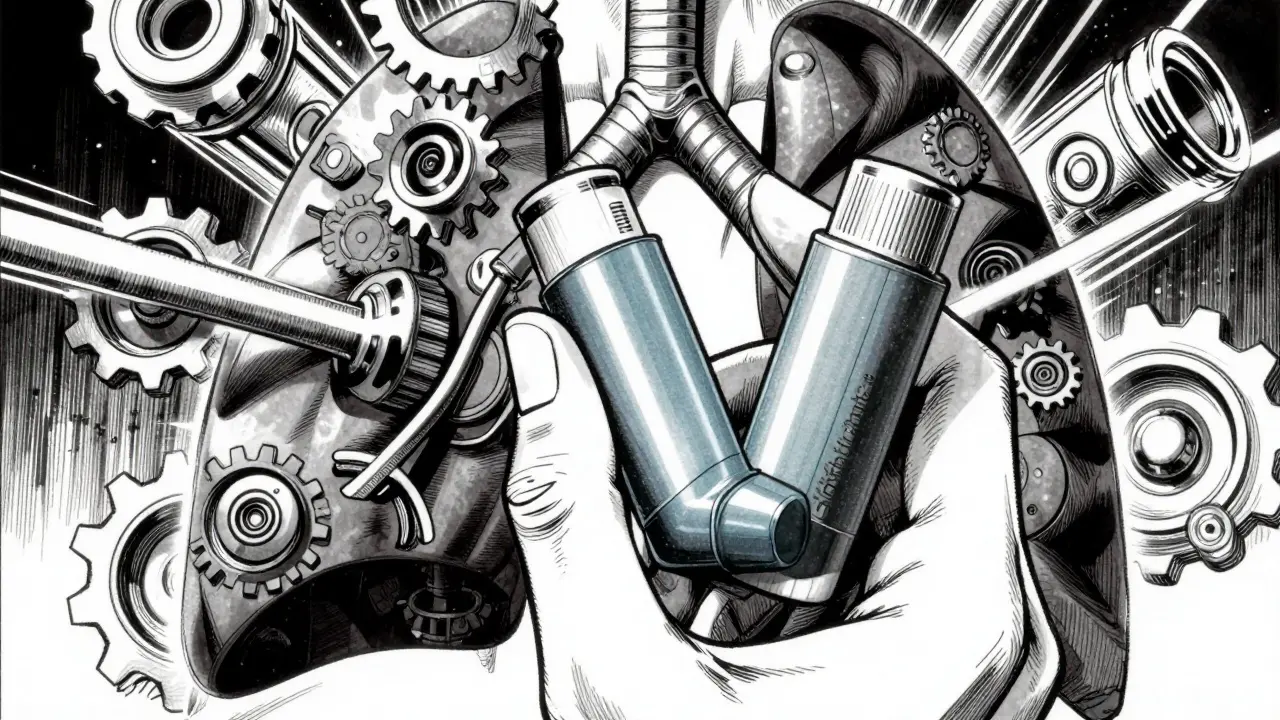
Imagine your lungs are a finely tuned engine. You’ve spent years learning exactly how to feed it the right fuel at the right time. Now, someone hands you a new nozzle that looks similar but works completely differently. If you don’t adjust your approach, the engine stalls. This is the reality for millions of patients using respiratory combination inhalers, which are pharmaceutical devices delivering two active ingredients, typically a corticosteroid and a long-acting beta agonist, in a single breath. As patents expire on major brands like Symbicort, generic versions are flooding the market. But unlike swapping one pill for another, switching inhalers isn’t just about chemistry-it’s about mechanics.
The Hidden Complexity of Inhaler Devices
We often think of generics as identical copies. For oral tablets, this is mostly true. The drug dissolves in your stomach, and the body absorbs it. With inhalers, the device is part of the medicine. The way you breathe in determines whether the drug reaches your lungs or stays stuck in your throat. There are three main types of delivery systems: pressurized metered-dose inhalers (pMDIs), dry powder inhalers (DPIs), and nebulizers. Each demands a specific breathing pattern.
pMDIs require coordination. You have to press the canister while inhaling slowly and deeply, then hold your breath for 5 to 10 seconds. DPIs, on the other hand, need force. You must inhale sharply and quickly to break up the powder particles so they can travel deep into the airways. A study published in PMC7672138 highlights that 76% of patients switched from a Turbuhaler to a Spiromax without proper training used the device incorrectly. Why? Because the Turbuhaler requires a twisting motion to load the dose, while the Spiromax uses a side slider. One small change in mechanism leads to massive confusion.
| Device Type | Breathing Technique | Loading Mechanism | Common Error |
|---|---|---|---|
| Turbuhaler (Brand) | Slow, deep inhalation | Twist to load | Not twisting enough |
| Spiromax (Generic) | Forceful, sharp inhalation | Slide to prime | Inhaling too softly |
| pMDI | Coordinated press-and-breathe | Shake before use | Poor hand-breath coordination |
Regulatory Divergence: US vs. Europe
If you live in the United States, the rules for substitution are looser than if you live in the UK or Germany. The U.S. Food and Drug Administration (FDA) has pushed for easier access to cheaper generics. In 2019, Dr. Janet Woodcock, former director of the FDA’s Center for Drug Evaluation and Research, celebrated the approval of the first generic asthma inhaler as a win for affordability. The FDA expects that patients can switch to a generic product without additional training from a healthcare provider.
Europe takes a much more cautious stance. The European Medicines Agency (EMA) updated its guidelines in 2022 to require strict proof of therapeutic equivalence. This means the generic manufacturer must prove that the drug lands in the lungs in the same amount and pattern as the original brand. The EMA notes that lung deposition patterns can vary by 25% to 40% between different device types. Without this match, the “generic” might not work as well, even if the chemical ingredients are identical. This regulatory split creates a confusing landscape for patients traveling or seeking online advice.

The Human Cost of Automatic Substitution
Data shows that automatic substitution-where a pharmacy swaps your brand-name inhaler for a generic without asking you-carries real risks. A 2021 study in the Journal of Aerosol Medicine and Pulmonary Drug Delivery found that patients switched from Symbicort Turbohaler to a generic Spiromax without training saw a 22% increase in asthma exacerbations within six months. That’s nearly one in four patients ending up worse off because no one taught them how to use the new device.
User experiences back this up. On Reddit’s r/asthma community, 83% of commenters reported worsening symptoms after being switched from Advair Diskus to a generic alternative without instruction. Asthma UK surveyed 1,247 participants in 2022 and found that 57% felt confused by the switch, and 32% visited an emergency department within three months. One patient told the Pharmaceutical Journal: "When my pharmacy switched me to the Spiromax without telling me, I didn't realize I needed to breathe in harder, and my asthma got so bad I ended up in hospital." These aren’t isolated incidents; they are systemic failures.
Why Pharmacists and Doctors Struggle Too
You might assume that doctors and pharmacists know how every inhaler works. The data suggests otherwise. An NIH study revealed that general practitioners needed an average of 12.7 minutes of specific training just to achieve 90% proficiency in demonstrating both Turbuhaler and Spiromax techniques. Shockingly, 43% of GPs initially couldn’t demonstrate the correct technique for either device. If your doctor doesn’t know the difference, who does?
In community pharmacies, the pressure is even higher. A 2022 survey by the American Pharmacists Association found that only 28% of pharmacies consistently provide device-specific training when substituting inhalers. Time is the enemy here. Pharmacists are busy, and explaining the nuances of a slide-versus-twist mechanism takes effort. In Germany, law mandates 15 minutes of in-person counseling for first-time users. In the US, it’s recommended but not required. This gap leaves patients vulnerable.

How to Protect Yourself During Substitution
If you are prescribed a respiratory combination inhaler, you have the power to control this process. Here is what you should do:
- Ask for Brand Consistency: If your current inhaler works well, ask your doctor to write “Dispense as Written” or “Brand Medically Necessary” on the prescription. This prevents automatic substitution.
- Demand a Demonstration: Never accept a new inhaler without a face-to-face demonstration. Use the “teach-back” method: show the pharmacist or nurse how you use it, and let them correct you immediately.
- Check Your Technique Monthly: Even with the same device, habits slip. Review your technique regularly, especially after any refill.
- Monitor Symptoms Closely: If you are switched, keep a diary for the first month. Note any increase in wheezing, coughing, or rescue inhaler use. Report these changes to your doctor immediately.
The Global Asthma Network reports that healthcare systems with structured education programs saw a 41% reduction in adverse events related to substitution. Knowledge is your best defense.
The Future of Inhaler Therapy
Technology is starting to help bridge this gap. Smart inhalers, like those from Propeller Health, attach to your device and track how you use it. A 2022 study in JAMA Internal Medicine showed that patients using these sensors had a 33% reduction in exacerbations because they received immediate feedback on their technique. As we move toward 2027, industry analysts predict that 45% of respiratory combination products will face generic competition. The focus is shifting from just cost savings to ensuring that cost savings don’t come at the expense of health outcomes.
The Global Initiative for Asthma (GINA) updated its 2023 guidelines to state that device familiarity and correct technique should be prioritized over generic substitution. This is a crucial shift. It acknowledges that a cheap inhaler that doesn’t work is far more expensive than a branded one that keeps you out of the hospital.
Can a pharmacist swap my asthma inhaler for a generic without asking me?
In many places, yes. Laws vary by country and state. In the US, automatic substitution is common unless your doctor specifies otherwise. In the UK and parts of Europe, regulations are stricter, but switches still happen. Always check your prescription label and ask your pharmacist if a substitution has occurred.
Are generic inhalers less effective than brand names?
Chemically, they contain the same active ingredients. However, effectiveness depends on the device. If the generic device delivers the drug differently to your lungs, or if you use the technique incorrectly, it may be less effective. Studies show increased exacerbation rates when patients switch devices without proper training.
What is the difference between a Turbuhaler and a Spiromax?
Both deliver budesonide/formoterol, but the mechanisms differ. The Turbuhaler requires you to twist the base to load the dose and inhale slowly. The Spiromax requires you to slide a lever to prime the device and inhale forcefully. Using the wrong technique for either device significantly reduces drug delivery.
How can I stop my doctor from prescribing a generic inhaler?
You can request that your doctor writes “Dispense as Written” or “Brand Medically Necessary” on the prescription. Explain that you have mastered the technique for your current device and that switching causes you anxiety or confusion. Most doctors will accommodate this request if you communicate clearly.
Do smart inhalers help with generic substitution issues?
Yes. Smart inhalers provide real-time feedback on your breathing technique. They can alert you if you are inhaling too softly or too hard. This technology helps ensure that regardless of the device brand, you are delivering the medication correctly, reducing the risk of exacerbations during transitions.


Claire A
May 5, 2026 AT 22:38Thanks for writing this up, it is really helpful to see the mechanics explained so clearly. I have been using my current inhaler for years and never thought about how much technique matters until now. It makes me nervous just thinking about switching without proper training.
Laura ciotoli
May 7, 2026 AT 01:49You need to stop being passive about your health immediately. The data in this post is irrefutable and shows that automatic substitution leads to worse outcomes for patients. If you do not demand a demonstration from your pharmacist, you are choosing to be ignorant of the risks involved. There is no excuse for accepting a device you do not know how to use correctly when your life depends on it. You must write 'Dispense as Written' on every prescription or face the consequences yourself.
Nisha Koshti
May 7, 2026 AT 09:40honestly this feels like another way big pharma keeps us scared :( they want us to think generics are bad so we pay more $$$ i bet the spiromax works fine if you just read the manual lol but nobody does that anymore :/ trust me its all a conspiracy to keep us dependent on their expensive brands :)
Raymond Roberts
May 7, 2026 AT 12:15i mean look at it this way, its kinda crazy how much goes into breathing right? like we take it for granted most days but then suddenly its a whole mechanical process with sliders and twists and all that jazz. i guess its just part of getting older or dealing with chronic issues, you gotta adapt to the new tools even if they feel clunky at first. maybe the generic ones are trying to save money for the system overall which helps everyone in the long run hopefully.
Jannet Suen
May 8, 2026 AT 12:46Oh please, spare me the drama about 'systemic failures' :). Look, I get that switching is annoying, but acting like pharmacists are out to get you is ridiculous. They are busy people trying to help you afford your meds. Just learn the new technique instead of complaining about everything. It’s not that hard to slide a lever vs twisting a base. Stop making it a personality issue and just breathe harder!
Dat Alexander
May 9, 2026 AT 01:45the real issue here is that we treat bodies like machines that can be swapped out without recalibration. it is a philosophical failure of modern medicine to ignore the ritual of care. when you switch devices you break the habit loop that keeps you safe. we need to respect the boundary between chemical equivalence and therapeutic experience. do not let them rush you through the transition.
Brian LeClercq
May 9, 2026 AT 10:30This entire article is a disgrace to American ingenuity. We lead the world in pharmaceutical innovation, yet these whiners complain about cheaper alternatives saving them money. The FDA knows what it is doing, unlike the bureaucrats in Europe who stifle progress with their nanny-state regulations. If you cannot handle a simple slider mechanism, perhaps you lack the discipline required for self-care. Generic drugs are a patriotic duty to reduce healthcare costs, not a personal affront to your ego.
andrew iregbayen
May 11, 2026 AT 03:46I actually tried one of those smart inhalers mentioned at the end and it was pretty cool. It didn't fix the confusion instantly but having the app tell me I was inhaling too softly helped a lot. It seems like technology might be the best bridge here since doctors are so rushed. I hope more insurance plans cover these sensors because knowing exactly how you used it takes the guesswork out of whether you got your dose.