
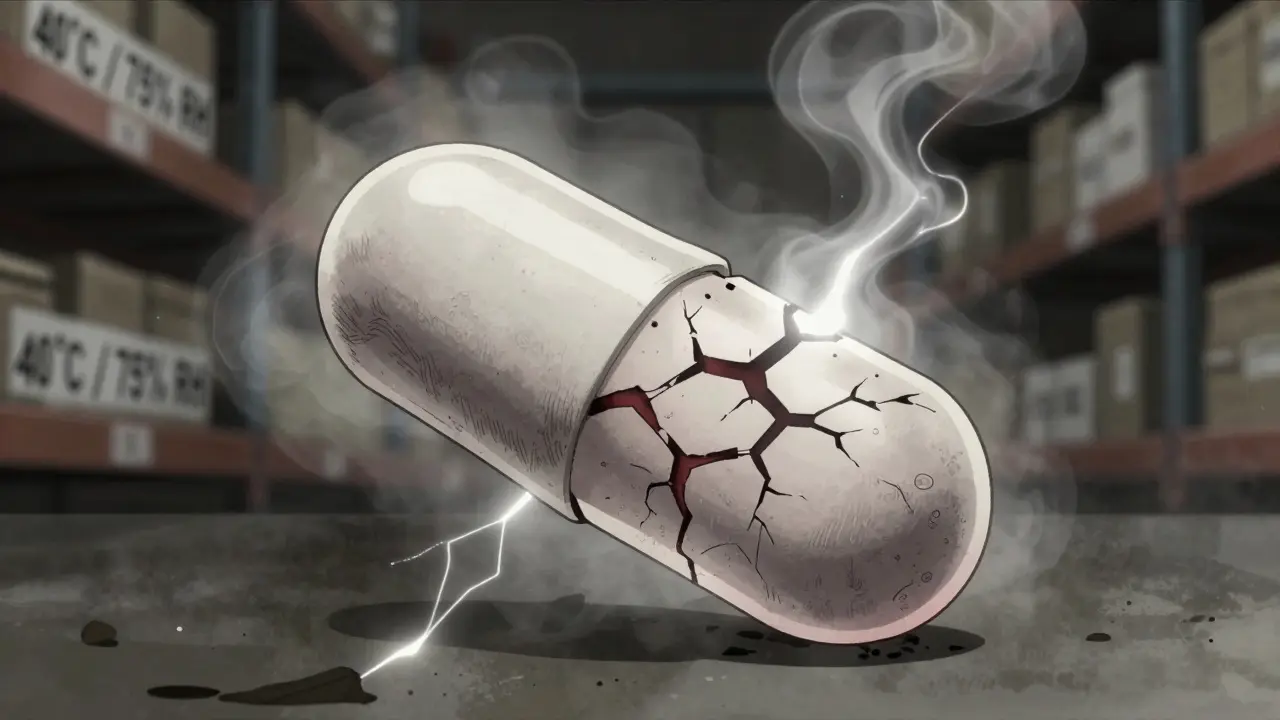
When a drug leaves the lab and heads to patients, it has to survive more than just a trip to the pharmacy. It has to survive heat, humidity, and time-sometimes for years. That’s where stability testing comes in. This isn’t optional. It’s the backbone of every drug’s safety and effectiveness. If a tablet degrades in a hot warehouse or a liquid medicine breaks down in a humid climate, it could stop working-or worse, become harmful. Regulatory agencies like the FDA and EMA don’t just ask for this data; they require it before approving any new drug. And the rules are strict: specific temperatures, precise humidity levels, and exact timeframes. Get it wrong, and your product gets rejected, recalled, or pulled from the market.
What Are the Standard Temperature and Time Conditions?
The global standard for stability testing comes from ICH Q1A(R2), a guideline first published in 2003 and still in use today. It’s followed by the FDA, EMA, Health Canada, and nearly every major regulatory body. There are three main testing categories: long-term, accelerated, and intermediate. Each has exact conditions.
For long-term testing, you have two options: 25°C ± 2°C with 60% RH ± 5% RH, or 30°C ± 2°C with 65% RH ± 5% RH. Which one you pick depends on where your drug will be sold. If it’s going to Europe or the U.S., 25°C/60% RH is typical. If it’s meant for tropical markets like Southeast Asia or parts of Africa, you’ll use 30°C/65% RH. You need at least 12 months of data at submission for the FDA. The EMA allows 6 months, but that can delay global approval.
Accelerated testing is the stress test. It’s done at 40°C ± 2°C and 75% RH ± 5% RH for exactly 6 months. This isn’t meant to mimic real-world storage-it’s meant to predict how the drug will behave over years in just months. The idea is simple: higher heat and humidity speed up chemical breakdown. If the drug shows significant changes here, you need to dig deeper.
Intermediate testing is the middle ground. It’s only required if your long-term study is at 25°C and the accelerated test shows problems. You run it at 30°C/65% RH for 6 months. It helps clarify whether the degradation seen in accelerated testing is real or just an artifact of extreme conditions.
How Do Refrigerated and Frozen Products Differ?
Not all drugs are stored at room temperature. Insulin, vaccines, and many biologics need refrigeration-or even freezing. Their stability rules are different.
For refrigerated products, long-term testing happens at 5°C ± 3°C for at least 12 months. Accelerated testing? Not at 40°C. Instead, it’s done at 25°C ± 2°C with 60% RH ± 5% RH for 6 months. Why? Because freezing and thawing can destroy proteins and nanoparticles. Putting them at 40°C would melt them, not test them. The WHO’s 2018 guidelines make this clear: you don’t stress refrigerated products with heat you’d use for pills or capsules.
Frozen products (below -15°C) are even trickier. There’s no single global standard yet. Testing often involves freeze-thaw cycles and monitoring for aggregation or precipitation. The FDA has issued warning letters to companies like Amgen and Roche because their monoclonal antibody products degraded after just one or two freeze-thaw cycles that weren’t properly tested.
What Is a ‘Significant Change’?
It’s the line between pass and fail. But here’s the problem: ICH Q1A(R2) doesn’t define it numerically.
It says a significant change means:
- A 5% change in assay from initial value
- Any degradation product exceeding its identification threshold
- Failure to meet physical attributes like color, texture, or dissolution
But what does “5% change” really mean? Is a 4.8% drop acceptable? A Pfizer quality analyst posted on Reddit about a case where a 4.8% assay drop triggered a regulatory rejection-even though statistically, it wasn’t significant. Regulators often interpret this differently. One lab’s ‘minor fluctuation’ is another’s ‘failure.’ That subjectivity causes delays, retests, and sometimes recalls.
Merck’s experience with Keytruda® shows how critical this is. Their intermediate testing at 30°C/65% RH caught a polymorphic transition-where the drug’s crystal structure changed-that wasn’t visible at 25°C. That discovery prevented a potential bioavailability issue in tropical markets. If they’d skipped intermediate testing, the drug might have been approved, then pulled later.

Why Do Some Products Fail Stability Testing?
Most failures aren’t due to bad science. They’re due to bad planning.
One common mistake? Ignoring humidity. A 2022 AAPS study found that 62% of stability failures in solid oral tablets come from humidity cycling-not constant high humidity. A pill sitting in a bathroom cabinet gets wet in the morning, dries out by noon, and repeats that cycle daily. Standard tests use constant 60% or 75% RH. They don’t mimic real life. That’s why some companies now use dual-loop environmental systems that reduce humidity swings from ±8% to ±3%.
Another issue? Temperature excursions. A 2023 LinkedIn survey of 142 stability professionals found that 78% had experienced at least one temperature spike over ±2°C during a 12-month study. One 3°C jump for 12 hours can invalidate the whole test. That’s why chamber qualification (IQ/OQ/PQ) isn’t optional. It takes three weeks per chamber, but skipping it means wasting months of data.
Biologics and new delivery systems like lipid nanoparticles (used in mRNA vaccines) are even harder. They’re sensitive to shear, light, and freeze-thaw cycles. The ICH Q1A(R2) guidelines were written for traditional small-molecule pills. They don’t cover these well. That’s why companies like Moderna and Pfizer now run extra tests beyond ICH-often at 50°C or higher-to predict real-world degradation. But regulators don’t always accept those models.
What’s Changing in Stability Testing?
The rules haven’t changed much since 2003. But the drugs have.
Now, we have antibody-drug conjugates (ADCs), cell therapies, and continuous manufacturing. The ICH Q1 working group is drafting Q1F, expected in late 2024, to address these. It will likely include new parameters for complex products.
Meanwhile, the FDA is piloting real-time stability assessment using Process Analytical Technology (PAT). Instead of waiting 12 months to test a batch, you monitor the drug’s chemistry as it’s made. Early results suggest this could cut testing time by 30-50% for continuous manufacturing products.
Some companies are already using predictive modeling. By testing at 50°C, 60°C, even 80°C, they can model degradation over years in weeks. A 2022 PMC study found that 74% of top pharmaceutical companies use these accelerated predictive studies. But the EMA rejected 8 such submissions in 2022-2023 because they didn’t meet traditional data standards.
Experts like Dr. Lisa McLeod argue the current system is outdated. “We’re still using 20-year-old rules for 21st-century medicines,” she says. “The framework doesn’t account for how modern drugs actually behave.”
How Do You Get Started?
If you’re launching a new drug, here’s your checklist:
- Define your target markets. Pick your long-term storage condition based on climate zone (Zone I-IV).
- Run accelerated testing at 40°C/75% RH for 6 months. Document every result.
- If you’re using 25°C for long-term, run intermediate testing at 30°C/65% RH for 6 months.
- For refrigerated products, test at 5°C ± 3°C and use 25°C/60% RH for acceleration.
- Qualify your chambers. Test temperature uniformity across all shelves. Document everything.
- Test at 0, 3, 6, 9, 12, 18, 24, and 36 months. More often early on if degradation is expected.
- Keep raw data for at least 10 years. FDA audits can happen years after approval.
Most small biotechs outsource this to CROs like WuXi AppTec or Charles River. The cost? $185,000 to $275,000 per product. But the alternative-recall, delay, or rejection-is far worse.
What Happens If You Don’t Comply?
In 2022, the FDA issued 27 warning letters citing stability testing deficiencies. One was for Teva Pharmaceuticals. Their generic Copaxone® failed to detect aggregation at 40°C. The result? A voluntary recall of 150,000 vials.
Stability isn’t just paperwork. It’s patient safety. A degraded antibiotic might not kill bacteria. A weak painkiller might not help. A broken vaccine might not protect. The numbers are clear: 92% of new drugs undergo full ICH testing. The ones that don’t? They don’t make it to market.
What are the ICH Q1A(R2) temperature and humidity conditions for long-term stability testing?
ICH Q1A(R2) allows two options for long-term stability testing: 25°C ± 2°C with 60% RH ± 5% RH, or 30°C ± 2°C with 65% RH ± 5% RH. The choice depends on the target market’s climate zone. For example, Zone I (temperate) uses 25°C/60% RH, while Zone IVa (hot-humid) uses 30°C/65% RH. At least 12 months of data is required for FDA submission.
Why is accelerated testing done at 40°C and 75% RH?
The 40°C/75% RH condition was chosen to simulate extreme environmental stress-like a drug being stored in a hot warehouse or shipped without climate control. It’s not meant to reflect normal storage, but to accelerate degradation and predict shelf life. Studies show this condition correlates to about 24 months of real-time stability at 25°C/60% RH for 85% of small molecule drugs.
Do refrigerated drugs follow the same stability rules as room-temperature drugs?
No. Refrigerated drugs are tested at 5°C ± 3°C for long-term storage. Their accelerated test is at 25°C/60% RH, not 40°C/75% RH. This is because freezing and thawing, not high heat, are the main risks for biologics and proteins. Testing at 40°C could destroy the product without revealing real-world degradation patterns.
What causes most stability test failures in solid oral dosage forms?
Humidity cycling-not constant high humidity-is the leading cause. A tablet exposed to morning dew and afternoon dryness can degrade faster than one kept in a constant 75% RH environment. This is why modern labs now use dual-loop humidity control systems to reduce variation from ±8% to ±3% RH.
Is stability testing required for generic drugs?
Yes. Generic drugs must meet the same ICH Q1A(R2) requirements as brand-name drugs. In 2021, Teva had to recall 150,000 vials of generic Copaxone® because their stability protocol failed to detect aggregation under accelerated conditions. Regulatory agencies treat generics with the same scrutiny as innovator products.
Can predictive modeling replace physical stability testing?
Some companies use predictive modeling with high-temperature data to estimate shelf life faster. But regulators like the EMA still require physical data. In 2022-2023, the EMA rejected 8 submissions based solely on modeling. While the FDA is piloting real-time testing using PAT, full replacement of physical testing isn’t approved yet. Hybrid approaches are the current norm.

Angela Stanton
January 7, 2026 AT 18:55Okay but let’s be real-ICH Q1A(R2) is a relic. 🤦♀️ I’ve seen labs run 50°C accelerated studies because their ADCs degrade faster than my coffee on a Monday. Regulators still act like we’re testing aspirin in 2003. The EMA rejected 8 submissions last year for using predictive modeling? Bro. We’re not in the Stone Age anymore. 😒
Johanna Baxter
January 8, 2026 AT 00:33So basically if your drug doesn’t survive a hot car in Florida, it’s dead? 😭 I just hope they test this stuff in my bathroom where the humidity goes from 10% to 90% in 20 minutes. My shampoo doesn’t even last that long.
Kiruthiga Udayakumar
January 9, 2026 AT 04:38India’s climate is Zone IVa, yet most pharma companies here still test at 25°C because it’s cheaper. This isn’t science-it’s negligence. Patients are dying because companies cut corners. I’ve seen expired insulin sold in rural clinics. Someone needs to be held accountable.
tali murah
January 9, 2026 AT 04:57Oh, so the FDA’s 27 warning letters in 2022? That’s just the tip of the iceberg. Let’s talk about the 300+ companies that quietly retested and resubmitted without public disclosure. The system isn’t broken-it’s designed to be gamed. And guess who pays? The patient. Again.
Jenci Spradlin
January 9, 2026 AT 11:31wait so humidity cycling is the real villain? i always thought it was just temp… but yeah my lab’s old chamber goes from 55% to 78% in a day and no one checks it. we just assume it’s fine… oops.
Ashley Kronenwetter
January 10, 2026 AT 19:52While I appreciate the technical depth of this post, I must emphasize the ethical imperative underlying stability testing. The integrity of pharmaceutical products is not merely a regulatory formality-it is a covenant with public health. Any deviation undermines trust in the entire medical ecosystem.
Aron Veldhuizen
January 12, 2026 AT 02:32But what if the real problem isn’t the guidelines… but the assumption that stability is even a thing? Maybe drugs are supposed to degrade. Maybe death is the only true endpoint for all things, including molecules. Are we clinging to the illusion of permanence because we fear mortality? Or is this just capitalism pretending science can outsmart entropy?
Heather Wilson
January 12, 2026 AT 18:02Let’s not pretend this is about science. It’s about liability. The 5% assay change? That’s not a scientific threshold-it’s a legal one. If you hit 5.1%, you’re fined. If you hit 4.9%, you get a pat on the back. It’s arbitrary. And yet, entire departments are built around this nonsense. I’ve seen PhDs cry over 0.2% fluctuations. The system doesn’t care about truth. It cares about paperwork.
Micheal Murdoch
January 13, 2026 AT 03:27For anyone new to stability testing-don’t get overwhelmed. Start with the checklist. Do the chamber qualification. Document everything. Even if your company cuts corners, your records are your shield. I’ve mentored junior scientists who thought they could skip steps because ‘it’s just a generic.’ They got burned. Hard. You’re not just testing a pill-you’re protecting someone’s mom, their kid, their grandpa. That’s why this matters. Slow down. Be thorough. And if you’re tired? Take a breath. Then go back and check the humidity log one more time.