
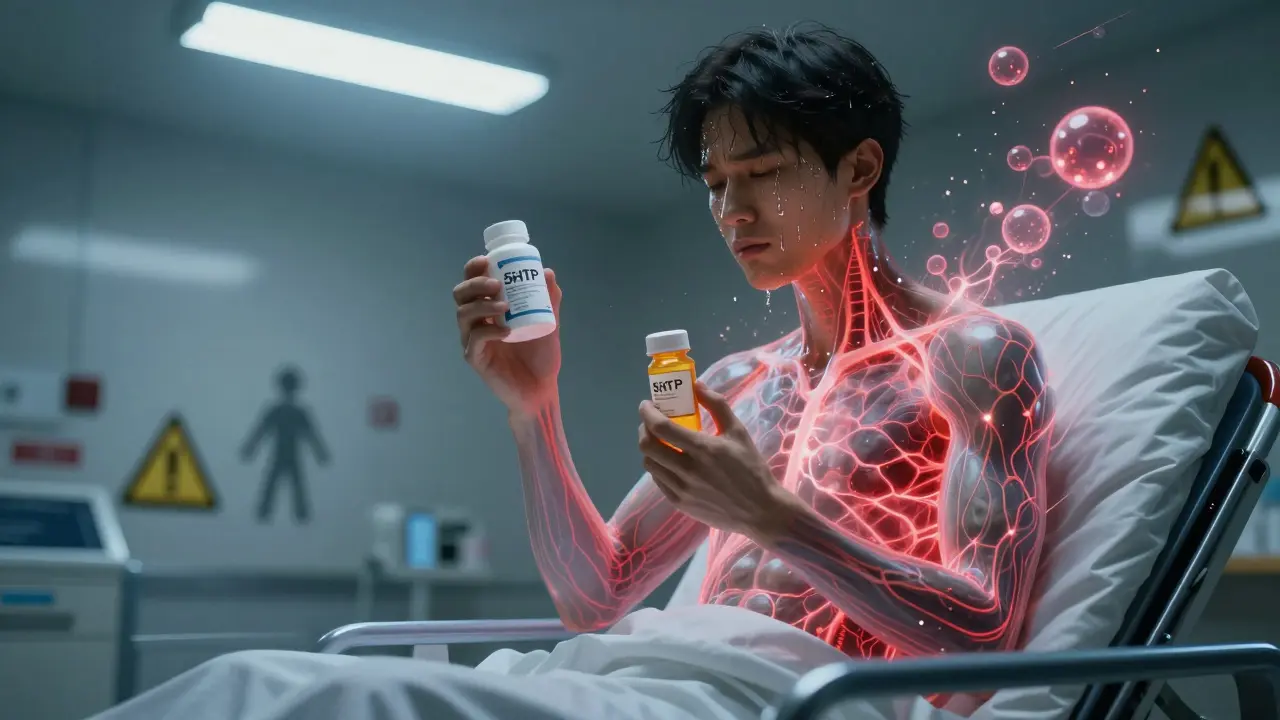
Serotonin Syndrome Risk Checker
Check Your Risk
This tool assesses potential risk of serotonin syndrome when combining 5-HTP with antidepressants.
Critical Warning
Combining 5-HTP with SSRIs creates a medical emergency. Serotonin syndrome can cause life-threatening symptoms including fever over 102°F, muscle rigidity, seizures, and organ failure. This is not a mild reaction—it's an emergency requiring immediate medical attention.
Do not delay seeking help if you're experiencing symptoms. Call emergency services immediately.
Combining 5-HTP with SSRIs isn’t just a bad idea-it’s a medical emergency waiting to happen. Thousands of people take 5-HTP supplements hoping to boost mood or sleep, often without realizing they’re mixing it with antidepressants like fluoxetine, sertraline, or escitalopram. What they don’t know could kill them.
What Happens When 5-HTP Meets SSRIs?
5-HTP is a natural compound your body uses to make serotonin. It’s sold as a supplement for anxiety, depression, and insomnia. SSRIs, on the other hand, are prescription antidepressants that stop your brain from reabsorbing serotonin, leaving more of it active in your nervous system. On their own, both are generally safe. Together? They create a dangerous feedback loop.
Think of it like this: SSRIs keep serotonin in your brain longer. 5-HTP floods your system with more serotonin than your brain can handle. The result? Excessive serotonin buildup-also known as serotonin syndrome. This isn’t a mild upset stomach or drowsiness. It’s a life-threatening condition that can spike your body temperature to 106°F, cause violent muscle rigidity, seizures, and organ failure.
The Hunter Criteria, the most reliable diagnostic tool used in emergency rooms, identifies serotonin syndrome with 97% accuracy. Key signs include spontaneous clonus (involuntary muscle contractions), inducible clonus with agitation or diaphoresis, ocular clonus with tremor, and hyperreflexia. If you’re taking an SSRI and suddenly feel shivering, sweating uncontrollably, or your muscles feel locked up, get help immediately.
Why This Combination Is More Dangerous Than You Think
Most people assume that because 5-HTP is "natural," it’s harmless. That’s a deadly myth. Unlike prescription drugs, supplements aren’t tested for safety before they hit store shelves. In 2022, ConsumerLab.com tested 5-HTP products and found that 31% had doses that varied by more than 25% from what was listed on the label. One pill might contain 50 mg. The next could have 128 mg. There’s no way to control your intake.
And it’s not just about dosage. The FDA received 127 reports of adverse events linked to 5-HTP and SSRIs between 2015 and 2019-including nine deaths. These aren’t rare outliers. A 2021 study in the Journal of Medical Toxicology found that 22% of serotonin syndrome cases in 2020 involved unregulated supplements like 5-HTP, up from just 7% in 2010. That’s a 214% increase in a decade.
Compare that to other common interactions: mixing SSRIs with tramadol carries a 4.6% risk of serotonin syndrome. St. John’s Wort? About 2.3%. But 5-HTP? It’s on par with mixing SSRIs with MAOIs-something doctors explicitly warn against. The American College of Medical Toxicology calls concurrent use of 5-HTP and SSRIs "contraindicated." That’s medical speak for "never do this."
Who’s at Risk-and Why Nobody’s Warning Them
The biggest problem? Most people don’t even know they’re at risk. A 2022 Healthline survey found that 41% of supplement users believe "natural" products can’t cause dangerous interactions. Among people taking antidepressants, nearly 30% were using 5-HTP without telling their doctor.
Reddit’s r/SSRI community has over 140,000 members. In just three years (2020-2022), 1,247 posts mentioned 5-HTP. Of those, 62% came from people self-medicating without medical advice. One user wrote: "Added 100 mg of 5-HTP to my 20 mg fluoxetine. Ended up in the ER with a fever of 104°F." Another described tremors so severe they couldn’t hold a cup of water.
Even doctors aren’t always aware. A 2020 assessment by the American Society of Health-System Pharmacists showed only 38% of primary care physicians correctly identified 5-HTP as a serotonin syndrome risk. FDA medication guides for SSRIs mention avoiding "herbal supplements"-but rarely name 5-HTP specifically. The NIH’s Office of Dietary Supplements does warn about it, but most patients never see that page.
What to Do If You’re Already Taking Both
If you’re currently taking an SSRI and a 5-HTP supplement, stop the supplement immediately. Do not quit your SSRI cold turkey-that can cause withdrawal symptoms like dizziness, nausea, or brain zaps. But do stop the 5-HTP.
Monitor yourself for symptoms over the next 24-72 hours. Mild cases of serotonin syndrome often resolve on their own once the supplement is stopped. But if you experience:
- High fever (above 102°F)
- Muscle stiffness or spasms
- Rapid heartbeat or fluctuating blood pressure
- Confusion, hallucinations, or agitation
-go to the emergency room. Tell them you took 5-HTP with an SSRI. That detail saves lives.
If you’re considering switching from an SSRI to 5-HTP, wait at least two weeks after stopping the antidepressant before starting the supplement. For certain SSRIs like paroxetine, which stays in your system for up to four weeks, you may need to wait longer. Always check with your doctor. There’s no safe shortcut.
Are There Any Safe Alternatives?
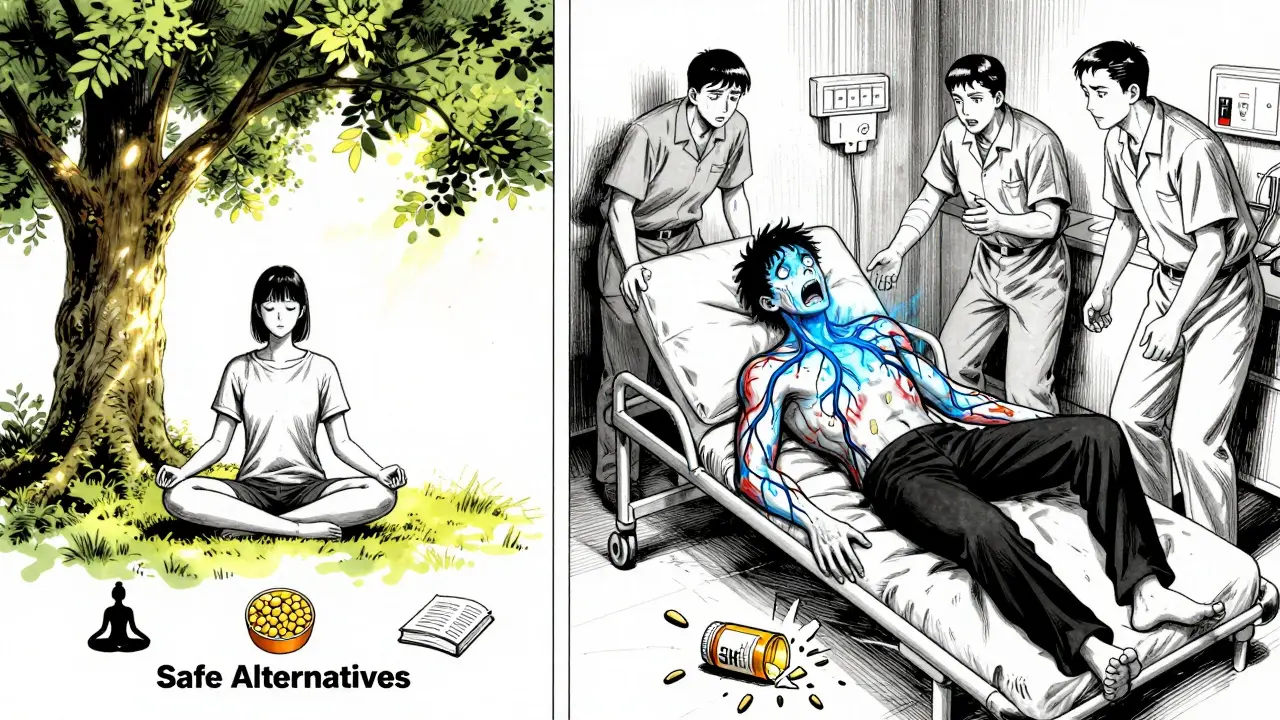
If you’re looking to reduce your SSRI dose or manage side effects, there are evidence-backed options-but none involve 5-HTP.
- Therapy: CBT and other forms of talk therapy are as effective as SSRIs for mild to moderate depression, with no risk of interaction.
- Exercise: Regular aerobic activity boosts serotonin naturally and improves mood long-term.
- Vitamin D and Omega-3s: Deficiencies in these are linked to depression. Correcting them can help without risking serotonin overload.
- Prescription alternatives: If SSRIs aren’t working, your doctor can try SNRIs, bupropion, or other medications that don’t rely on serotonin.
There is no scientific proof that 5-HTP enhances SSRI effectiveness. The few studies claiming otherwise are small, poorly controlled, or funded by supplement companies. The overwhelming consensus-from toxicologists, psychiatrists, and emergency medicine specialists-is that the risks far outweigh any unproven benefits.
The Bigger Picture: Why This Keeps Happening
This isn’t just about one supplement. It’s about a broken system. The Dietary Supplement Health and Education Act of 1994 lets companies sell 5-HTP without proving it’s safe. The FDA can only act after people get hurt. Since 2018, they’ve issued 14 warning letters to manufacturers for false claims-but enforcement is slow and inconsistent.
Meanwhile, the 5-HTP market is growing fast-worth nearly $200 million in 2022-with 78% of users combining it with prescription meds. The FDA is pushing for new warning labels on SSRI packaging by 2025. The American Psychiatric Association now requires doctors to ask patients directly: "Are you taking any supplements like 5-HTP or tryptophan?" But until those changes stick, the danger remains.
People aren’t being reckless because they’re careless. They’re being misled by marketing, misinformation, and the false promise that "natural" equals "safe." The truth is, your body doesn’t care if a chemical comes from a pill or a capsule labeled "organic." It reacts the same way.
Final Warning: This Is Preventable
Serotonin syndrome is rare-but only if people avoid known triggers. You don’t need to take 5-HTP to feel better. You don’t need to risk your life to find relief. If your SSRI isn’t working, talk to your doctor. If you’re tired of side effects, ask about alternatives. But never, ever combine it with 5-HTP.
There’s no miracle supplement that fixes depression without risk. And if someone tells you otherwise, they’re not helping-they’re putting you in danger.
Can I take 5-HTP with my SSRI if I use a low dose?
No. Even low doses of 5-HTP can trigger serotonin syndrome when combined with SSRIs. The risk isn’t about the amount-it’s about the mechanism. 5-HTP increases serotonin production, while SSRIs prevent its removal. Together, they overwhelm your system regardless of dosage. There is no safe low-dose combination.
How long should I wait after stopping an SSRI before starting 5-HTP?
Wait at least two weeks. For SSRIs with long half-lives like fluoxetine or paroxetine, wait four weeks or longer. Serotonin levels stay elevated for weeks after stopping these medications. Starting 5-HTP too soon can still cause serotonin syndrome. Always confirm the washout period with your doctor based on the specific SSRI you’re taking.
What are the early warning signs of serotonin syndrome?
Early signs include shivering, diarrhea, tremors, muscle twitching, sweating, and restlessness. These can appear within hours of taking 5-HTP with an SSRI. If you notice any of these and you’re on an antidepressant, stop the supplement and monitor closely. If symptoms worsen-like high fever, rigid muscles, or confusion-seek emergency care immediately.
Is 5-HTP safer than St. John’s Wort for depression?
Neither is safe to combine with SSRIs. St. John’s Wort carries a 2.3% risk of serotonin syndrome when mixed with SSRIs. 5-HTP’s risk is higher-comparable to dangerous combinations like SSRIs and MAOIs. Both are unregulated supplements with unpredictable potency. Neither should be used alongside prescription antidepressants without strict medical supervision, and even then, it’s not recommended.
Can my doctor prescribe 5-HTP with my SSRI?
No reputable doctor will prescribe or recommend combining 5-HTP with SSRIs. While a few alternative practitioners may suggest it, mainstream medical organizations-including the American Psychiatric Association and the American College of Medical Toxicology-explicitly warn against it. There is no approved medical protocol for this combination. Any doctor who suggests it is acting outside evidence-based guidelines.
What should I do if I’ve already taken 5-HTP and an SSRI together?
Stop taking 5-HTP immediately. Watch for symptoms like fever, muscle stiffness, rapid heartbeat, or confusion. If you have any of these, go to the ER. If you feel fine, still inform your doctor. They may want to monitor you or adjust your SSRI dose. Even if you feel okay now, the risk doesn’t disappear overnight. Document what you took and when-it could save your life later.

Alec Amiri
January 22, 2026 AT 22:54Bro. Just stop. I saw a guy at the gym take 5-HTP with his Zoloft and end up in the ER shaking like a leaf. He thought it was ‘natural energy.’ Natural? Bro, your brain isn’t a smoothie.
Lana Kabulova
January 24, 2026 AT 03:52Okay, but-wait-did you see the FDA’s 2021 report? The one that showed 5-HTP products vary by up to 150% in dosage? And no one’s regulating this? People are literally gambling with their nervous systems. This isn’t ‘alternative medicine’-it’s Russian roulette with a serotonin twist.
Philip House
January 25, 2026 AT 22:20It’s not about 5-HTP. It’s about the collapse of medical literacy. We’ve turned pharmacology into a cult of ‘natural’ magic beans. If you don’t understand how serotonin reuptake works, you shouldn’t be mixing anything. The problem isn’t the supplement-it’s the people who think biology is optional.
Ryan Riesterer
January 26, 2026 AT 04:27Per the Hunter Criteria, serotonin syndrome diagnosis requires at least one of: spontaneous clonus, inducible clonus + agitation/diaphoresis, ocular clonus + tremor, or hyperreflexia. The 97% sensitivity is well-documented in Annals of Emergency Medicine, 2019. Supplement-induced cases are rising because of unregulated bioavailability. Not a myth. Not hype. Data.
Jasmine Bryant
January 27, 2026 AT 14:43Wait so if i take 25mg of 5-htp and my ssri is super low dose like 10mg cipralex... is it still risky?? i mean like... maybe just a little?? i just wanna sleep better lol
Liberty C
January 28, 2026 AT 23:10Let me guess-you bought this from a ‘wellness influencer’ who calls herself a ‘neuro-nutritionist’ and posts yoga selfies with a bottle of 5-HTP in one hand and a crystal in the other. You didn’t read the label. You didn’t ask your doctor. You trusted a TikTok. Now you’re lucky you’re still breathing. This isn’t ‘holistic healing.’ It’s negligence dressed in hemp.
shivani acharya
January 30, 2026 AT 10:22They don't want you to know this but the FDA and Big Pharma are in cahoots. They let 5-HTP slide because they make billions off SSRIs. They don't care if you die as long as you keep buying pills. That’s why they don't put big warnings on the bottles. That’s why doctors ‘forget’ to ask. They’re paid off. Look at the numbers-214% increase since 2010? That’s not a trend. That’s a cover-up.
Sarvesh CK
January 31, 2026 AT 04:04The real tragedy here isn't just the medical risk-it's the erosion of trust in science. We've replaced evidence with anecdote, expertise with influencers, and caution with convenience. 5-HTP isn't the villain; it's a symptom. We've created a culture where the easiest path to feeling better is also the most dangerous. Perhaps the question isn't ‘why do people take it?’ but ‘why have we stopped listening to each other?’
Hilary Miller
January 31, 2026 AT 17:15My cousin in India takes 5-HTP with her antidepressants. She says it helps her ‘feel calm.’ She’s fine. Maybe it’s not universal?
Margaret Khaemba
February 2, 2026 AT 02:18Okay but what about tryptophan? Is that the same? I saw a friend take that with Lexapro and she was fine. Or is that different? I’m confused now.
Malik Ronquillo
February 3, 2026 AT 04:57Just don't take it. End of story. People die. You don't need it. You're not special. Stop trying to ‘optimize’ your brain with junk from a gas station.
Brenda King
February 3, 2026 AT 07:24I used to take 5-HTP with my SSRI for sleep. I didn't know it was dangerous until I had a panic attack and my arms locked up for 20 minutes. I'm so glad I found this post. I'm telling everyone I know. You're not alone if you did this. Please, stop. Talk to your doctor. You deserve to feel better safely 😊
Keith Helm
February 4, 2026 AT 19:25Per the American College of Medical Toxicology, concurrent use of 5-HTP and SSRIs is contraindicated. This is not a suggestion. It is a clinical directive.