
BPH Anticholinergic Risk Calculator
Assess Your Risk
This tool calculates your risk of urinary retention when taking anticholinergics based on clinical measurements from the article.
If you're a man over 60 with an enlarged prostate, and your doctor just prescribed a pill for an overactive bladder, stop for a second. That medication might be doing more harm than good.
What Anticholinergics Do to Your Bladder
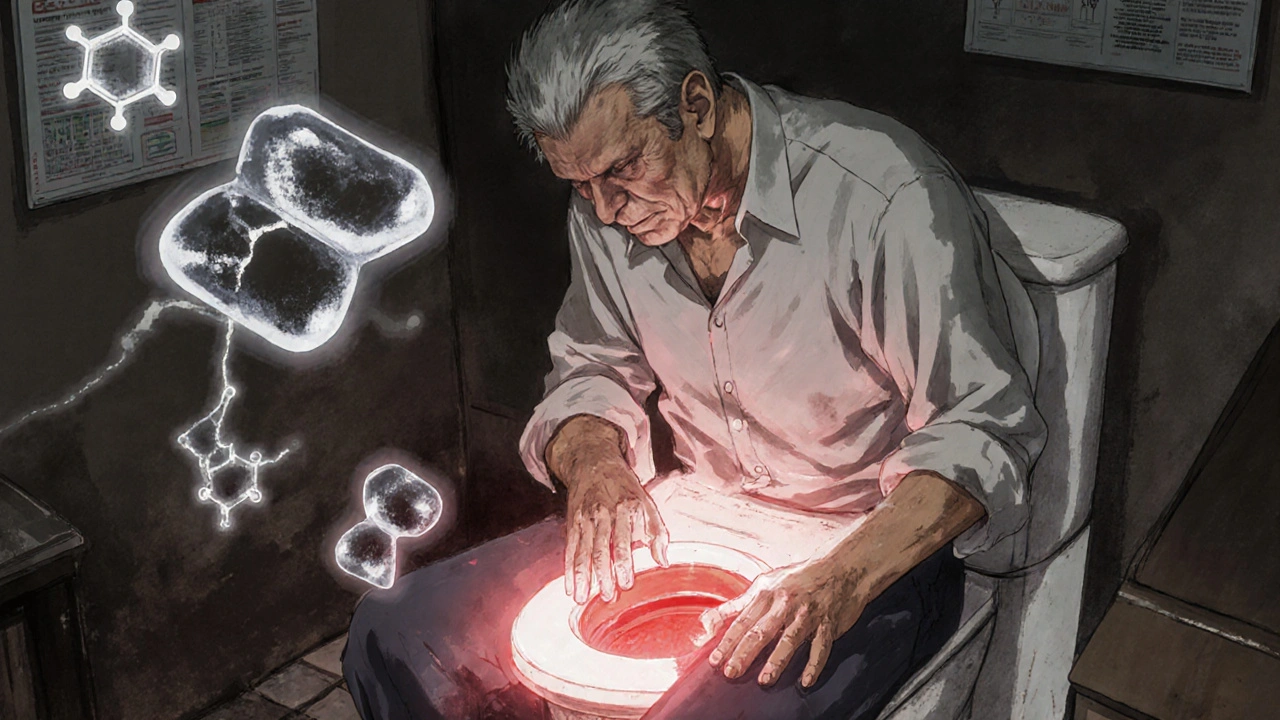
Anticholinergics like oxybutynin, solifenacin, and tolterodine are meant to calm an overactive bladder. They work by blocking a chemical called acetylcholine that tells the bladder muscle to squeeze. For someone with no prostate issues, this can mean fewer bathroom trips and less urgency. But for men with benign prostatic hyperplasia (BPH), it’s like turning down the engine on a car already stuck in mud.The bladder in men with BPH is already working overtime. The prostate squeezes the urethra shut, so the bladder has to push harder to get urine out. That’s why many of these men have weak urine flow, straining, or a feeling that they haven’t fully emptied. Now add an anticholinergic on top of that. It weakens the bladder’s squeeze even more. The result? Urine builds up. And if it builds up enough, you can’t pee at all.
Why This Is a Silent Emergency
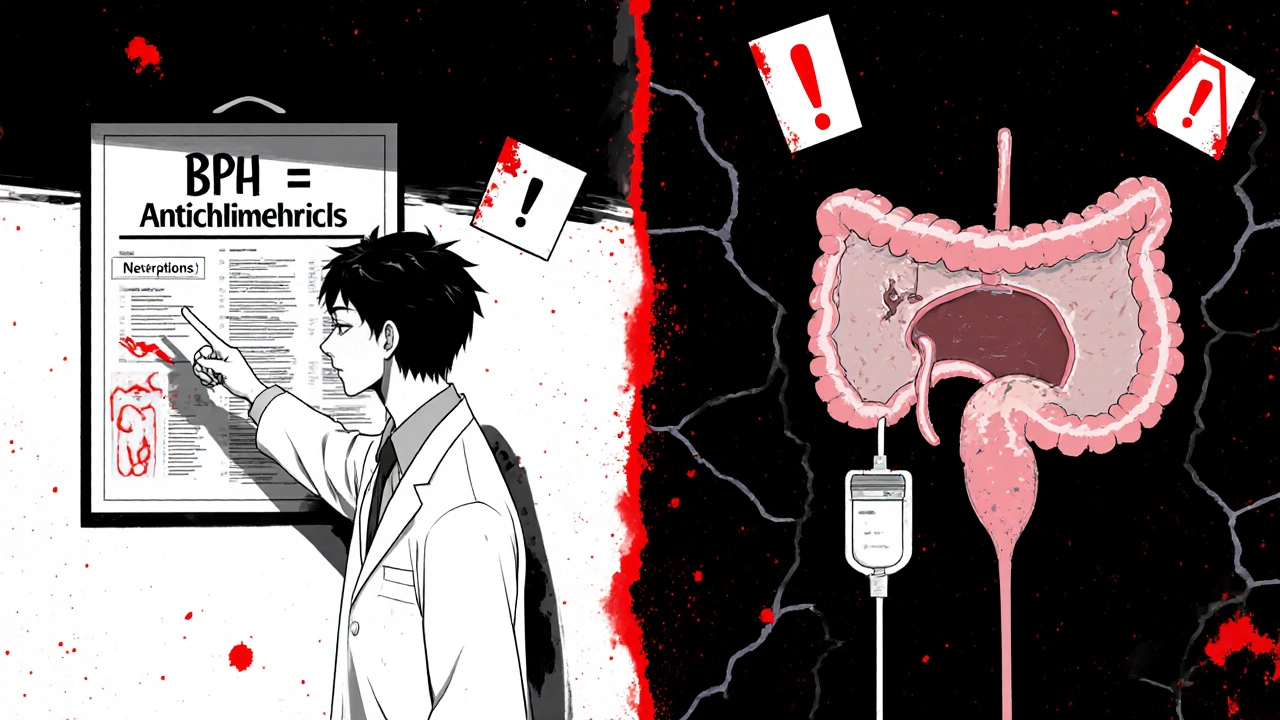
Urinary retention isn’t just uncomfortable. It’s dangerous. Acute urinary retention means your bladder fills up so much that you can’t pass any urine-even if you try for hours. This isn’t rare. Studies show that up to 10% of all urinary retention cases are caused by medications, and anticholinergics are the top offenders.Men with BPH who take these drugs have a 2.3 times higher risk of sudden retention than those who don’t. The numbers don’t lie: between 2018 and 2022, over 1,200 cases of urinary retention linked to anticholinergics were reported to the FDA. Nearly two-thirds of those cases happened in men over 65 with diagnosed prostate enlargement.
One man on a prostate support forum described it this way: “I started Detrol for urgency. Three days later, I couldn’t pee. My bladder was stretched to 1,200 ml-more than a full soda bottle. I ended up in the ER with a catheter.” That’s not an outlier. Reddit threads from men with BPH show 78% had bad experiences with anticholinergics. Over a third ended up needing a catheter.
Doctors Know This. So Why Is It Still Happening?
The American Urological Association has been clear since 2018: don’t give anticholinergics to men with moderate to severe BPH. Their guidelines say avoid them if your prostate is over 30 grams or your symptom score is above 20. The American Geriatrics Society calls these drugs “potentially inappropriate” for older men with urinary retention.Yet, a 2019 study found that 40% of nursing home residents with BPH were still being prescribed anticholinergics. Why? Because doctors sometimes focus only on the urgency, not the obstruction. They see frequent bathroom trips and think, “Let’s quiet the bladder.” They forget that the bladder isn’t overactive-it’s struggling.
There’s also a gap in patient education. Many men don’t know that their prostate is part of the problem. They take the pill because it’s “for bladder control,” and don’t realize it could lock their bladder shut.
What Are the Safer Alternatives?
If you have BPH and overactive bladder symptoms, you have better options.- Alpha-blockers like tamsulosin (Flomax) or alfuzosin (Uroxatral) relax the muscles around the prostate and urethra. They don’t weaken the bladder-they help it work better. Studies show men on alpha-blockers after catheter removal are 30-50% more likely to pee on their own within a few days.
- 5-alpha reductase inhibitors like finasteride (Proscar) or dutasteride (Avodart) shrink the prostate over time. After four to six years, they cut the risk of acute retention by half.
- Mirabegron (Myrbetriq) and vibegron (Gemtesa) are newer drugs that work differently. Instead of blocking nerves, they stimulate a different receptor in the bladder to relax it. In trials, mirabegron caused urinary retention in only 4% of men with mild BPH-compared to 18% with anticholinergics.
The FDA approved vibegron in 2020 specifically for men who can’t tolerate anticholinergics. It’s not a magic bullet, but it’s a much safer bet for prostate patients.
When Might Anticholinergics Still Be Used?
There’s one small group where they might still be considered: men with very mild BPH and clear signs of detrusor overactivity (a bladder that contracts too hard, too often). A 2017 study found that if you screen carefully-check your urine flow, measure residual volume, and start with a low dose-some men can use solifenacin without trouble.But here’s the catch: even then, you need strict monitoring. Monthly uroflow tests. Regular checks of how much urine is left after you pee. If your peak flow drops below 10 mL/sec or your post-void residual climbs above 150 mL, you need to stop the drug.
Most doctors won’t go down this road unless they’ve ruled out everything else. And even then, they’ll warn you: “If you can’t pee, come right in.”

What You Should Do Right Now
If you’re taking an anticholinergic and have BPH:- Don’t stop cold turkey. Talk to your doctor first.
- Ask for a uroflow test. This measures how fast you pee. A rate below 10 mL/sec means high risk.
- Get a post-void residual check. A bladder that holds more than 150 mL after urinating is already struggling.
- Ask if you can switch to mirabegron or vibegron.
- If you’re already catheterized or had a retention episode, alpha-blockers like tamsulosin should be started immediately.
If you haven’t started the medication yet, ask your doctor: “Is my prostate size or flow rate being checked? Is there a safer option?”
The Bigger Picture
This isn’t just about one drug. It’s about how we treat aging bodies. We often treat symptoms without looking at the whole system. A weak bladder isn’t always overactive-it’s under pressure. A frequent urge isn’t always a nervous bladder-it’s a blocked pipe.By 2028, experts predict anticholinergic prescriptions for men over 65 with BPH will drop by 35%. Why? Because better options exist. Because the risks are too high. And because more doctors are learning to see the prostate-not just the bladder.
If you’re managing BPH and bladder symptoms, you deserve a plan that doesn’t put you at risk of a hospital visit. Ask the right questions. Demand the right tests. And don’t accept a pill just because it’s been prescribed before.
Can anticholinergics cause permanent bladder damage?
Acute urinary retention from anticholinergics doesn’t usually cause permanent damage if treated quickly. But repeated episodes can stretch the bladder muscle over time, leading to long-term weakness. If the bladder stays overfilled for days, it can lose its ability to contract properly, making future voiding harder-even after stopping the drug. That’s why early intervention is critical.
Are all anticholinergics equally risky for prostate patients?
All anticholinergics carry similar risks because they work the same way-blocking acetylcholine. Some, like solifenacin, are marketed as more “bladder-selective,” but studies show they still affect other muscles in the body. No anticholinergic is truly safe for men with BPH. The difference is in how carefully they’re monitored, not in the drug itself.
What symptoms should I watch for that mean I’m in danger?
Watch for sudden inability to urinate, even with a strong urge. Other warning signs include lower abdominal pain or bloating, feeling like you’ve just peed but still feel full, or a very weak stream that stops and starts. If you’ve had these symptoms for more than 6-8 hours, go to the ER. Don’t wait. Delayed treatment increases the risk of infection or bladder damage.
Can I take anticholinergics if I’ve had a TURP procedure?
After a TURP (transurethral resection of the prostate), the obstruction is removed, so the risk drops significantly. Many men can safely take anticholinergics after surgery, especially if their bladder function has recovered. But your urologist should still check your flow rate and residual volume before prescribing. Never assume it’s safe just because you had surgery.
Why don’t more doctors know about this risk?
Many doctors, especially general practitioners, are trained to treat overactive bladder as a standalone condition. They may not routinely check prostate size or urine flow. Also, anticholinergics are widely advertised and easy to prescribe. Urologists are more aware, but not all patients see one. The gap exists because the system doesn’t always connect the dots between bladder symptoms and prostate health.


Sachin Agnihotri
November 28, 2025 AT 19:43Wow, this is so spot-on. I’ve been on oxybutynin for months and didn’t realize my bladder was basically screaming for help, not begging to be silenced. My urologist never mentioned the prostate connection-just said ‘take it and see.’ Now I’m scared to even drink water.
Thanks for laying it out like this. I’m scheduling a uroflow test tomorrow.
Diana Askew
November 30, 2025 AT 01:28They’re hiding this on purpose. Big Pharma doesn’t want you to know anticholinergics cause retention-because catheters and ER visits = more $$$! I saw a documentary where they admitted this in a secret meeting. They’re poisoning old men to sell more drugs. 😡
Also, your doctor is probably on their payroll. Check your pill bottle-there’s a QR code that links to their investor page. I did it. I swear.
King Property
December 1, 2025 AT 09:15You people are clueless. This isn’t even controversial. The AUA guidelines have been clear since 2018. If your doctor prescribed you an anticholinergic with BPH, they’re either lazy, untrained, or actively harming you.
And don’t get me started on ‘mirabegron is safer’-that’s just the next placebo with a fancy name. Real men use alpha-blockers. Tamsulosin. Done. No drama. Stop overcomplicating it.
Also, your ‘post-void residual’? If it’s over 150 mL, you’re already in the danger zone. You don’t need a study-you need a catheter and a new doctor.
Yash Hemrajani
December 1, 2025 AT 14:21Oh, so now we’re pretending this is a new discovery? 🤦♂️
I’ve been telling my patients this since 2015. Anticholinergics in BPH patients? It’s like giving a drowning man a snorkel. He’s not breathing wrong-he’s underwater.
And yes, vibegron’s better-but it’s still not free. Insurance won’t cover it unless you’ve tried and failed three other things. So we’re stuck playing whack-a-mole with side effects while patients sit in ERs.
TL;DR: Your doctor didn’t forget. They just got paid to ignore it.
Pawittar Singh
December 2, 2025 AT 17:09Hey everyone-this is important, and I’m so glad someone finally said it. I was terrified after my retention episode last year. I thought I was just ‘getting old.’
But after switching to tamsulosin? I can pee like I’m 30 again. No catheters. No panic. Just peace.
If you’re reading this and you’re on one of those pills-don’t panic. Just talk to your doc. Ask for the flow test. It takes 5 minutes. You’ve got this. 💪
And if your doctor says ‘it’s fine’-go to a urologist. They’re the real MVPs here.
Josh Evans
December 4, 2025 AT 03:36This is wild. My dad’s on solifenacin and he’s been complaining about not being able to pee for weeks. I showed him this post and he finally agreed to get tested. Turns out his residual was 400 mL.
He’s on tamsulosin now and says he feels like a new man. Honestly, I didn’t even know BPH could cause this. Thanks for the clarity.
Allison Reed
December 6, 2025 AT 01:57Thank you for writing this with such care and precision. The science is clear, the risks are documented, and yet the medical system continues to overlook it. This isn’t just about medication-it’s about how we value the dignity of aging men.
Every time a man is told ‘it’s just part of getting older,’ we fail him. This post is a small act of resistance-and I’m grateful for it.
Jacob Keil
December 6, 2025 AT 19:37anticholinergics r just the tip of the iceberg. they r using this to make us dependent on catheters so they can sell u fancy ones with bluetooth and apps. i saw a patent for a ‘smart catheter’ that texts ur doctor when u get retained. its all a scam. also, the FDA is owned by Pfizer. i know cuz i read it on a forum.
also, ur prostate is a sentient being and it hates u now. it’s revenge for all the bad habits. u need to apologize to it. maybe with a warm bath and some chamomile tea.
Rosy Wilkens
December 8, 2025 AT 17:31This article is dangerously misleading. You imply that anticholinergics are universally harmful, yet fail to mention that many elderly patients with neurogenic bladder benefit significantly from them. You’re promoting a narrow urological bias while ignoring the broader geriatric context.
Also, mirabegron has been linked to hypertension and arrhythmias in 12% of patients over 75. Did you omit that? Or is this another case of selective data cherry-picking to push a narrative?
Doctors don’t prescribe these drugs blindly-they weigh risk versus benefit. You’re reducing complex clinical decisions to soundbites.
Andrea Jones
December 9, 2025 AT 00:28Okay, so I’m a nurse, and I’ve seen this play out too many times. A sweet 72-year-old man comes in with ‘I gotta go every hour’-doc gives him oxybutynin. Two weeks later, he’s back, sweating, in pain, catheter in place.
I always ask: ‘Did you ever get your prostate checked?’
9 times out of 10, they haven’t.
So yeah, this is real. But here’s the good part: once they switch meds, they’re *so* relieved. It’s like flipping a switch.
Don’t be scared. Be informed. And if your doc doesn’t know this? Find one who does. You deserve better.