
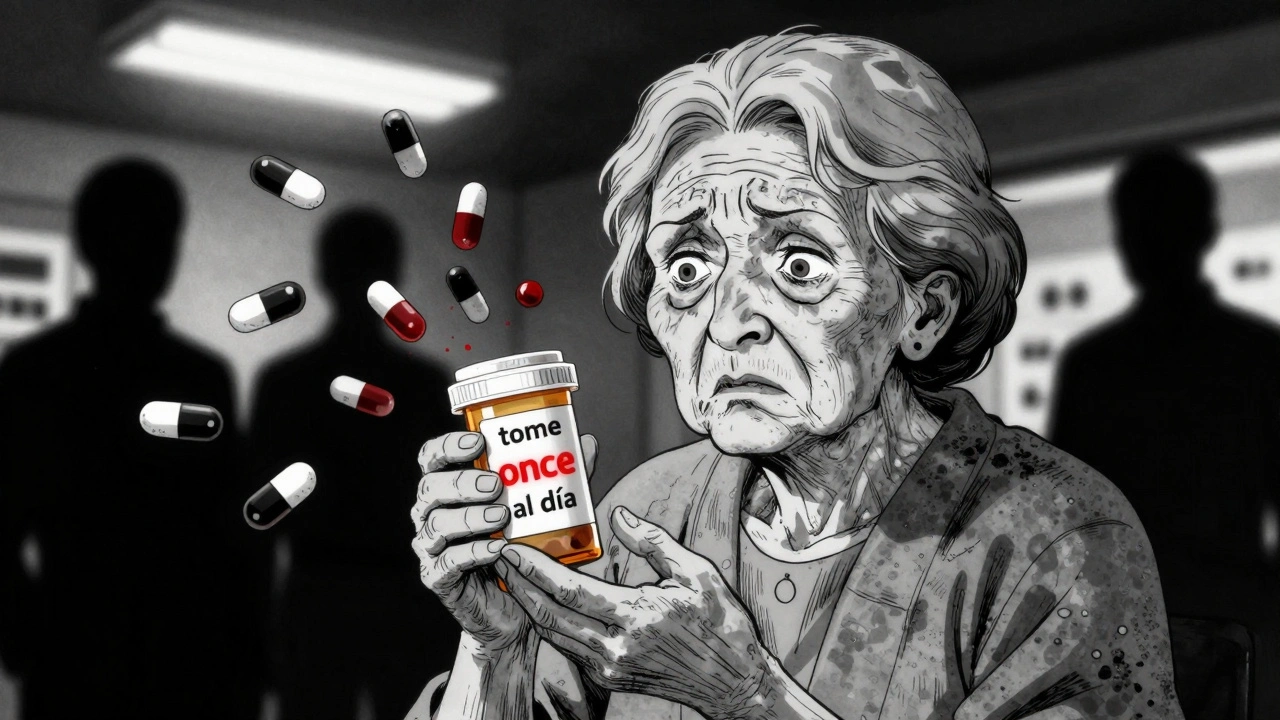
Imagine taking your medicine because the label says "take once a day"-but it actually meant "take eleven times a day". That’s not a hypothetical. It’s happened. And it’s not rare.
In the U.S., over 25 million people struggle with English. For them, a prescription label isn’t just a set of instructions-it’s a lifeline. But too often, that lifeline is tangled in bad translations. Computer-generated labels, mixed-up words, and inconsistent phrasing turn simple directions into dangerous puzzles. The result? People take too much. Too little. At the wrong time. Sometimes, they end up in the emergency room.
Why Translation Errors Happen on Prescription Labels
Most pharmacies don’t hire professional translators. They use cheap, automated systems that spit out translations in seconds. These systems don’t understand medical context. They don’t know that the word "once" in English means "una vez" in Spanish-but in Spanish, "once" means "eleven". That’s not a typo. That’s a deadly mix-up.
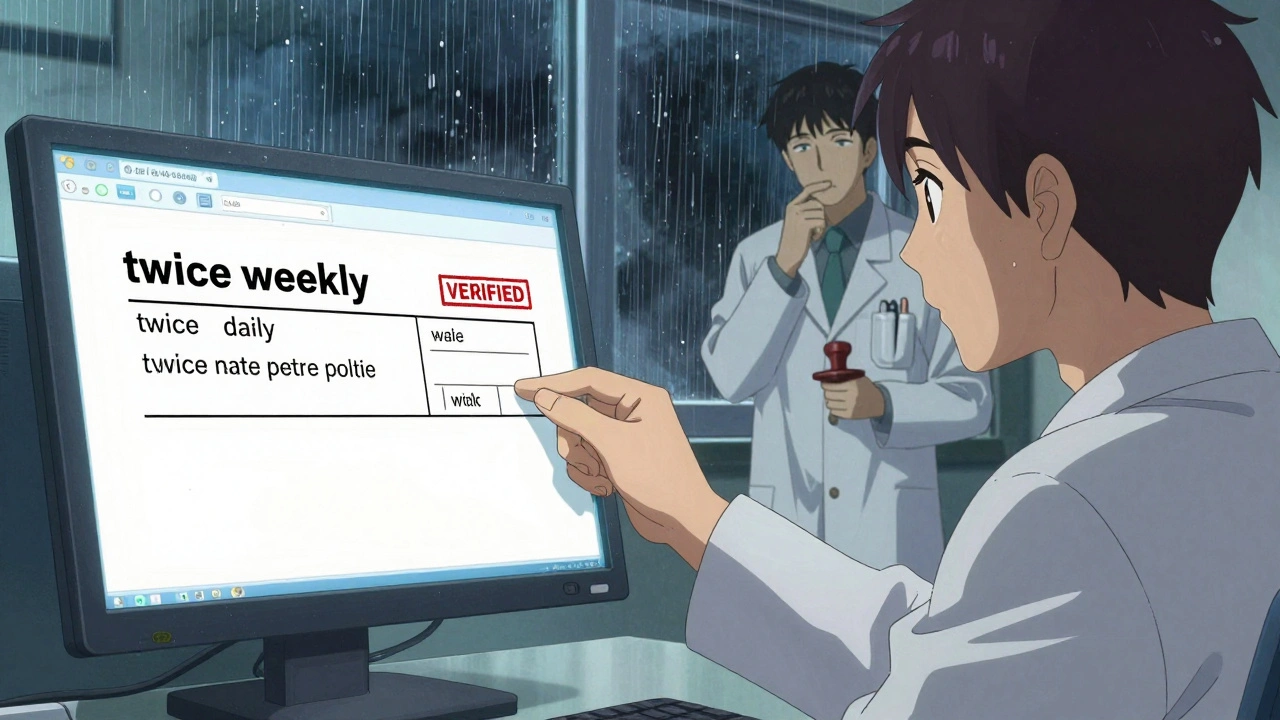
One study of 286 pharmacies in the Bronx found that 86% used machine translation for Spanish labels. Half of those labels had errors. Some said to take pills "twice weekly" when the doctor meant "twice daily". Others translated "take with food" as "take with alcohol"-a dangerous mistake, especially for antibiotics or blood pressure meds.
Even worse, the same phrase can be translated differently at different pharmacies. One CVS might say "tome una pastilla cada 12 horas" for "take one pill every 12 hours." Another Walgreens might say "tome una pastilla cada media jornada." Both are grammatically correct. But patients don’t know which version is right. They just know they’re confused.
The Real Cost of a Bad Translation
These aren’t just minor mistakes. They lead to real harm.
A 2023 survey found that 63% of patients with limited English proficiency felt confused about their medication instructions. Nearly 3 in 10 admitted they’d taken the wrong dose because of translation problems. One Reddit user shared how their mother, who speaks only Spanish, took her heart medication twice a week instead of twice a day-because one pharmacy translated it incorrectly. Her condition worsened. She ended up hospitalized.
In California, where bilingual labels have been required since 2016, medication errors among Spanish-speaking patients dropped by 32%. That’s not a coincidence. It’s proof that good translation saves lives.
But outside of a few states, there’s no rule forcing pharmacies to get it right. In most places, it’s up to the pharmacy’s budget-and most choose the cheapest option. Automated systems cost about 5 cents per label. Professional translation? Around 25 cents. That difference adds up fast. But when you’re risking someone’s life, 20 cents isn’t too much to pay.
Where Translation Goes Wrong: Common Mistakes
Some errors are obvious. Others are sneaky.
- False cognates: "Once" = eleven in Spanish. "Embarazada" doesn’t mean "embarrassed"-it means "pregnant."
- Dosage confusion: "Take two tablets twice a day" becomes "take two tablets twice a week"-a 75% reduction in dose.
- Timing errors: "Every 8 hours" translated as "three times a day"-but not at evenly spaced intervals.
- Regional dialects: "Alcohol" in Latin America means rubbing alcohol. In Spain, it means drinking alcohol. Which one does the label mean?
- Missing context: "Take on an empty stomach" might be translated, but not explained. What does "empty stomach" mean? Two hours before? After meals?
Even simple words like "as needed" get butchered. In Spanish, "según sea necesario" is correct. But some systems output "según necesidad," which sounds like "according to need"-vague, confusing, and unhelpful.
Who’s Getting It Right?
Some pharmacies are stepping up.
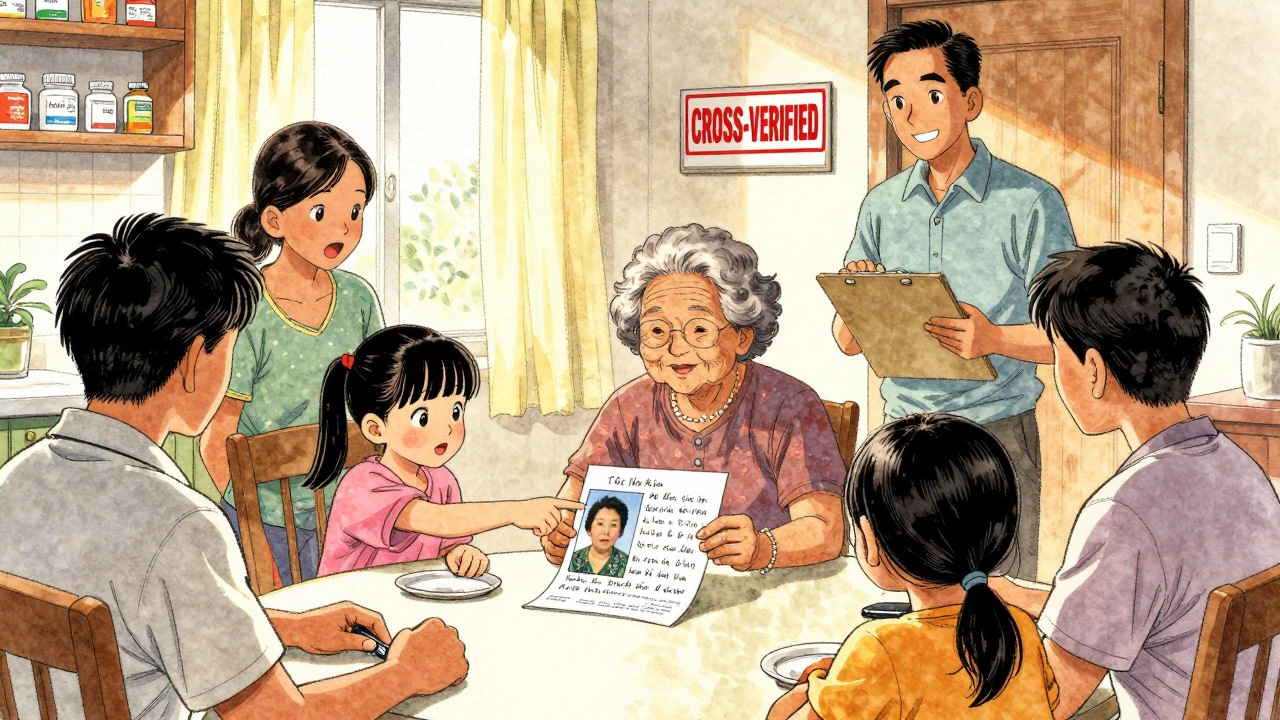
California and New York are the only two states with laws requiring accurate translation. In California, pharmacies must use certified medical translators and verify translations with a second bilingual staff member. The result? Fewer ER visits. Fewer hospitalizations. Better outcomes.
Major chains are starting to catch up. Walgreens rolled out its MedTranslate AI system in late 2023. It uses neural translation-but only after a pharmacist reviews it. CVS Health’s LanguageBridge platform does the same. Both cut errors by over 60% in pilot programs.
Kaiser Permanente spent nearly $15,000 per location to overhaul its system. It took eight months. But they now have bilingual verification checkpoints, translation memory tools, and staff trained in language access laws. Their error rate? Under 5%.
And it’s not just about Spanish. Chinese, Vietnamese, and Arabic translations are available at only 23% of major pharmacies. That’s not enough. Millions of people speak these languages. They deserve clear labels too.
What You Can Do If Your Label Doesn’t Make Sense
You don’t have to accept a confusing label. Here’s what to do:
- Ask for a human translator. Don’t settle for a printed sheet. Say: "Can I speak with someone who speaks my language? I need to understand this medicine." Most pharmacies have phone interpreter services-even if they don’t have staff on-site.
- Request a printed copy in your language. If they say no, ask to speak with the pharmacist. Federal law (Title VI of the Civil Rights Act) says healthcare providers must offer language assistance. You have the right to it.
- Take a photo of the label and show it to someone who speaks both languages. A friend, family member, or community health worker can help you compare it to the original English version.
- Call the pharmacy’s customer service line. Many chains have 24/7 translation hotlines. Ask for the number and save it.
- Report bad translations. If you get a dangerous label, report it to the pharmacy, your doctor, and your state’s health department. Public pressure drives change.
One woman in Miami told her Walgreens pharmacist her mother was confused by the label. The pharmacist called in a certified translator on the spot. They reviewed the instructions together. The translator corrected "once" to "una vez" and added a note: "No es once (eleven). Es una vez (one time)." That one correction prevented a potential overdose.
The Bigger Picture: Why This Matters
This isn’t just about labels. It’s about dignity. It’s about safety. It’s about whether someone can trust the healthcare system.
When you give someone a prescription in a language they don’t understand, you’re not just failing them-you’re putting them at risk. And that risk isn’t evenly distributed. It falls hardest on older adults, immigrants, and low-income families who can’t afford to hire translators themselves.
But progress is happening. The FDA now recommends plain language and dual verification. The HHS launched a $25 million grant program to help pharmacies improve translation. More states are considering laws like California’s.
Every $1 spent on accurate translation saves $3.80 in avoided hospital visits, according to McKinsey’s analysis. That’s not just a moral win. It’s a financial one too.
Clear labels aren’t a luxury. They’re a necessity. And they’re not hard to fix. They just require willpower-and the courage to demand better.
Why do prescription labels sometimes say "once" when they mean "one time"?
In Spanish, the word "once" means "eleven." So if a computer translates "take once a day" as "tome once al día," it accidentally tells patients to take the medicine eleven times a day. That’s a life-threatening error. Professional translators use "una vez" to mean "one time," avoiding this confusion.
Which states require accurate prescription label translations?
Only California and New York have laws requiring accurate, human-reviewed translations on prescription labels. California’s law, effective since 2016, mandates certified translators and dual verification. Other states have no such requirements, even though millions of residents speak languages other than English.
Can I ask my pharmacy for a translator even if I’m not in California or New York?
Yes. Under Title VI of the Civil Rights Act, any pharmacy that receives federal funding (which includes most major chains) must provide language assistance. You have the right to ask for a live interpreter, either in person or over the phone. If they refuse, ask to speak with a manager or file a complaint with your state’s health department.
How can I check if my prescription label is translated correctly?
Compare the translated label with the English version. Look for key details: dosage (how many pills), frequency (how often), and instructions (with food, on empty stomach, etc.). If the translation sounds odd or inconsistent with what your doctor said, ask for help. You can also take a photo and show it to a bilingual friend or community health worker.
Are AI translation tools better than old computer systems?
Yes-but only if they’re paired with human review. AI tools like Walgreens’ MedTranslate and CVS’s LanguageBridge are 60-70% more accurate than older systems. But they still make mistakes. That’s why both companies require a pharmacist to verify every translation before it’s printed. AI helps. It doesn’t replace human judgment.
What Comes Next?
The problem won’t fix itself. But it can be fixed.
If you’re a patient: speak up. Demand clarity. Don’t be afraid to say, "I don’t understand this. Can you help?"
If you’re a caregiver: check labels. Ask questions. Don’t assume the pharmacy got it right.
If you’re a healthcare worker: push for better systems. Advocate for certified translators. Push back against cost-cutting that puts lives at risk.
Clear labels aren’t just about language. They’re about trust. And when people can understand their medicine, they take it right. They heal faster. They stay out of the hospital.
That’s worth more than 20 cents per label.

Olivia Hand
December 7, 2025 AT 15:38I never realized how many lives hang on a single word. That 'once' = 'eleven' thing? Chilling. I work in public health, and I’ve seen patients stare at labels like they’re ancient runes. It’s not laziness-it’s systemic neglect. We treat language access like a bonus feature, not a human right.
Ted Rosenwasser
December 7, 2025 AT 23:16Let’s be real-this is what happens when you let non-native speakers handle critical infrastructure. The U.S. needs to stop outsourcing translation to algorithms that don’t even know the difference between 'a' and 'an.' We’re not a third-world country. Why are we using 2005-era machine translation like it’s 2010?
Helen Maples
December 9, 2025 AT 09:22California’s law is the bare minimum. And yet, 48 states still refuse to implement it. This isn’t about cost-it’s about power. Pharmacies know that non-English speakers won’t fight back. They count on silence. But silence isn’t consent. It’s complicity. If you’re reading this and you’re not advocating for translation reform, you’re part of the problem.
Ashley Farmer
December 10, 2025 AT 03:31I have a neighbor who’s 78 and only speaks Vietnamese. She takes six different meds. Last month, she showed me her label-it said 'take three times a week' when it should’ve been 'three times a day.' She didn’t say anything because she didn’t want to be a burden. That’s the real tragedy here. It’s not the translation-it’s the shame we make people feel for asking for help.
David Brooks
December 10, 2025 AT 04:40THIS IS WHY WE NEED TO STOP LETTING CORPORATIONS RUN OUR HEALTHCARE. A 20-cent difference? That’s a death sentence for someone’s grandma. I’m so sick of hearing 'it’s too expensive' when the real cost is measured in ER visits, ICU stays, and funeral bills. We’re literally paying more to kill people than to save them. Wake up, America.
Sadie Nastor
December 12, 2025 AT 01:30so like… if you get a label in spanish and it says 'once'… does that mean you should take it 11 times? 😅 i just had a panic moment reading this. i have no idea how people navigate this daily. my heart breaks for folks who just want to get better but the system is working against them.
Nicholas Heer
December 13, 2025 AT 14:14THIS IS THE NEW WORLD ORDER. They’re flooding our meds with bad translations so we get sick, then they sell us more drugs. It’s all a scam. Who’s behind these AI translation tools? Big Pharma? The UN? The WHO? They don’t want you healthy-they want you dependent. And now they’re using language as a weapon. You think this is an accident? It’s a plan.
Stacy here
December 14, 2025 AT 09:03Language isn’t just communication-it’s power. When you translate 'take once a day' as 'tome once al día,' you’re not making a mistake. You’re erasing agency. You’re telling someone their understanding doesn’t matter. That’s not incompetence. That’s structural violence. And until we name it as such, nothing changes. We’re not fixing labels-we’re fixing a system that sees non-English speakers as disposable.
Kyle Flores
December 15, 2025 AT 06:37My aunt’s label said 'take with water' but it came out as 'take with wine' in Portuguese. She drank a glass before each pill. Thought it was a tip. Ended up in the hospital. Pharmacies need to stop treating translation like a checkbox. It’s not a service-it’s a safety protocol. Like fire alarms. You don’t skip those because they're expensive.
Jennifer Anderson
December 16, 2025 AT 13:57my mom got her blood pressure med label in spanish and it said 'dos veces por semana' but it was supposed to be 'dos veces por dia'... she took it twice a week for 3 months. her bp went crazy. she didn’t say anything because she didn’t want to 'bother' anyone. i cried for a whole day. this isn’t just a mistake. it’s a betrayal.
Sangram Lavte
December 18, 2025 AT 06:23As a pharmacist in India, I’ve seen this too. In Hindi, 'ek baar' means once, but 'ek' sounds like '1'-and some automated systems confuse it with '11'. We’ve had cases where patients took insulin 11 times thinking it was once. We now have a rule: every translation must be signed off by two staff. Simple. Effective. Why can’t the U.S. do this?