
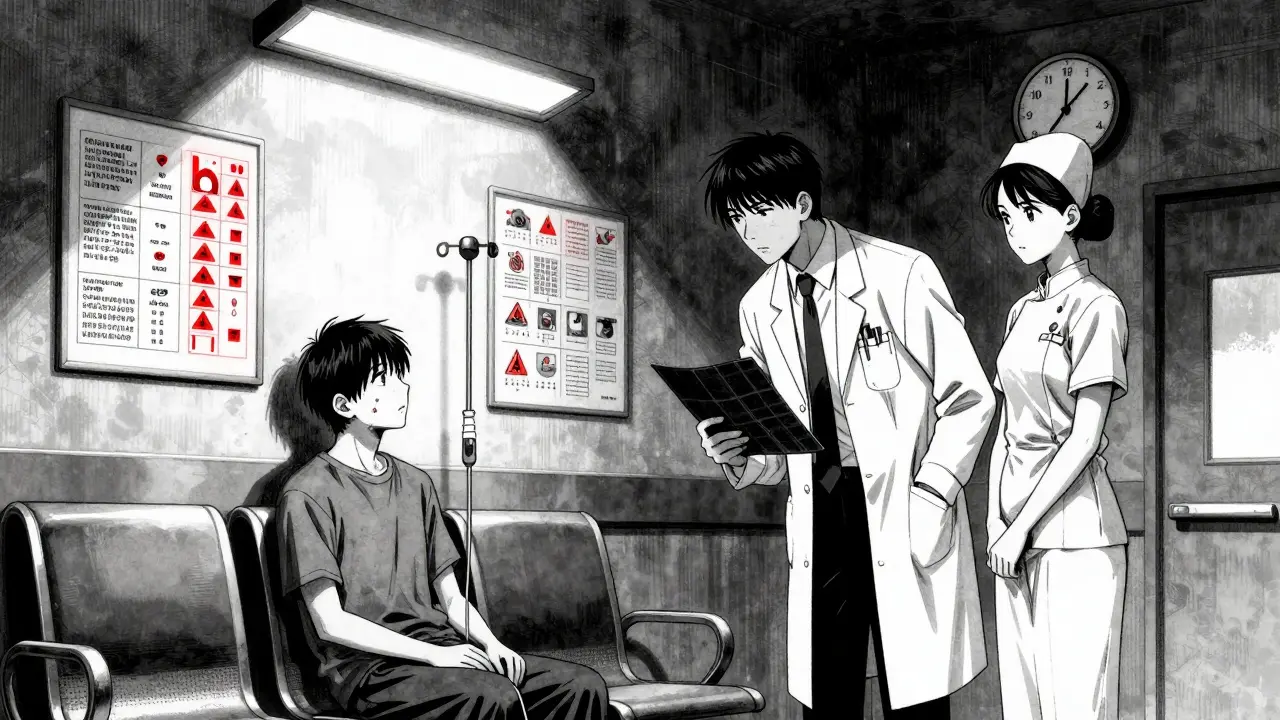
When you need a CT scan or X-ray with contrast dye, the last thing you want is a bad reaction. Even though serious reactions are rare-happening in fewer than 1 in 500 scans-people who’ve had one before are at much higher risk. That’s where premedication and careful safety planning come in. It’s not about avoiding the scan. It’s about making sure you can get the imaging you need without risking your health.
Who Needs Premedication?
Not everyone needs it. Only those with a history of an allergic-type reaction to iodinated contrast dye are considered high-risk. That means if you’ve had hives, swelling, trouble breathing, or a drop in blood pressure during a previous scan, you’re in the group that needs protection.Many people think that being allergic to shellfish or iodine means you’re at risk. That’s a myth. Shellfish allergies aren’t linked to contrast reactions. Iodine itself isn’t the culprit either. The real trigger is the chemical structure of the contrast dye. If you’ve had a reaction to one type of iodinated contrast, switching to a different brand within the same class can often reduce your risk-sometimes as much as premedication does.
For mild reactions-like a few hives or mild nausea-most guidelines now say premedication isn’t needed. A 2021 study in Radiology showed the chance of recurrence is very low. But if you’ve had a moderate reaction-like vomiting, wheezing, or low blood pressure-or a severe one like anaphylaxis, then you need a plan.
The Standard Premedication Regimen
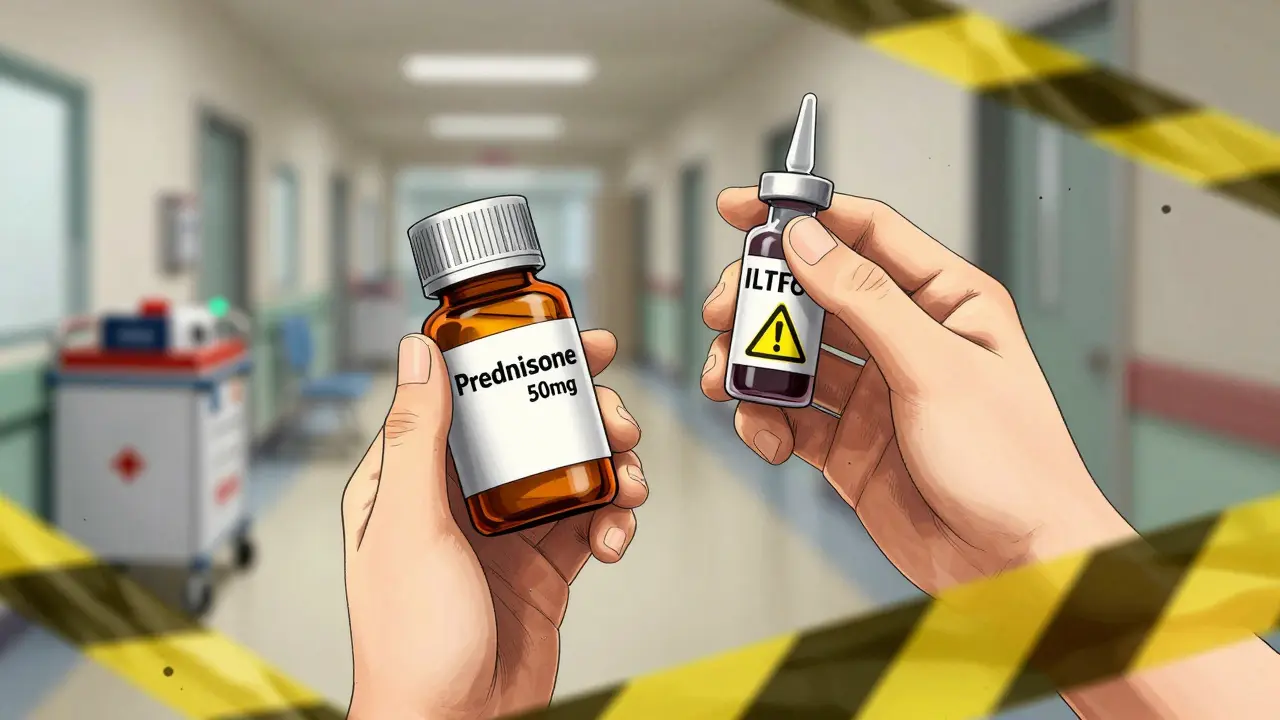
The most trusted method comes from the American College of Radiology (ACR) guidelines. It combines a steroid and an antihistamine to calm your immune system before the dye goes in.For outpatient scans, the classic plan is:
- Prednisone 50 mg by mouth at 13 hours before the scan
- Prednisone 50 mg again at 7 hours before
- Prednisone 50 mg one hour before
- Diphenhydramine (Benadryl) 50 mg by mouth one hour before
This gives your body time to build up protection. But here’s the catch: Benadryl makes you drowsy. You won’t be able to drive yourself home. You’ll need someone to pick you up.
In hospitals or emergency rooms, they use IV versions:
- Methylprednisolone 40 mg IV (or hydrocortisone 200 mg IV)
- Diphenhydramine 50 mg IV one hour before the scan
Both options work fast. But they must be given at least 4-5 hours before the contrast. Giving them 30 minutes beforehand? That won’t help. The science is clear: you need time for the steroids to work.
What If You Can’t Wait 13 Hours?
Life doesn’t always wait. If you’re in the ER with a possible stroke or internal bleed, you can’t delay the scan for a full day.That’s where accelerated protocols come in. A 2017 study in Radiology tested a 5-hour plan: methylprednisolone 32 mg by mouth at 5 hours and again at 1 hour before the scan, plus Benadryl 50 mg at 1 hour. The results? Just as effective as the 13-hour plan. No extra reactions. No drop in safety.
Many hospitals now use this faster version for urgent cases. It’s not yet the standard everywhere-but it’s gaining ground. And it’s a game-changer for people who need imaging right away.
What About Kids?
Children react differently. They don’t get the same steroid doses as adults. For kids 6 and older who need antihistamine-only protection, UCSF recommends cetirizine 10 mg by mouth one hour before the scan. That’s the same dose you’d give for hay fever. It’s gentle, effective, and doesn’t cause drowsiness like Benadryl.For younger children or those with severe past reactions, the team will decide case by case. But the goal is always the same: use the least amount of medication needed to keep them safe.
Safety Planning: It’s More Than Just Pills
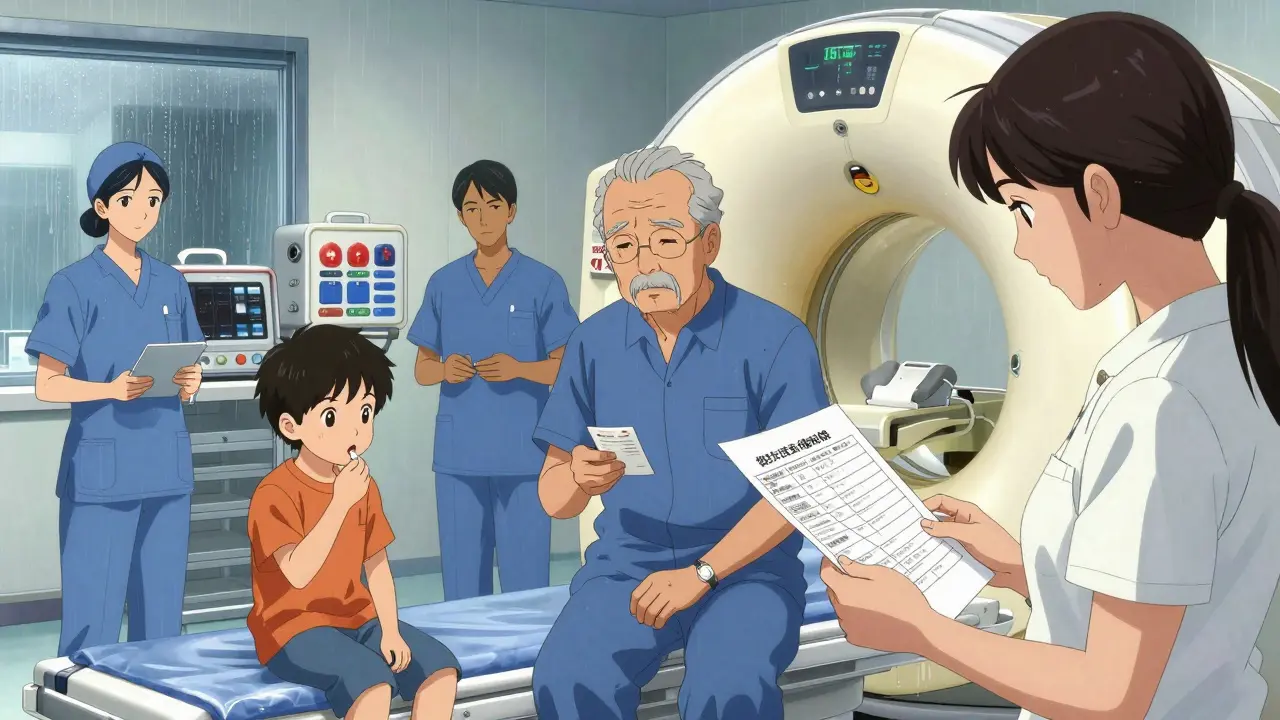
Premedication isn’t the whole story. How and where you get the scan matters just as much.Major hospitals require that anyone with a history of severe contrast reactions be scanned in a facility with immediate access to emergency care. That means a crash cart, trained staff, and rapid-response teams on standby. At UCSF, they only schedule these patients at Mount Zion, Moffitt-Long, or Mission Bay-places where help is right there.
And documentation? It’s strict. Your doctor must consult with a radiologist before scheduling. The radiologist needs to know your full history. If you’ve had a reaction before, your chart should say so clearly. No assumptions. No guesswork.
Even with all this, there’s still a 2% chance of a breakthrough reaction. That’s why no one treats premedication as a guarantee. It’s a shield-not a force field.
What If You’re Still Worried?
You have options. The best one? Switch the contrast dye. If you reacted to one brand, ask if you can use another. Studies show switching agents within the same class can reduce recurrence risk to under 5%. Sometimes, that’s all you need.Another option? Skip the dye altogether. In some cases, non-contrast CT scans or MRI can give you the same answers. Talk to your doctor. Ask if the scan is truly necessary. If it is, can you get it without contrast?
And remember: you’re not alone. Millions of people get contrast dye every year. Most have zero issues. But if you’ve had a reaction before, you’ve earned the right to ask questions. Push for a plan. Make sure your care team knows your history. Don’t let them rush you.
Cost, Accessibility, and Real-World Use
The cost of premedication is tiny. Prednisone 50 mg pills cost about 25 cents each. Benadryl is 15 cents a dose. Combined, it’s less than a dollar. Compared to a $1,000 CT scan? It’s negligible.But access isn’t equal. In big academic hospitals, 95% follow the ACR guidelines. In small community clinics? Only about 78% do. That’s a gap. If you’re getting scanned outside a major hospital, ask: Do you have a protocol for patients with contrast allergies? If they don’t know, that’s a red flag.
The Joint Commission requires all facilities to be ready for emergencies during contrast administration. That means crash carts, oxygen, and trained staff must be immediately available. If they’re not, the scan shouldn’t happen.
What’s Next?
The ACR is updating its guidelines. The next version, expected in late 2024, will likely put more emphasis on switching contrast agents instead of automatically reaching for steroids. That’s a shift. We’re moving away from blanket premedication toward smarter, personalized care.Future contrast dyes may be even safer. Newer formulations already have lower reaction rates than the ones used 20 years ago. Eventually, premedication might only be needed for a tiny fraction of patients.
For now, though, the rules are clear: Know your history. Tell your team. Follow the plan. And never assume your allergy is "just a mild one." Even mild can turn dangerous if you’re unprepared.
Can I have a CT scan with contrast if I’m allergic to shellfish?
Yes. Being allergic to shellfish doesn’t increase your risk for contrast dye reactions. The allergy is to proteins in shellfish, not iodine or the contrast chemical. Studies show people with shellfish allergies have only a slightly higher risk than the general public-far too low to warrant routine premedication.
How long before a CT scan should I take my premedication?
For the traditional oral plan, you take prednisone at 13, 7, and 1 hour before the scan, plus Benadryl at 1 hour. For urgent cases, a 5-hour plan (methylprednisolone at 5 and 1 hour before) works just as well. Never take it less than 4 hours before-timing matters.
Can I drive myself home after taking Benadryl for contrast premedication?
No. Benadryl causes drowsiness, dizziness, and slowed reaction times. You must have someone drive you. Many imaging centers will reschedule your appointment if you don’t have a ride.
Is premedication 100% effective at preventing reactions?
No. Even with full premedication, about 2% of high-risk patients still have a reaction. That’s why hospitals require emergency equipment and trained staff to be present during the scan. Premedication reduces risk-it doesn’t eliminate it.
What if I had a reaction years ago? Do I still need premedication?
Yes. Past reactions-even from 10 years ago-still count. Your immune system remembers. If you’ve had a reaction before, you’re still at higher risk. Don’t assume it’s "outgrown." Always disclose your history to your care team.
Can I take my own Benadryl before the scan?
Only if your radiology team approves it. They need to control the dose, timing, and route (oral vs. IV). Taking it on your own might delay the scan or interfere with their protocol. Always follow their instructions.
Do I need premedication for an MRI with contrast?
No. MRI contrast uses gadolinium, not iodine. Reactions to gadolinium are rare and unrelated to iodinated contrast reactions. Premedication for CT contrast does not apply to MRI.
What should I tell my doctor before scheduling a contrast scan?
Tell them exactly what happened during your previous reaction: symptoms, how severe, when it happened, and what contrast dye was used. If you don’t know the name, describe the reaction. This helps them choose the safest plan for you.

Kathy McDaniel
January 28, 2026 AT 09:08so i got my ct last month with contrast and they gave me benadryl and i was totally fine but like... i slept for 3 hours after and my husband had to drive me home lol. worth it though, i needed that scan.
Kirstin Santiago
January 29, 2026 AT 00:20really glad this got posted. i used to think shellfish allergies meant i couldn't get contrast until my radiologist sat me down and explained the science. it's not iodine, it's the molecule. life changed after that.
Harry Henderson
January 29, 2026 AT 20:04if your clinic doesn't have a protocol for contrast reactions, they're not ready to treat you. period. no excuses. you're not a guinea pig, you're a patient. demand the a cr guidelines or go elsewhere.
suhail ahmed
January 31, 2026 AT 00:04man, this is the kind of clarity i wish every doctor had. in india, they still tell people to avoid contrast if they ate shrimp once in 2010. it's like medical folklore passed down like grandma's curry recipe. time to update the manual.
Anjula Jyala
February 1, 2026 AT 05:15premedication is overrated. the real issue is poor training and lazy radiologists who dont bother to check history. if you react to contrast its because you were never properly assessed. stop relying on pills and start asking better questions
April Williams
February 2, 2026 AT 05:14they're lying about the 2% reaction rate. i had a reaction after premedication and the hospital covered it up. they told me it was 'anxiety' and refused to document it. if you've had one reaction, you're basically a walking bomb and no one wants to admit it.
Andrew Clausen
February 2, 2026 AT 09:45the 5-hour protocol was tested on a cohort of 127 patients in a single-center retrospective study. it is not equivalent to the 13-hour regimen in prospective randomized trials. the author is overstating the evidence. precision matters.
Desaundrea Morton-Pusey
February 4, 2026 AT 09:25why do we even use this stuff? america is obsessed with scans. just look at the cost. you're paying $1000 for a dye that might make you sick. why not just eat healthy and avoid needing scans in the first place? this is capitalism medicine.
Murphy Game
February 5, 2026 AT 17:47they're hiding something. why is benadryl the only antihistamine used? why not cetirizine for everyone? because big pharma owns the guidelines. the 2% reaction rate? that's the number they want you to see. the real number is higher and they bury it in footnotes.
John O'Brien
February 5, 2026 AT 23:33bro i had a reaction in 2018 and they just gave me more dye the next time like it was nothing. i was like nah, i'm switching hospitals. now i go to a big med center and they treat me like a human. if you've had a reaction, don't settle. fight for your safety.
Kegan Powell
February 7, 2026 AT 15:45we're all just trying to survive the system 😔 but this post? it's like a flashlight in a dark hallway. knowing the science, knowing your rights, knowing you don't have to be scared alone... that's power. thank you for writing this. you made someone feel seen today 💙
Candice Hartley
February 7, 2026 AT 23:57my kid got cetirizine before her ct and didn't even get sleepy. perfect. thanks for the tip!
astrid cook
February 9, 2026 AT 11:20why do they even bother with prednisone if benadryl is the only thing that matters? this whole system is a mess. someone needs to audit these protocols and shut down the ones that don't make sense
Paul Taylor
February 10, 2026 AT 14:27look i've been doing this for 20 years and the truth is no one really knows why some people react and others don't. the guidelines are based on best guesses and small studies. we're flying blind half the time. the fact that we have any protocol at all is better than what we had 15 years ago but don't treat this like a science. it's still more art than medicine
Conor Murphy
February 10, 2026 AT 20:35from ireland here - we use the 5-hour protocol in most hospitals now. no one uses the 13-hour unless it's elective and they're scheduling weeks ahead. benadryl still makes people zonked though. always bring a blanket and a book. and never, ever drive.