
Supplement-Drug Interaction Checker
Check Potential Interactions
Enter your supplements and medications to identify possible interactions. This tool uses common interaction data from medical guidelines.
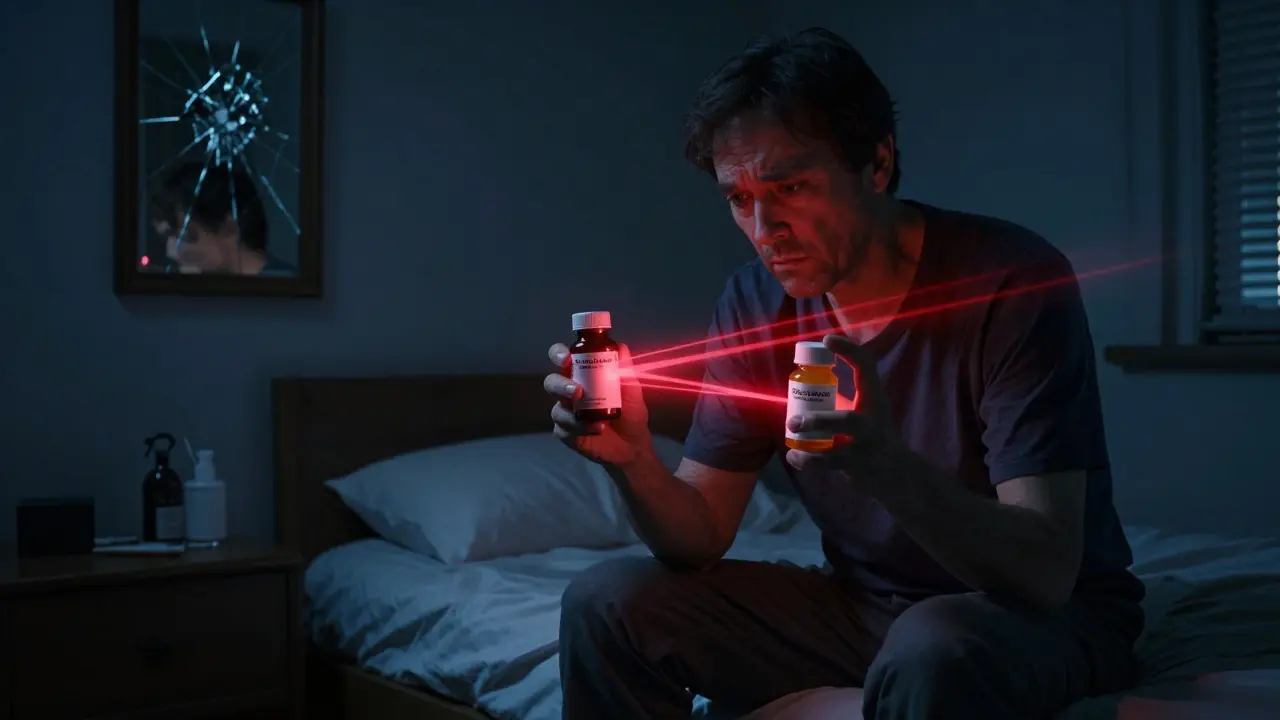
Every year, millions of people in the U.S. and around the world take dietary supplements-vitamins, herbs, fish oil, probiotics, or herbal extracts-thinking they’re harmless because they’re "natural." But here’s the truth: supplements aren’t harmless. They can interfere with your medications, worsen chronic conditions, or even cause dangerous side effects you never saw coming. And the biggest risk? Not the supplement itself-but the fact that you’re not telling your doctor about it.
Why Your Doctor Needs to Know What You’re Taking
Most people assume their doctor knows what they’re taking. They don’t. Research shows only about 33% of people who use herbal or dietary supplements tell their conventional healthcare provider. That’s a massive gap. Imagine your doctor prescribing you blood pressure medication, not knowing you’re also taking garlic extract or ginkgo biloba-both of which can thin your blood. The result? You could end up in the emergency room with internal bleeding. This isn’t rare. A 2015 study in JAMA found that dietary supplements send about 23,000 people to U.S. emergency rooms every year. And that’s just the ones that get reported.
The problem isn’t that supplements are dangerous by nature. It’s that they’re unregulated. Under the Dietary Supplement Health and Education Act (DSHEA) of 1994, supplement makers don’t need to prove safety or effectiveness before selling their products. The FDA can’t stop them from being sold unless they’ve already caused harm. That means a product labeled "St. John’s wort" might contain half the dose it claims-or a hidden drug like an antidepressant. And you’d never know.
The Hidden Dangers: Supplements That Interact With Common Medications
Some supplements are riskier than others. Here are the most common ones that cause serious problems when mixed with prescription drugs:
- St. John’s wort: Used for mild depression, it can cut the effectiveness of birth control pills, blood thinners, antidepressants, and even HIV medications. One study found it reduces the effectiveness of 57% of prescription drugs.
- Ginkgo biloba: Often taken for memory, it can increase bleeding risk when combined with warfarin, aspirin, or NSAIDs. There are documented cases of brain bleeds after people took ginkgo with blood thinners.
- Garlic supplements: Can enhance the effects of blood thinners and lower blood sugar too much in diabetics on insulin.
- Glucosamine/chondroitin: Often used for arthritis, it may interfere with blood thinners and affect blood sugar levels.
- Echinacea: Can alter how the liver processes medications, leading to toxic buildup or reduced drug effectiveness.
And here’s the kicker: most people don’t think these count as "medicine." They call them "natural remedies," "vitamins," or "herbal teas." But your body doesn’t care what you call them-it reacts the same way to a pill of St. John’s wort as it does to a pill of fluoxetine.
Why People Don’t Tell Their Doctors
It’s not because they’re hiding something. Most patients don’t disclose because:
- They assume their doctor doesn’t care.
- They’ve been dismissed before: "Oh, that’s just herbal stuff-it doesn’t matter."
- They think supplements are "safe" because they’re sold in stores.
- They’re embarrassed or afraid their doctor will judge them.
A 2022 survey found 68% of patients who mentioned supplements in reviews felt their providers didn’t take them seriously. One patient wrote: "I didn’t think my doctor needed to know about natural stuff." That mindset almost got her killed. She took ginkgo with warfarin. She had a major brain hemorrhage. She didn’t connect the two.

How to Talk to Your Care Team-Without Feeling Awkward
Doctors aren’t trained to ask about supplements. A 2023 study found medical students get just 2.7 hours of nutrition and supplement education during four years of school. So if you want to be safe, you have to take the lead.
Here’s how to do it right:
- Start with an open question: "I’ve been taking a few supplements to help with my health. I want to make sure they’re safe with my medications. What do you think?"
- Be specific: Don’t say "I take vitamins." Say: "I take 1,000 mg of vitamin D daily, 500 mg of magnesium, and two capsules of St. John’s wort for low mood."
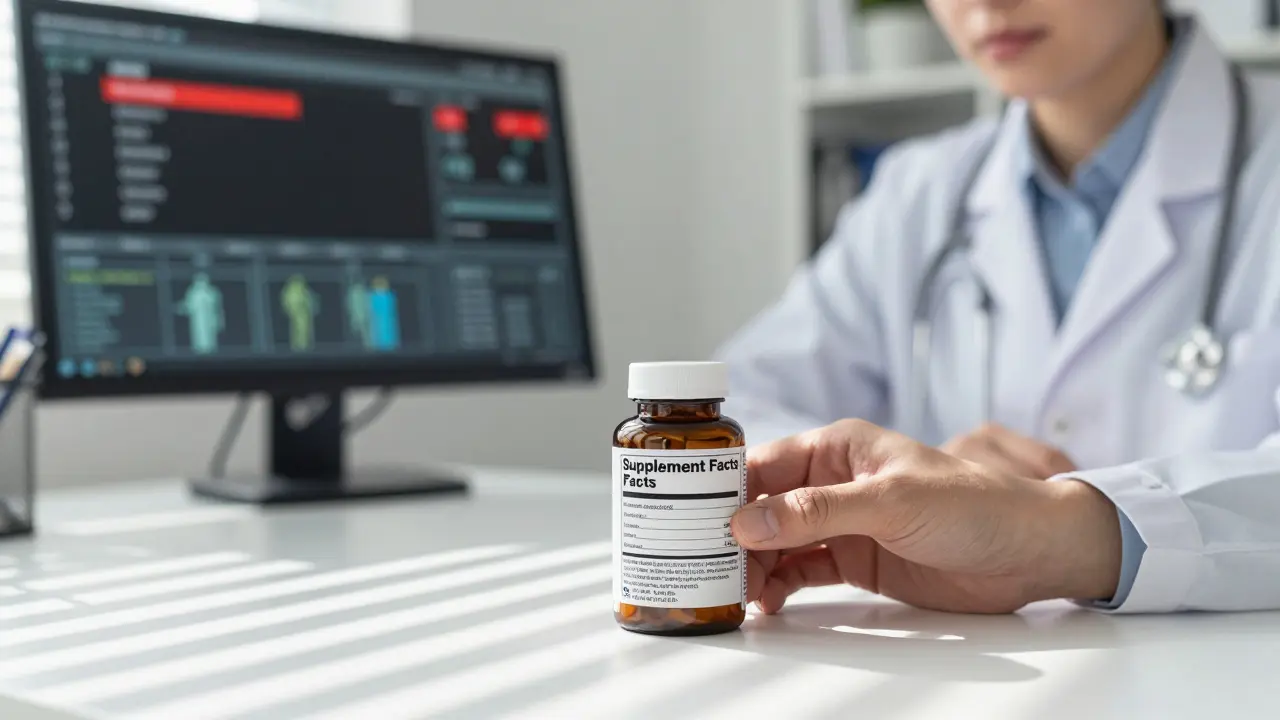
- Bring the bottle: Photos of the label aren’t enough. Bring the actual bottle or a clear picture of the Supplement Facts panel. That way, your doctor can see the exact ingredients and dosages.
- Ask directly: "Could any of these interact with my blood pressure meds or diabetes pills?"
One nurse practitioner in Texas changed her entire practice after realizing how few patients were disclosing. She started asking: "What supplements or vitamins are you taking that your pharmacist might not know about?" Disclosure rates in her clinic jumped from 30% to 62% in six months.
What Your Doctor Should Be Doing
Health systems are starting to wake up. As of January 2023, 87% of American hospitals now require supplement disclosure as part of admission paperwork. The FDA’s Dietary Supplement Ingredient Database (DSID-5), launched in January 2023, gives clinicians verified data on what’s actually in common supplements-something they didn’t have before.
Electronic health record systems like Epic are adding dedicated supplement modules for 2024. These will automatically flag interactions between your prescriptions and supplements. But none of this matters if you don’t tell them what you’re taking.
Doctors who ask directly, without judgment, get better results. A 2018 study showed disclosure rates jumped from 29% to 72% when providers asked: "Do you take any herbal supplements or vitamins?" instead of waiting for patients to bring it up.
What to Do Right Now
You don’t need to wait for your next appointment. Here’s what to do today:
- Look in your medicine cabinet. Find every bottle labeled "supplement," "herbal," or "natural."
- Write down the name, dosage, and how often you take it.
- Check the label for the Supplement Facts panel. Take a photo.
- Call your doctor’s office. Say: "I’d like to review my supplement use with you. Can we add it to my chart?"
It’s not about being perfect. It’s about being safe. Even if you’ve been taking the same supplement for years, your body changes. Your medications change. Your health changes. What was safe last year might not be safe today.
Supplements Aren’t the Enemy-Silence Is
Supplements can be helpful. Some people benefit from vitamin D, omega-3s, or magnesium. But they’re not harmless. They’re powerful. And they’re not monitored like drugs.
The real danger isn’t the supplement. It’s the assumption that your doctor already knows. It’s the belief that "natural" means "safe." It’s the fear of being judged for taking something that’s sold on a shelf next to cereal.
There’s no shame in taking supplements. There’s shame in hiding them. Your care team isn’t here to scold you. They’re here to keep you alive. And they can’t do that if they’re working in the dark.
Next time you see your doctor-whether it’s for a cold, a checkup, or a chronic condition-say it out loud: "I’m taking supplements. I want to make sure they’re safe with everything else."
That one sentence could save your life.
Do I need to tell my doctor about vitamins and minerals too?
Yes. Even common vitamins like vitamin D, vitamin K, or iron can interact with medications. For example, vitamin K can reduce the effectiveness of warfarin, a blood thinner. High-dose vitamin C can interfere with chemotherapy drugs. Your doctor needs to know the full picture-even if you think it’s "just a multivitamin."
Can my pharmacist help with supplement safety?
Pharmacists are trained to check for drug-supplement interactions and often have access to databases like Natural Medicine Database. But they don’t have your full medical history. Your doctor does. That’s why both need to know. Tell your pharmacist, but don’t assume they’ll tell your doctor. You’re the only one who can connect those dots.
What if my doctor says supplements are "just placebo"?
Some providers dismiss supplements because they lack strong evidence for certain claims. But that doesn’t mean they’re harmless. Even if a supplement doesn’t cure arthritis, it might still thin your blood or raise your liver enzymes. Your job isn’t to convince them it works-it’s to make sure it doesn’t hurt you. Say: "I’m not asking if it works. I’m asking if it’s safe with my other meds."
Are there supplements that are always safe?
No. Even water can be dangerous if you drink too much. Every substance your body processes has a potential effect. What’s safe for one person might be risky for another, depending on their medications, liver function, kidney health, or genetic factors. There’s no universal "safe" supplement.
How do I know if a supplement brand is trustworthy?
Look for third-party testing seals like USP, NSF International, or ConsumerLab. These organizations test for purity, potency, and contamination. But even these don’t guarantee safety with your medications. They only tell you what’s in the bottle-not how it reacts with your body. Always discuss supplements with your provider, regardless of the brand.
Natasha Rodríguez Lara
March 24, 2026 AT 10:16I used to think supplements were just "extra insurance" for my health-until I started taking St. John’s wort for anxiety and ended up with a weird rash and weirdly low blood pressure. My doctor had no idea I was taking it. Once I told her, she checked my meds and found it was messing with my beta-blocker. I felt dumb, but also relieved. Now I bring every bottle to every appointment. No shame in being safe.
Also-yes, even the multivitamin. I didn’t know vitamin K could mess with warfarin. Who knew?
Caroline Bonner
March 24, 2026 AT 23:24Okay, I just read this whole thing and I’m genuinely impressed-not because I’m surprised (I’ve been in the healthcare field for 18 years), but because this is one of the most balanced, clear, and urgently needed pieces I’ve seen in ages. Seriously. The fact that we’ve got people popping ginkgo biloba like it’s candy while on warfarin, and then acting shocked when they get a brain bleed? It’s not ignorance-it’s systemic. We don’t teach this in med school. We don’t train nurses. We don’t even have standardized intake forms that ask about supplements in a non-judgmental way. And yet, we act like it’s the patient’s fault for not knowing. I’ve had patients cry because they thought their herbal tea was "just tea," and their provider laughed. That’s not care. That’s negligence. We need mandatory supplement disclosure modules in EHRs. We need pharmacists to flag interactions at the point of sale. We need insurance companies to cover supplement consultations. And we need to stop calling them "natural" like that’s a free pass. They’re bioactive compounds. They’re not cereal.
Also-glucosamine? Yeah, it can mess with blood sugar. I’ve seen it. And people think it’s "harmless" because it’s from shells. It’s not. It’s a sugar derivative. I’m glad someone finally said this out loud.
peter vencken
March 26, 2026 AT 20:06bro i took garlic pills for "heart health" for 3 years and never told my doc. then i got a nosebleed that wouldn’t stop and ended up in the er. turns out it was interacting with my aspirin. i was like, "wait, garlic isn’t food?" lol. now i just eat real garlic. way less scary. also, my pharmacist asked me about supplements last time and i was like "uhhh i don’t even know what’s in that bottle" so i took a pic. he said 70% of people don’t know what’s in their own supplements. wild.
James Moreau
March 28, 2026 AT 17:37This is why I always say: if you’re going to take something that’s not FDA-approved, you’re taking a risk. Not because it’s evil-it’s because no one’s checking. I’m not anti-supplement. I take magnesium. But I tell my doctor. I bring the bottle. I ask: "Is this going to mess with my kidney meds?" That’s not paranoia. That’s responsibility.
J. Murphy
March 29, 2026 AT 23:46supplements are a scam. the whole industry is built on people being dumb. if you need vitamins, eat food. if you think ginkgo helps your memory, you’re delusional. also, doctors don’t care. they’re too busy with their 12-min appointments to care about your "herbal tea." stop making it a thing.
Jesse Hall
March 30, 2026 AT 06:56THIS. 🙌 I had a friend who took echinacea with her chemo. Her oncologist didn’t ask. She didn’t say. She got a severe liver reaction. She’s fine now, but it was terrifying. My rule? No supplement goes in my body without me saying "Hey, what do you think about this?" to my doc. It’s not awkward. It’s smart. 💯
Sean Bechtelheimer
March 30, 2026 AT 13:47the FDA is in on it. they let these supplements sell because they’re controlled by big pharma. think about it-why would they let you take something natural that fixes your depression if they can sell you an antidepressant? it’s all a lie. St. John’s wort? They banned it in 2017. They just don’t tell you. I’ve got receipts. You’re being manipulated.
Alex Arcilla
April 1, 2026 AT 06:14so let me get this straight-we’re supposed to bring our supplement bottles to the doctor like we’re at a grocery store audit? cool. also, why is it always the patient’s job to educate the doctor? shouldn’t they know this stuff? i’ve had docs say "oh, that’s just a herb" like i’m 5. i’m tired of being the one who has to say "this isn’t a smoothie, it’s a drug."
Brandon Shatley
April 2, 2026 AT 09:19i never thought about this. i take fish oil and vitamin d. i thought that was just... healthy. now i’m gonna check with my doc. also, i just realized i don’t even know what’s in my ginkgo bottle. oops.
Blessing Ogboso
April 2, 2026 AT 12:40As someone from Nigeria, I’ve seen this firsthand. In my community, we use herbal remedies daily-bitter leaf for blood pressure, neem for diabetes, moringa for energy. We don’t see them as "supplements." We see them as tradition. But when my cousin started taking bitter leaf with her blood thinner, she almost died. No one told the doctor because they thought it was "just tea." We need to bridge the gap between traditional healing and modern medicine-not erase one for the other. I’ve started teaching my family: "Tell your doctor what you’re using. Not because they know better, but because they can help you use it safely." We don’t have to choose between culture and safety. We can have both. Let’s talk. Let’s share. Let’s protect each other.
And yes, even the "harmless" ones. My grandma takes turmeric for her knees. She didn’t know it can thin blood. Now she brings the bottle to every visit. She says, "If I’m going to live to 100, I want to do it with my doctor on my side."
Kenneth Jones
April 4, 2026 AT 10:28stop coddling people. if you’re dumb enough to take supplements without knowing what they do, you deserve to get hurt. stop making this a victim story. it’s not the doctor’s job to babysit your herbal nonsense.
Darlene Gomez
April 5, 2026 AT 13:34Thank you for writing this. I’ve been a nurse for 15 years, and I’ve seen too many people get hurt because they didn’t speak up-and too many providers who didn’t ask. I start every intake now with: "What are you taking that your pharmacist doesn’t know about?" It’s not about judgment. It’s about connection. One patient told me she’d been taking ashwagandha for anxiety for 7 years. She didn’t say anything because she thought I’d laugh. I didn’t laugh. I said: "Let’s look at how this affects your thyroid meds." We changed her dose. She cried. Not from shame-from relief. We’re not here to police. We’re here to protect. And sometimes, protection starts with a simple sentence: "I take this. Is it safe?" That’s not weakness. That’s courage.
Katie Putbrese
April 6, 2026 AT 05:58AMERICA IS BECOMING A NATION OF WEAK, OVERMEDICATED COWARDS. You take a supplement? Fine. But don’t act like you’re some enlightened health guru. Eat real food. Stop buying into the wellness cult. Your body doesn’t need your $40 bottle of "adaptogenic mushroom powder." And if your doctor doesn’t know about it, good. That means you’re not falling for the scam. Stop giving these companies power.
Jacob Hessler
April 6, 2026 AT 22:40supplements are a scam. big pharma made them so people would stop taking real medicine. i stopped taking my blood pressure pill and switched to garlic. i felt great. until i passed out. now i take my pill. and i dont tell no one. lol