
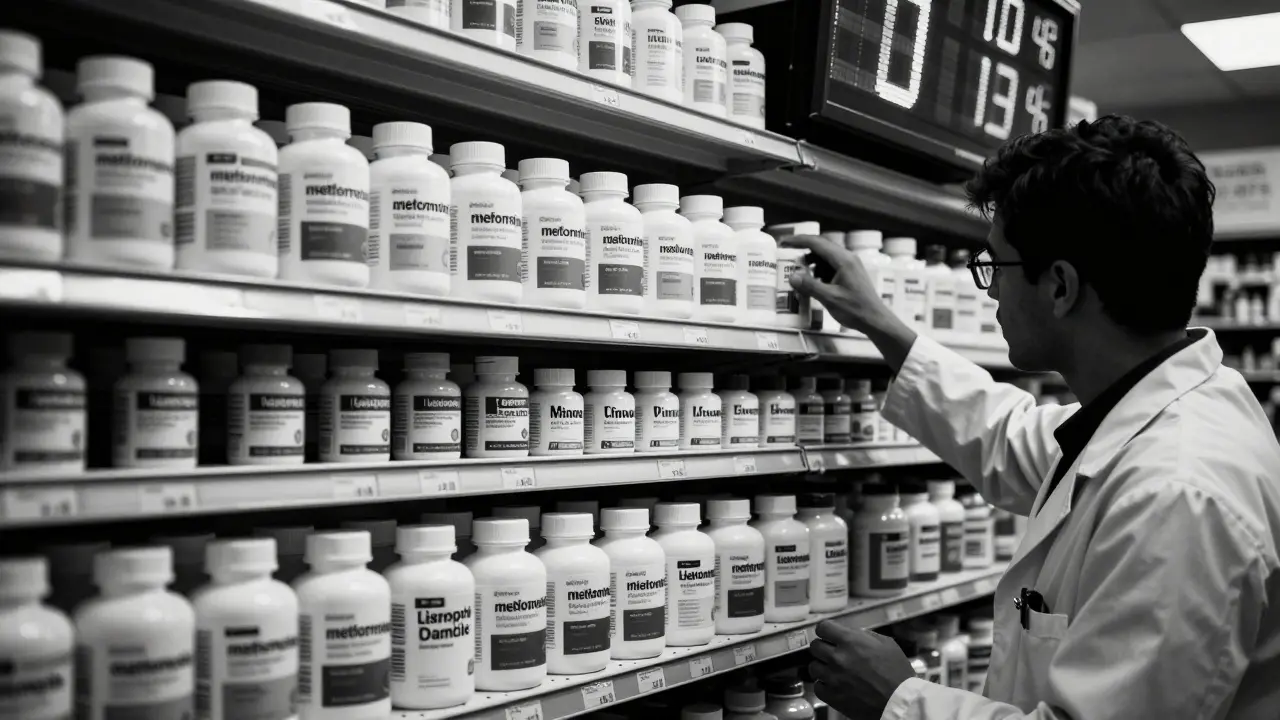
When you walk into a pharmacy and see a bottle of metformin for $4, or lisinopril for $5, you’re seeing the result of something powerful: generic drug competition. It’s not luck. It’s not charity. It’s a carefully engineered market force that buyers-governments, insurers, and healthcare systems-use to force drug prices down. And it works. When six companies make the same generic drug, prices drop by over 90%. With nine? Nearly 97%. That’s not a guess. That’s FDA data from real-world sales.
How Generic Drugs Drive Prices Down
Generic drugs aren’t cheaper because they’re worse. They’re cheaper because there are more of them. When a brand-name drug loses its patent, dozens of manufacturers can start making the same pill. No need to spend millions on clinical trials. No need to pay for TV ads. Just make it, sell it, and compete on price. The first generic might drop the price by 30%. The second? Another 40%. By the time you hit five or six makers, the brand-name drug is practically irrelevant. The numbers don’t lie. According to IQVIA, generic drugs make up 90% of all prescriptions filled in the U.S., but only 22% of total spending. That’s because competition keeps prices low. A 2019 study found that when nine companies sell the same generic, the average price falls to just 2.7% of the original brand price. That’s not inflation. That’s market discipline.How Buyers Use This Competition to Negotiate
Buyers don’t just wait for generics to show up. They use them as leverage. Think of it like shopping for a TV. If you know the same model is selling for $200 at Best Buy, you’re not going to pay $500 at another store. That’s exactly what Medicare and private insurers do with drugs. The Centers for Medicare & Medicaid Services (CMS) uses a method called therapeutic alternatives. If a brand-name drug like Humira has ten generic or biosimilar competitors, CMS doesn’t negotiate from the brand’s asking price. It starts with the average price of those cheaper alternatives. Then it works backward. The brand manufacturer has to justify why their drug should cost more-even if it’s slightly better clinically. And often, they can’t. This approach is baked into the Inflation Reduction Act of 2022. For the first time, the U.S. government can directly negotiate prices for certain high-cost drugs. But here’s the twist: CMS can’t negotiate with drugs that already have generic competition. Instead, it uses those generics as a price anchor. The presence of generics sets the floor. The brand has to meet it-or walk away.International Models: Canada, Europe, and Beyond
The U.S. isn’t the only one doing this. Canada has used a tiered pricing system since 2014. If only one company sells a drug, the government allows a higher price. But as more generics enter the market, the maximum allowed price drops. It’s a direct link between competition and price control. In Europe, countries like Germany and the UK use reference pricing. They pick the cheapest drug in a therapeutic class-the lowest-priced generic-and set that as the benchmark. If a brand or another generic costs more, the patient pays the difference out of pocket. That pushes manufacturers to compete on price, not marketing. Japan, by contrast, lags behind. Only 58% of prescriptions are filled with generics, partly because pricing rules don’t reward competition as aggressively. The result? Higher costs for patients and the system.
The Hidden Game: Patent Thickets and Reverse Payments
Generic competition isn’t always fair. Brand-name companies don’t give up easily. Between 2010 and 2020, the FTC found 106 cases where big pharma paid generic makers to delay entering the market. These are called reverse payments. The brand pays the generic to stay off the market-sometimes for years. That’s not competition. That’s collusion. Another tactic is product hopping. A company slightly changes a drug’s formula-maybe switches from a pill to a capsule-and gets a new patent. Then they stop making the old version. Patients are forced to switch, and generics can’t enter until the new patent expires. Between 2015 and 2020, there were 1,247 of these maneuvers, according to the FTC. These tactics are why the EPIC Act (Enhancing Generic and Incentivizing Competitive Drugs Act) is gaining support. It would delay Medicare’s price negotiations until after generics have had a chance to enter the market. That way, the government isn’t setting prices before competition even begins.Who Wins? Who Loses?
Patients win. Medicare beneficiaries are projected to save $6.8 billion annually just from the first 10 negotiated drugs. People on fixed incomes can finally afford their insulin, statins, and blood pressure meds. Generic manufacturers win too-when the system works. Companies like Teva, Sandoz, and Viatris thrive when there’s clear, predictable competition. But when the government sets a price before generics enter, it creates a problem. As Avalere Health found, if CMS sets a low price for a brand drug, generics can’t make money entering the market. Why spend $10 million to get FDA approval if you’re competing against a government-set price that’s already below your cost to produce? Big pharma loses. PhRMA, the industry’s main lobbying group, spent over $300 million in 2023 to fight Medicare negotiation. Their argument? It kills innovation. But the data says otherwise. The U.S. still leads the world in new drug approvals. Innovation isn’t dying-it’s being priced fairly.
What’s Next? Complex Generics and Biosimilars
Not all generics are the same. Simple pills like metformin are easy to copy. But complex drugs-injectables, inhalers, patches-are harder. They require specialized equipment and testing. That’s why their prices don’t drop as fast. Biosimilars, the generic version of biologic drugs (like Humira or Enbrel), face even bigger hurdles. They’re not exact copies-they’re highly similar. The FDA says they’re safe and effective, but they cost more to make. So far, biosimilars have only captured 45% of the market, compared to 90% for traditional generics. The next frontier is real-world evidence. Instead of just looking at lab results, regulators are starting to use data from actual patient outcomes. If a generic works just as well in the real world as the brand, it should cost less. By 2025, 73% of health agencies plan to use this data in pricing decisions.Why This Matters for Everyone
Generic competition isn’t just about saving money. It’s about access. It’s about dignity. It’s about not having to choose between medicine and rent. When competition works, prices fall naturally. No lobbying. No bureaucracy. Just more makers, lower prices. The system isn’t perfect. Patent abuse, reverse payments, and delayed entries still happen. But the tools to fix them exist. Canada’s tiered pricing. Europe’s reference pricing. CMS’s use of therapeutic alternatives. These aren’t radical ideas. They’re common sense. The real question isn’t whether we should use generic competition to lower prices. It’s why we waited this long.How do generic drugs lower drug prices so much?
Generic drugs lower prices because multiple manufacturers can produce the same medicine without repeating expensive clinical trials. Once a patent expires, competition kicks in. Each new generic maker lowers the price to win market share. Studies show that with six generic competitors, prices drop by 90.1%. With nine, they fall to 97.3% of the original brand price.
Does Medicare negotiate prices with generic drugs?
No, Medicare doesn’t negotiate prices for drugs that already have generic competitors. Instead, it uses the prices of those generics as a benchmark to set the starting price for brand-name drugs. This is called using ‘therapeutic alternatives.’ The presence of low-cost generics forces brand manufacturers to offer lower prices or risk losing coverage.
Why don’t all countries have low generic drug prices?
Countries with strong generic competition-like the U.S. and Canada-have rules that encourage multiple manufacturers to enter the market. In contrast, places like Japan have pricing systems that don’t reward competition as aggressively. Some countries also allow brand manufacturers to delay generics through patent tricks or by paying them to stay out of the market.
What are reverse payments in drug pricing?
Reverse payments happen when a brand-name drug company pays a generic manufacturer to delay launching its cheaper version. This keeps the brand’s monopoly alive longer. Between 2010 and 2020, the FTC documented 106 such deals. These are anti-competitive and illegal in many cases, but they still occur.
Can government price setting hurt generic drug makers?
Yes. If the government sets a low price for a brand-name drug before generics enter the market, it can make it impossible for generics to profit. Generic manufacturers spend millions to get FDA approval. If the market price is already set too low by the government, they can’t recover their costs. This is called a ‘chilling effect’-and it’s a major concern for industry analysts.
Are biosimilars as effective as generics at lowering prices?
Not yet. Biosimilars are the generic version of complex biologic drugs, like those used for arthritis or cancer. They’re harder and more expensive to make, so they don’t drop in price as quickly. While traditional generics capture 90% of the market, biosimilars have only reached about 45% market share. Their pricing power is growing, but it’s slower.
Jenny Salmingo
January 2, 2026 AT 10:39Just saw my grandma fill her metformin prescription for $3.50 last week. She said she used to cry over the cost before generics kicked in. No one should have to choose between food and medicine.
Frank SSS
January 3, 2026 AT 15:09Big Pharma’s got a whole playbook for screwing us: reverse payments, product hopping, patent thickets. It’s not capitalism-it’s cartel behavior with a lab coat. And yeah, I’m mad.
Paul Huppert
January 5, 2026 AT 10:40Really appreciate how this breaks down the mechanics. Never realized how much of a lever generics are for insurers. Makes sense now why my co-pay dropped last year.
Hanna Spittel
January 6, 2026 AT 03:12They’re lying to you. 🤡 The FDA is bought. Big Pharma owns the patents AND the regulators. You think $4 metformin is a win? Wait till you see the side effects they hide.
Brady K.
January 7, 2026 AT 04:41Let me get this straight-we let corporations patent life-saving molecules for 20 years, then act shocked when they fight tooth and nail to keep the gravy train running? This isn’t a market failure. It’s a moral failure.
Robb Rice
January 7, 2026 AT 17:38While I appreciate the data-driven approach, I must point out that the assumption that all generic manufacturers operate with equal efficiency is misleading. Some cut corners on excipients or stability testing, and the FDA’s post-market surveillance is underfunded. A 97% price drop doesn’t guarantee equivalent bioavailability across all brands.
That said, the core argument holds: competition drives prices down. But we need transparency in manufacturing audits-not just price caps.
Also, the EPIC Act is a step in the right direction, but it doesn’t address the issue of orphaned generics-drugs where only one manufacturer remains after others exit due to low margins. That’s a monopoly by default.
Kayla Kliphardt
January 8, 2026 AT 03:34I’ve been on lisinopril for 8 years. When it went generic, my bill went from $120 to $5. I don’t know how people don’t see this as a win.
anggit marga
January 8, 2026 AT 14:13USA thinks it’s so smart with generics but in Nigeria we just pay cash and get real medicine without insurance red tape. You overcomplicate everything with your laws and patents. We don’t need your system
Emma Hooper
January 8, 2026 AT 16:04Generic drugs are the unsung heroes of American healthcare. They’re the quiet rebels in white pill bottles, dismantling corporate greed one dosage at a time. I want a statue of a pharmacist holding a vial of metformin in Times Square.
Also, if you’re still paying full price for a generic, you’re being robbed. Go to Walmart. Go to Costco. They’re not hiding it-you just didn’t look.
Martin Viau
January 9, 2026 AT 11:41Reference pricing in Germany? Sure. But they also have price controls on R&D. That’s why their pharma innovation lags. You can’t have both cheap generics and breakthrough drugs. Pick one.
Urvi Patel
January 10, 2026 AT 10:26Of course generics work better in the US you Americans think your system is superior to everyone else's. In India we have generics for pennies because we don't worship patents like religion. Your system is a joke
John Chapman
January 12, 2026 AT 10:03Y’all are missing the point. The real win isn’t the $4 metformin-it’s that now, people can actually stick to their meds. No more skipping doses. No more ER visits from uncontrolled diabetes. That’s the real ROI.
Also, if you think big pharma isn’t lobbying to kill this, you’re sleeping. They spent $300M this year alone. Don’t get comfy.
Marilyn Ferrera
January 13, 2026 AT 09:29One thing no one mentions: the FDA’s ANDA backlog. It takes 2-3 years to approve a generic-sometimes longer. That’s not market competition; that’s bureaucratic delay. If we want true price drops, we need to fund the FDA to review applications faster. It’s not magic-it’s logistics.