
Medication Safety Risk Calculator
Assess Your Workplace Medication Risk
Enter your job details to see if your medications or work environment pose safety risks
When you’re on medication for a back injury, anxiety, or chronic pain, you might not think about how it affects your job. But for many workers-especially those in healthcare, construction, or manufacturing-what’s in your medicine cabinet could be a hidden workplace hazard. It’s not just about being drowsy. It’s about whether you can safely operate machinery, handle chemicals, or care for patients without putting yourself or others at risk.
Two Sides of the Same Problem
There are two major ways medications impact work safety, and they’re often confused. One is when workers take prescription drugs that change how their body and brain work. The other is when workers are exposed to dangerous drugs as part of their job-like nurses handling chemotherapy or pharmacists mixing toxic compounds. Both can lead to serious harm, but they need totally different solutions.For workers taking opioids or benzodiazepines, the risk is clear: these drugs slow reaction time, blur vision, and increase the chance of falls or mistakes. A 2017 study in the Journal of Occupational and Environmental Medicine found that workers using both opioids and benzodiazepines had an 84% higher risk of falling on the job. That’s not just a personal health issue-it’s a workplace safety crisis.
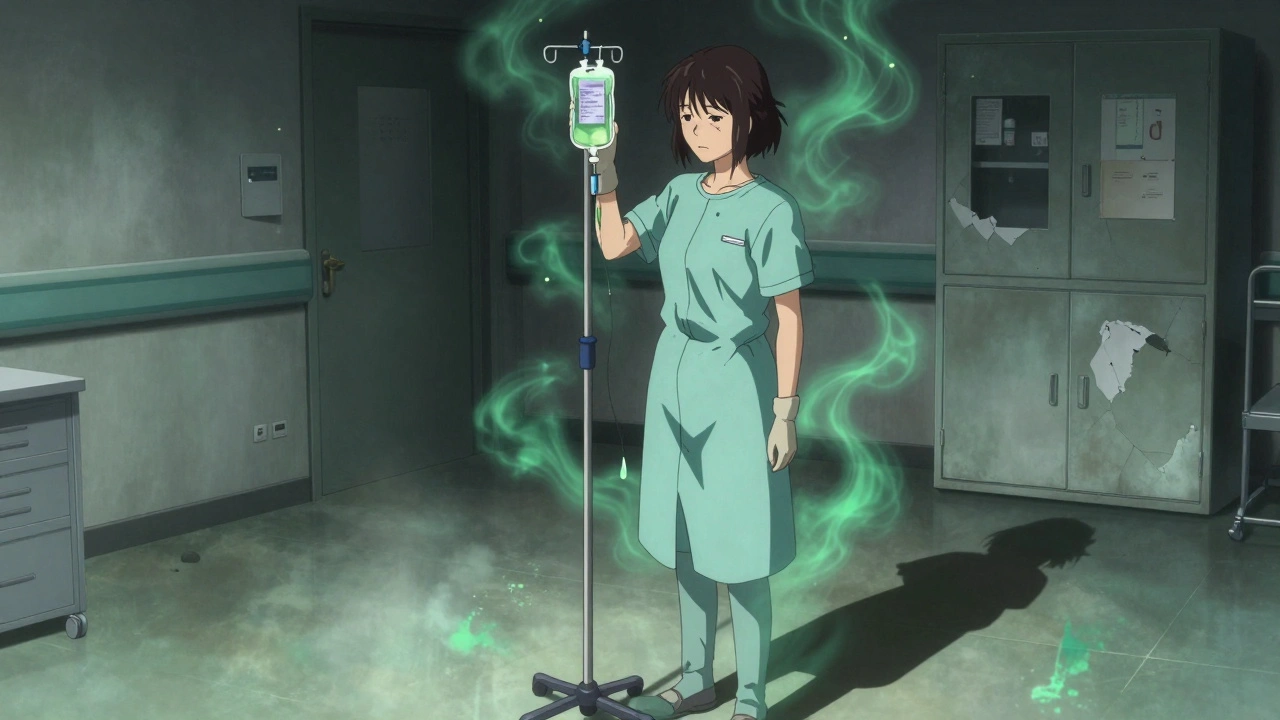
On the other side, healthcare workers are exposed to hazardous drugs every day. The 2024 NIOSH list includes 370 drugs classified as dangerous because they can cause cancer, birth defects, or organ damage-even at tiny doses. Antineoplastic agents (cancer drugs) make up the biggest chunk: 267 of them. Nurses, pharmacists, and lab techs who handle these drugs aren’t just wearing gloves-they’re breathing in invisible particles, touching contaminated surfaces, and sometimes getting splashed during IV prep.
How Exposure Happens (And Why It’s Worse Than You Think)
Most people assume if you follow the rules, you’re safe. But exposure to hazardous drugs doesn’t always come from spills or accidents. It’s often from routine tasks.According to WorkSafeBC’s 2022 analysis, here’s how exposure breaks down:
- 38% from inhaling vapors or aerosols during drug preparation
- 29% from skin or eye contact during spills or splashes
- 22% from touching contaminated surfaces like countertops or IV bags
- 7% from swallowing traces after poor hand hygiene
- 4% from needlestick injuries
That means even if you never see a spill, you’re still at risk. A 2023 Reddit post from a chemotherapy nurse described chronic skin rashes after three years on the job-even though she followed all protocols. Surface tests later showed detectable levels of drugs in 68% of work areas.
Chronic exposure doesn’t show up right away. But studies show healthcare workers exposed to hazardous drugs have 2.3 times the risk of reproductive problems like miscarriage or infertility. OSHA’s 2022 review found they’re also 3.4 times more likely to develop certain cancers over time.
What’s Being Done-and Where It Falls Short
There are rules in place, but they don’t cover everyone.OSHA’s Hazard Communication Standard (29 CFR 1910.1200) requires employers to label hazardous substances and train workers. But it only applies to about 6.2 million U.S. workplaces. That leaves 1.8 million healthcare workers in smaller clinics, private practices, and home care settings without protection.
The U.S. Pharmacopeial Convention’s General Chapter 800, which went into effect in 2019, sets stricter standards for handling hazardous drugs-but only in compounding pharmacies. That covers just 58,000 workers, while millions more in oncology units, ERs, and surgical centers are still operating under weaker guidelines.
Some places are doing better. Mayo Clinic cut hazardous drug exposures by 89% between 2018 and 2021 by installing closed-system transfer devices (CSTDs), upgrading ventilation, and adding mandatory training. CSTDs reduce surface contamination by 94.7%, according to WorkSafeBC’s 2021 tests. A pharmacy technician in Texas told WorkCompWire that after her facility adopted NIOSH’s 2024 guidelines, contamination dropped from 42% to just 4.7% in six months.
But not every hospital can afford $15,000 safety cabinets or hire full-time safety officers. Smaller facilities with fewer than 50 beds are half as likely to have a formal hazardous drug program as large hospitals, according to the American Hospital Association.

Prescription Drugs and Worker Performance
While healthcare workers worry about what’s on the surface, others worry about what’s in their bloodstream.NIOSH’s 2018 study found 18.7% of U.S. workers with musculoskeletal injuries are prescribed opioids. That’s nearly one in five. And 7.2% use benzodiazepines for anxiety or sleep issues. Both drugs impair judgment and motor control. Workers on these medications are 2.1 times more likely to suffer a workplace injury.
When opioids and benzodiazepines are taken together, the danger multiplies. Dr. Laura Welch told Congress in 2022 that this combination leads to 2.7 times higher disability rates and 38% higher annual healthcare costs per worker.
One anesthesiologist on Medscape shared a near-miss story: after being prescribed opioids for a work-related back injury, he felt dizzy and nauseous during surgery. He barely caught himself before knocking over an IV stand. He didn’t report it, fearing he’d be seen as unfit for duty.
That’s the hidden cost: silence. Workers don’t speak up because they fear losing their jobs. A 2021 editorial in the Journal of Occupational Rehabilitation found that 32% of workers on necessary medications were fired or pushed out-even when they showed no signs of impairment.
What Works: Real Solutions That Save Lives
The good news? Many risks are preventable.For hazardous drug exposure:
- Closed-system transfer devices (CSTDs) reduce contamination by over 90%
- Proper ventilation and negative-pressure rooms stop airborne particles
- NIOSH’s 5-step risk assessment (identify, evaluate, control, verify, document) is the gold standard
- Annual training of 4-8 hours keeps protocols fresh
For workers on prescription meds:
- Drug-free workplace policies that include medical exemptions reduce incidents by 42%
- Manager training on recognizing signs of impairment without stigma helps
- Alternative pain management like physical therapy or non-opioid meds reduces reliance on risky drugs
Unionized workers report 22% fewer medication-related incidents than non-unionized ones, according to AFL-CIO’s 2023 analysis. Why? Better safety culture, clearer reporting channels, and stronger protections against retaliation.

The Future Is Here-But Not Everywhere
New tools are emerging fast. Johns Hopkins Hospital is testing AI systems that predict high-exposure moments during drug prep with 92% accuracy. OSHA is expected to propose a surface contamination limit of 0.1 ng/cm² by late 2024-a first-of-its-kind standard.Meanwhile, the FDA now requires boxed warnings on 27 cancer drugs about occupational exposure risks. And NIOSH updated its 2024 list, removing liraglutide and pertuzumab after new data showed lower risks.
But progress is uneven. While 78% of large hospitals have full programs, only 34% of small clinics do. And 42% of new oncology drugs approved in 2023 still lack any occupational exposure limits.
The economic toll is huge: $4.7 billion a year in healthcare costs, lost productivity, and workers’ comp claims, according to the National Safety Council. That’s money spent because we waited too long to act.
What You Can Do Right Now
If you’re a worker:- Know your meds. Ask your doctor: “Could this affect my ability to do my job safely?”
- Report symptoms-dizziness, rashes, nausea-immediately. Don’t wait for a crisis.
- Know your rights. You can’t be fired for taking legally prescribed medication unless it directly impairs safety.
If you’re an employer:
- Use the NIOSH 2024 list to identify hazardous drugs in your workplace.
- Install CSTDs and improve ventilation in areas where drugs are handled.
- Train staff every year-not just once.
- Offer non-punitive reporting for medication-related concerns.
It’s not about suspicion. It’s about science. Medications can heal-or harm-depending on how we manage them. The data is clear. The tools exist. What’s missing is the will to use them.
Can I be fired for taking prescribed pain medication?
You cannot be fired solely for taking legally prescribed medication. However, if your job involves safety-sensitive tasks-like operating heavy machinery, driving, or handling hazardous drugs-and your medication impairs your ability to perform those duties safely, your employer may need to make accommodations or temporarily reassign you. The Americans with Disabilities Act (ADA) protects workers with medical conditions, but it doesn’t require employers to keep someone in a role if they pose a direct safety risk. The key is open communication: talk to your doctor and employer about alternatives or adjustments before problems arise.
What should I do if I notice unsafe handling of chemotherapy drugs at work?
First, document what you saw-dates, times, what happened, who was involved. Then report it to your supervisor or safety officer. If nothing changes, contact your union representative or file a complaint with OSHA. You have the right to a safe workplace under the Occupational Safety and Health Act. Anonymous reporting is allowed, and retaliation is illegal. Many workers report that speaking up leads to real improvements, especially when multiple staff raise the same concern.
Are over-the-counter drugs like ibuprofen a safety risk at work?
Generally, no. Common OTC pain relievers like ibuprofen or acetaminophen don’t impair cognitive or motor function at standard doses. However, some cold and allergy meds contain antihistamines or decongestants that can cause drowsiness or dizziness. Always read labels and check with your pharmacist if you’re unsure. If you’re working in a high-risk role-like construction, emergency response, or operating equipment-it’s smart to avoid any OTC drug that says “may cause drowsiness” on the label.
How often should hazardous drug handling training be repeated?
Initial training should be 16-24 hours, covering exposure routes, PPE use, spill response, and NIOSH guidelines. After that, annual refresher training of 4-8 hours is required under USP Chapter 800. Some facilities do quarterly drills for high-risk areas like oncology units. The goal isn’t just compliance-it’s muscle memory. Workers who train regularly are 60% less likely to have exposure incidents, according to CDC field studies.
What’s the difference between NIOSH and OSHA guidelines?
NIOSH is part of the CDC and makes science-based recommendations for preventing occupational hazards. Their 2024 List of Hazardous Drugs is the most current guide for identifying which drugs are dangerous. OSHA is the federal agency that enforces workplace safety laws. They set legally binding standards-like the Hazard Communication Standard-that require labeling, training, and exposure control. NIOSH tells you what’s risky; OSHA says how to protect against it. Many employers follow NIOSH’s recommendations even when OSHA doesn’t require it, because they’re more detailed and up-to-date.
Do home care workers face hazardous drug exposure risks?
Yes, and they’re often the most vulnerable. Home care workers who administer chemotherapy, inject medications, or clean up bodily fluids are at risk-but they rarely have access to safety cabinets, ventilation systems, or formal training. OSHA’s rules don’t cover most home care settings. The CDC estimates over 200,000 home health aides handle hazardous drugs without proper protections. Employers and agencies need to provide PPE, training, and exposure monitoring even in non-traditional settings. Workers should ask for safety supplies and report any symptoms like rashes or nausea immediately.
Myles White
December 7, 2025 AT 04:55It’s wild how many people don’t realize that the same drugs helping them sleep or manage pain could be silently sabotaging their job performance-especially if they’re operating machinery or handling chemicals. I’ve seen coworkers on opioids who swear they’re fine, but their reaction times are sluggish, and they’re making tiny errors that pile up. And the benzodiazepine combo? That’s a disaster waiting to happen. We need better screening, not just punitive policies. It’s not about distrust-it’s about data. The numbers don’t lie: 84% higher fall risk? That’s not a personal failure, it’s a systemic blind spot.
And on the flip side, the exposure risks for nurses and pharmacists? That’s even more insidious because it’s invisible. You don’t feel it, you don’t see it, but your skin’s absorbing it, your lungs are inhaling it. That nurse with the chronic rashes? She’s not overreacting. The contamination levels in 68% of workspaces? That’s not ‘bad luck’-that’s negligence masked as procedure. We need mandatory CSTDs everywhere, not just in fancy hospitals. This isn’t luxury-it’s basic occupational hygiene.
And why are we still talking about gloves like they’re enough? Gloves don’t stop aerosols. Ventilation systems don’t get upgraded because someone didn’t spill a vial. It’s always reactive, never preventive. We treat hazardous drug exposure like it’s a rare accident, when it’s actually routine. The fact that 1.8 million workers are outside OSHA’s reach? That’s a policy failure, not a logistical one. We have the tools. We just don’t have the will to use them universally.
And let’s not pretend OTC meds are harmless. Some people think ibuprofen is ‘safe’ so they double-dose before a shift. But add that to fatigue, dehydration, and stress? It’s a cocktail. We need pharmacists embedded in workplace safety teams, not just after the fact. This isn’t just about drugs-it’s about culture. We treat health like a personal issue, when it’s a collective responsibility.
I’ve worked in three hospitals. Two had full NIOSH compliance. One didn’t. The difference in morale, injury rates, and turnover was night and day. It’s not expensive to do right-it’s expensive to ignore.
And unions? They’re not the enemy. They’re the only thing keeping people from being fired for being honest about their meds. If you’re afraid to say you’re on painkillers because you’ll be sidelined, that’s not a medical issue-that’s a cultural one. We need to stop punishing people for needing help and start rewarding transparency.
It’s not about suspicion. It’s about science. And science says we’re failing. Hard.
Akash Takyar
December 9, 2025 AT 03:09Excellent breakdown-especially the part about CSTDs and ventilation. Many facilities still treat safety as an afterthought, not a core function. Training must be annual, not one-time; documentation must be rigorous, not checkbox-style. Accountability saves lives.
Also, employers must recognize: compliance isn’t optional. It’s ethical. And if you’re in a small clinic without resources, partner with regional health networks-share equipment, share training. No one should be left behind.
Priya Ranjan
December 9, 2025 AT 12:10Of course the system is broken. Everyone knows meds are dangerous, but no one wants to admit workers are vulnerable. They’d rather blame the employee for being ‘weak’ than fix the environment. Meanwhile, the pharmaceutical companies profit from both the pills and the safety gear. It’s all a money game.
And don’t get me started on how ‘non-punitive reporting’ is just a slogan. You think someone’s going to report dizziness after taking a prescription when HR already gave them the side-eye last month? Please. The system is rigged to silence people, not protect them.
joanne humphreys
December 10, 2025 AT 02:29I appreciate how this post lays out both sides-the worker taking meds and the worker handling them. It’s rare to see both perspectives treated with equal weight. I’ve worked in oncology and seen firsthand how easy it is to underestimate exposure. Even with gloves, even with training, the cumulative effect is real. I hope more clinics start using NIOSH’s 5-step process. It’s practical, not theoretical. And yes, small clinics need support-not blame.
Nigel ntini
December 10, 2025 AT 22:51Just wanted to say-this is the kind of post that should be mandatory reading for every manager in healthcare, construction, and manufacturing. Not because it’s scary, but because it’s solvable. We have the science. We have the tools. What we’re missing is leadership that prioritizes safety over savings. Let’s stop treating workers like disposable parts and start treating them like people who deserve to go home unharmed. Every. Single. Day.
Ibrahim Yakubu
December 12, 2025 AT 10:33You people are missing the real issue. This isn’t about drugs-it’s about control. The government, the pharmaceutical industry, and the hospitals? They’re all in bed together. They want you dependent on meds so you stay productive but docile. The ‘risks’ are exaggerated to scare you into accepting worse conditions. You think CSTDs are expensive? They’re a distraction. The real cost is your autonomy. They don’t want you healthy-they want you compliant.
Ashish Vazirani
December 13, 2025 AT 15:59India has been doing this right for decades-why are we still playing catch-up? In Mumbai hospitals, they use automated dispensing systems, mandatory bio-monitoring, and zero-tolerance for unsafe practices. No one’s allowed to take opioids on the job. Period. We don’t need fancy American studies-we need discipline. This ‘open communication’ nonsense? It’s weakness dressed as empathy. If your meds make you unsafe, you don’t get to work. Simple. No stigma. No excuses. Just safety.
Chris Park
December 14, 2025 AT 14:50Let’s be honest: 90% of these ‘hazardous drug exposure’ claims are fabricated by lawyers and activists pushing a narrative. Surface contamination? That’s lab-grade sensitivity. You’re measuring picograms on a counter and calling it a crisis. Meanwhile, real hazards-like falling ladders, faulty wiring, or distracted driving-are ignored because they’re too common to sell a story. And don’t get me started on the ‘opioid crisis’ being weaponized to strip workers of their prescriptions. You’re not protecting workers-you’re punishing them for being injured.
Dan Cole
December 16, 2025 AT 10:35There’s a deeper metaphysical layer here. Medication isn’t just a chemical intervention-it’s a negotiation between the self and the system. When you take a pill, you’re not just altering your biology; you’re surrendering agency to institutional logic. The workplace demands performance, but the body demands rest. The system offers drugs as a bridge-but never a way out. So we walk the bridge, blindfolded, while the walls close in. The real hazard isn’t the drug-it’s the silence we’re forced to keep. We don’t need more protocols. We need a new language-one that honors the fragility of the human body, not just the efficiency of the machine.
Saketh Sai Rachapudi
December 17, 2025 AT 04:06Why are we even talking about this? In India, we don't have time for this weak thinking. If you can't do your job because of meds, you're fired. No drama. No excuses. We don't coddle people. If you want to work hard, you take care of yourself. End of story. This post is just another American overreaction. We need discipline, not hand-holding.