
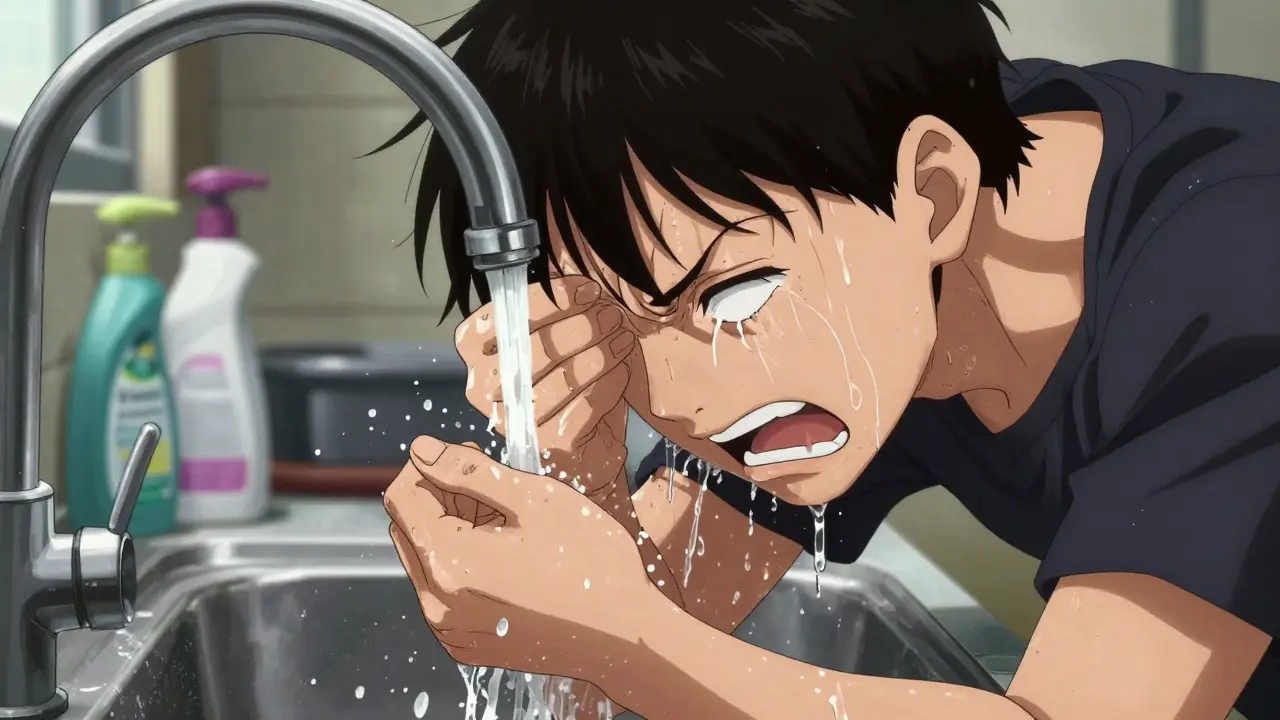
One second. That’s all it takes for a chemical splash to change your vision forever. A drop of drain cleaner, a burst of ammonia from a cleaning bottle, or even a stray mist from a battery acid container - these aren’t just accidents. They’re emergencies that demand instant action. And if you wait even a few seconds to rinse your eye, you could be risking permanent damage.
Why Timing Is Everything
Chemical splashes don’t just sting - they burn. Alkali chemicals like lye, bleach, or ammonia can eat through the cornea in under a minute. Acids like vinegar or battery acid may seem less scary, but they still cause serious harm. The key isn’t just getting water to your eye - it’s getting enough water, fast. Research shows that if you start flushing your eye within 10 seconds of exposure, your chance of avoiding permanent vision loss jumps by 76%. That’s not a guess. It’s from a 2017 meta-analysis in the British Journal of Ophthalmology. Every second counts. Delaying even 30 seconds can mean the difference between mild irritation and a corneal ulcer that requires surgery.What to Do Right Now: The 5-Step Protocol
If you or someone else gets a chemical splash in the eye, follow these steps exactly:- Don’t rub. Rubbing pushes the chemical deeper and scrapes the surface. It’s the most common mistake - 68% of victims do it.
- Start flushing immediately. Use cool tap water. No need for saline. Studies, including one from JAMA Ophthalmology, show tap water works just as well as sterile saline for the first critical minutes.
- Hold the eye open. Use your fingers to gently pull the upper and lower eyelids apart. Keep them open while water flows. If you’re helping someone else, hold their head steady and keep their eye open with your fingers.
- Flush for at least 20 minutes. Don’t stop after 5 or 10. Healthdirect Australia, the CDC, and the American Red Cross all agree: 20 minutes is the minimum for serious cases. Some experts say even longer if the chemical was strong. If you’re at work, use an eyewash station. At home, use the shower or sink. Keep the water flowing continuously.
- Position the head correctly. Tilt your head back and turn it toward the injured side. This keeps the chemical from washing into your good eye. Most guides skip this - but it’s critical.
If the person wears contact lenses, try to remove them while flushing - but only if you can do it without pressing on the eye. If the surface is already swollen or damaged, leave them in. The water will wash under them. Don’t waste time trying to pull them out if it’s painful or hard.
What Not to Do
People make the same mistakes over and over. Here’s what you must avoid:- Don’t use eye drops or ointments. They trap chemicals and delay flushing.
- Don’t cover the eye with a bandage or cloth. You need to keep flushing.
- Don’t wait for someone else to help. Act now - don’t call for help first. Call 911 or go to the ER after you’ve flushed for at least 10 minutes.
- Don’t assume it’s “just a little sting.” Even if it feels better after a few minutes, damage can be ongoing.
Workplace vs. Home: Different Rules, Same Urgency
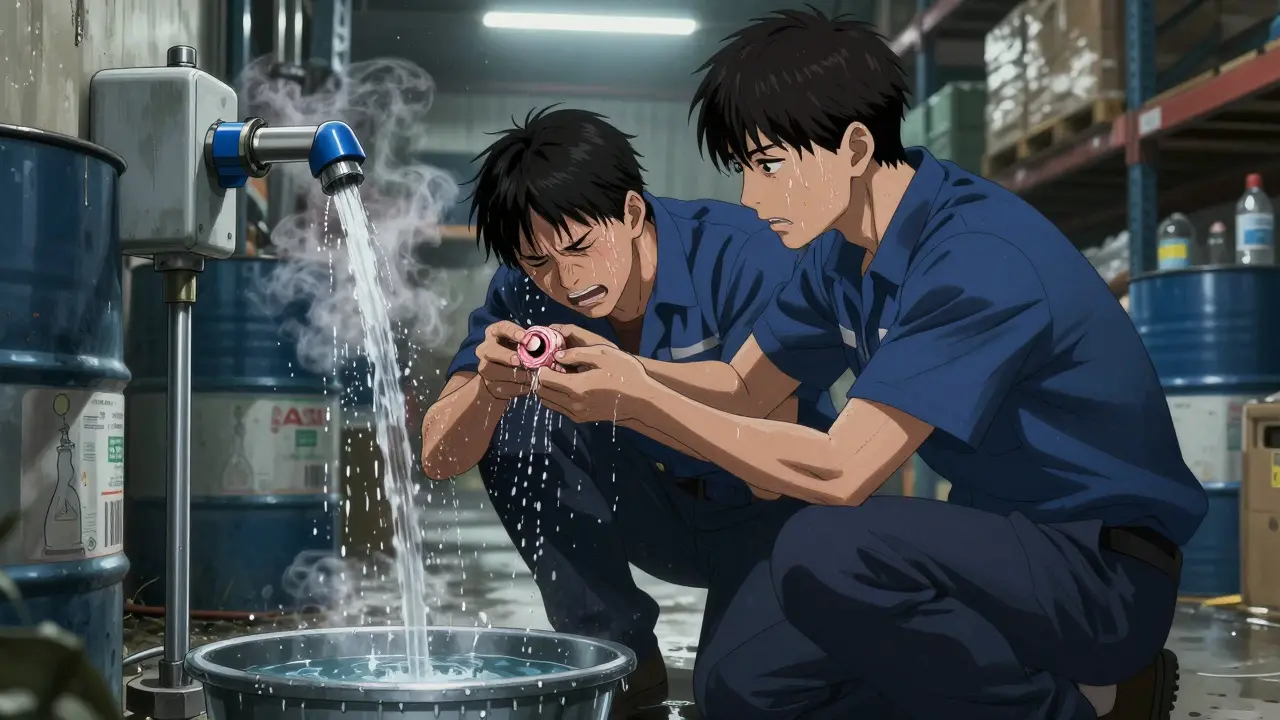
If this happens at work, ANSI Z358.1-2021 standards require eyewash stations to deliver tepid water (60-100°F) at 0.4 gallons per minute for at least 15 minutes. That’s not optional. Employers are legally required to have these stations within 10 seconds’ reach of any chemical hazard. Yet, OSHA found in 2023 that nearly 23% of workplaces with chemicals didn’t meet this standard. At home, you don’t have that luxury. But you don’t need fancy equipment. A kitchen sink with running water works. A shower works better. The goal isn’t perfection - it’s volume and duration. A 2022 CDC survey found that 78% of households had no emergency eyewash solution ready. That’s terrifying. Keep a bottle of saline or even just a clean jug of water near your cleaning supplies.The Real Cost of Waiting
Chemical eye injuries aren’t just painful - they’re expensive. In the U.S. alone, they cost employers $327 million a year in medical bills and lost work. The average workers’ comp claim? Over $14,000. And that’s just the start. Nearly 19% of people who suffer these injuries need a corneal transplant within five years. Each transplant costs over $27,000. But the biggest cost? Vision. Dr. Paul T. Finger, a leading ophthalmologist, says bluntly: “The single most important factor in determining visual outcome after chemical injury is the speed and duration of initial irrigation.” No surgery. No medicine. Just water - fast and long.What’s New in Treatment
There’s some progress. In 2022, the FDA approved a new solution called Diphoterine. It doesn’t just wash away chemicals - it binds to them and neutralizes them on contact. It cuts irrigation time by 40%. But it’s not available over the counter. You’ll only find it in hospitals or high-risk workplaces. Researchers are also testing citrate buffers - additives that can neutralize alkali chemicals better than plain water. And smart goggles with built-in pH sensors are in beta testing. They’ll flash a warning if they detect a chemical splash. But for now, none of that matters if you don’t flush immediately.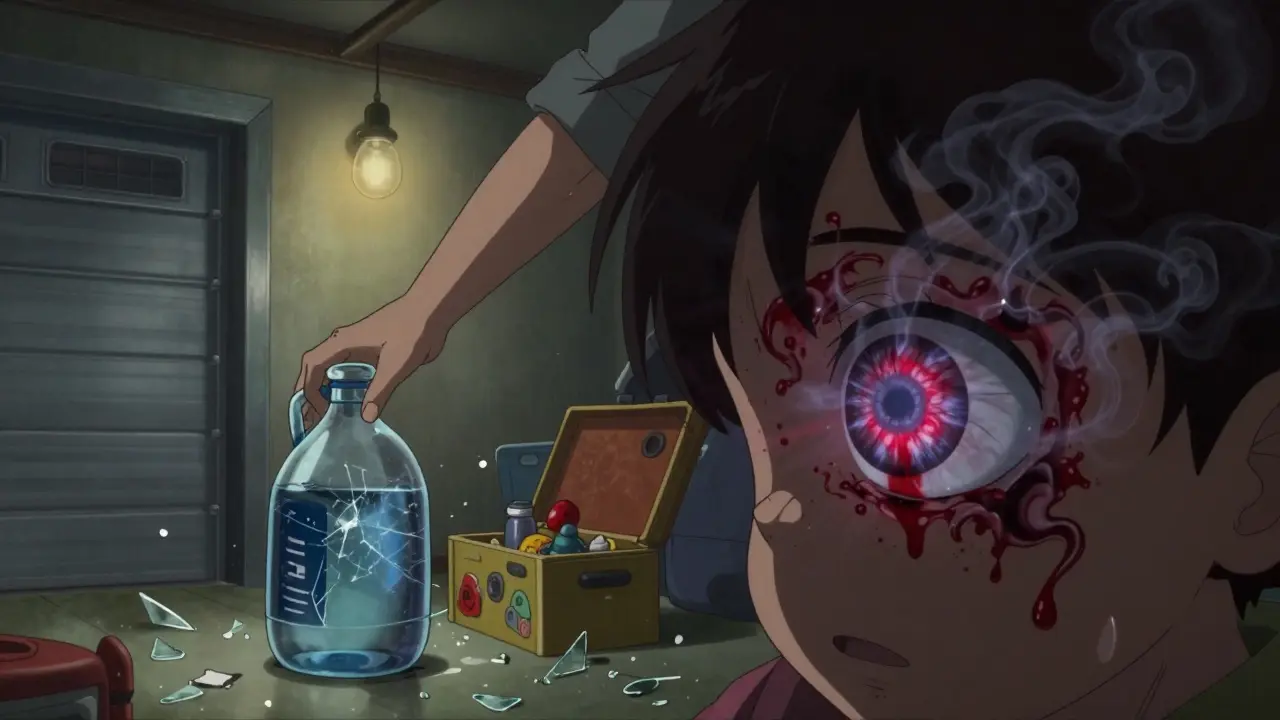
Training Makes the Difference
A 2022 study of over 1,200 workplace eye injuries found that only 44% of people started flushing within a minute. The average delay? Two minutes and 17 seconds. That’s too long. But here’s the good news: People who’ve had hands-on first aid training are 3.2 times more likely to do it right. That’s not a small gap. It’s life-changing. If you work with chemicals - even household cleaners - get trained. Take a Red Cross course. Watch a video. Practice with a friend. Know what to do before you need to.When to Go to the ER
Even after you’ve flushed for 20 minutes, you still need medical care. Don’t assume it’s fine because the burning stopped. Chemicals can keep damaging tissue for hours. Go to the ER or call an ophthalmologist immediately. Tell them exactly what chemical it was, how long you flushed, and whether you removed any contact lenses. Signs you need urgent care:- Blurry or lost vision
- Severe pain that doesn’t improve
- Redness that spreads
- Swelling or eyelids stuck shut
- Seeing flashes or floaters
These aren’t signs to wait on. They’re red flags.
Prevention Is the Only Real Cure
The best first aid is no first aid at all. Wear safety goggles when using bleach, drain cleaner, or any strong chemical. Keep cleaning products out of reach of kids. Label containers clearly. Don’t mix cleaners - ammonia and bleach create deadly fumes. If you’re a parent, check your home. Do you have a bottle of oven cleaner sitting on the counter? Is your child’s toy box near the garage where antifreeze or battery acid might be stored? Small changes prevent big disasters.Chemical eye injuries are rare - but they’re devastating. And they’re almost always preventable. The science is clear. The steps are simple. The clock starts the moment the splash happens. Don’t wait. Don’t hesitate. Flush. Now.
Can I use saline solution instead of tap water for chemical eye injuries?
Yes, you can use saline - but you don’t need to. Tap water works just as well for immediate first aid. A 2020 study in JAMA Ophthalmology found no advantage to using sterile saline over clean tap water in the first critical minutes. What matters is speed and volume, not the type of liquid. Don’t waste time searching for saline if water is right there.
How long should I flush my eye after a chemical splash?
Flush for at least 20 minutes. Some guidelines say 15 minutes, but Healthdirect Australia and the CDC recommend 20. For strong alkalis like lye or ammonia, longer is better. Don’t stop just because the burning feels better. Damage can continue under the surface. Keep flushing until you’re sure the chemical is gone - and then keep going for a few more minutes.
Should I remove my contact lenses after a chemical splash?
Try to remove them if you can do it safely without pressing on the eye. But if the eye is swollen, painful, or you can’t see well enough to handle them, leave them in. Water will flush underneath. Trying to remove them too aggressively can cause more damage. Once you’ve flushed for 20 minutes, a doctor can safely remove them.
Do I need to go to the hospital even if my eye feels fine after flushing?
Yes. Chemical damage doesn’t always show up right away. You might feel okay after 20 minutes of flushing, but the cornea could still be burning internally. Only an eye doctor can check for hidden damage using special tools. Delaying care increases the risk of scarring, infection, or permanent vision loss.
Are there any home remedies I can use for chemical eye injuries?
No. Don’t use milk, baking soda, vinegar, or any other home remedy. These can make things worse. The only thing that works in the first minutes is clean, cool, running water. Everything else - including eye drops, ointments, or rinses - should wait until you’ve seen a doctor.

Adam Gainski
January 8, 2026 AT 05:08Just ran through this whole thing while cleaning my garage last weekend. Had a bottle of drain cleaner slip and splash near my eye-didn’t hit it, but I froze for two seconds. That 76% stat? Yeah, it stuck with me. I grabbed the sink and flushed for 25 minutes straight, even though it felt fine after five. Better safe than blind. Thanks for the clear steps.
Christine Joy Chicano
January 8, 2026 AT 16:24Wow. This isn’t just advice-it’s a manifesto for survival. I’ve read a hundred first-aid guides, but none of them made me feel like I was holding a stopwatch against my own cornea. The part about tilting your head toward the injured side? That’s the kind of detail that separates ‘good’ from ‘life-saving.’ Someone should turn this into a viral TikTok. With subtitles. In ASL too.
Anastasia Novak
January 9, 2026 AT 00:13Oh please. Like anyone actually flushes for 20 minutes. You think people are gonna stand there like lab rats while their eye burns? Nah. They’re gonna scream, call 911, then sit on the floor crying while the chemical keeps eating through their sclera. This whole thing reads like a corporate compliance brochure written by someone who’s never been near a real emergency. And don’t get me started on ‘Diphoterine’-that’s just pharma’s way of selling you a $200 bottle of water.
Alex Danner
January 9, 2026 AT 05:50Correcting a common myth here: saline isn’t better than tap water. JAMA Ophthalmology 2020 study confirmed it. The problem isn’t the fluid-it’s the delay. People waste precious seconds hunting for saline bottles while their eye turns into a science experiment. Tap water is everywhere. Use it. Don’t overthink it. And for god’s sake, don’t rub. I’ve seen too many patients ruin their own corneas trying to ‘get it out.’
Elen Pihlap
January 9, 2026 AT 14:17you ever had a chemical burn? i did. it felt like my eyeball was melting. i cried for hours. no one helped me. i still can’t see right. why do people act like this is just another blog post? it’s not. it’s my nightmare. please just flush. please.
steve rumsford
January 9, 2026 AT 14:59so i tried the 20 minute flush thing last week after i spilled bleach on my glasses. didn’t even get it in my eye but i flushed anyway just to be safe. my roommate thought i was having a breakdown. i told her ‘this isn’t drama, this is survival.’ she laughed. then i showed her the CDC link. she’s now got a jug of water by her cleaning supplies. progress.
Andrew N
January 10, 2026 AT 23:57you say flush for 20 minutes but what if you’re in a car? or a forest? or your sink is broken? you’re just gonna die? this guide assumes you live in a perfect world with running water and no trauma. what about people who don’t have that? you’re not helping. you’re just making people feel guilty.
Poppy Newman
January 12, 2026 AT 07:39THIS IS SO IMPORTANT 💔 I just shared this with my entire family. My dad uses oven cleaner every weekend and never wears goggles. I’m putting a sign on the cabinet now. Also, I bought a cheap travel eyewash bottle for my car. 🚗💧 #EyeSafety #DontWait
Vince Nairn
January 12, 2026 AT 10:52so you’re telling me the solution to a chemical eye injury is… water? and the real villain is procrastination? shocking. who knew the most powerful medicine in the world was something you get for free from your kitchen faucet? next you’ll tell me oxygen is good for lungs.
Kyle King
January 14, 2026 AT 06:21fake news. this is all a ploy to sell eyewash stations. the real reason they want you to flush for 20 minutes is so you don’t sue the company. they know if you wait 30 seconds you’ll be blind so they make you think you’re doing the right thing by standing there for 20 minutes. meanwhile the chemical is still in your eye. they don’t want you to know that. they want you to think you’re safe. trust no one.
Kamlesh Chauhan
January 15, 2026 AT 06:20why you write so long i dont read all this. just flush eye and go hospital. done. why you make it so complicated. in india we just rinse with water and drink chai. problem solved
Rachel Steward
January 16, 2026 AT 18:03Let’s be honest-this entire protocol is just a glorified placebo effect wrapped in medical jargon. You flush for 20 minutes, feel better, and assume the damage is gone. But what if the chemical has already bound to your corneal proteins? What if the pH has already triggered apoptosis? Water doesn’t reverse cellular necrosis. It just delays the inevitable. The real solution isn’t flushing-it’s systemic alkali neutralization. And no, Diphoterine isn’t the answer either. We need targeted molecular scavengers. But you? You’re still standing there with a faucet, believing you’re a hero.
Sai Ganesh
January 18, 2026 AT 05:28In India, we teach this in schools. My grandfather was a factory worker. He always said: ‘Water first, god next.’ No fancy gadgets. No expensive solutions. Just clean water, fast. I still keep a bucket by my cleaning supplies. Simple. Effective. Human. This post? It’s just putting words to something we’ve known for generations.