

More than one in four adults worldwide has fat building up in their liver - and most have no idea. This isn’t caused by drinking. It’s called nonalcoholic fatty liver disease, or now, MASLD - metabolic dysfunction-associated steatotic liver disease. The name changed in 2023 because doctors realized it’s not just about avoiding alcohol. It’s about how your body handles sugar, fat, and insulin. Left unchecked, this silent condition can lead to scarring, liver failure, or even cancer. The good news? It’s one of the few chronic liver diseases you can reverse - if you catch it early.
What exactly is MASLD (formerly NAFLD)?
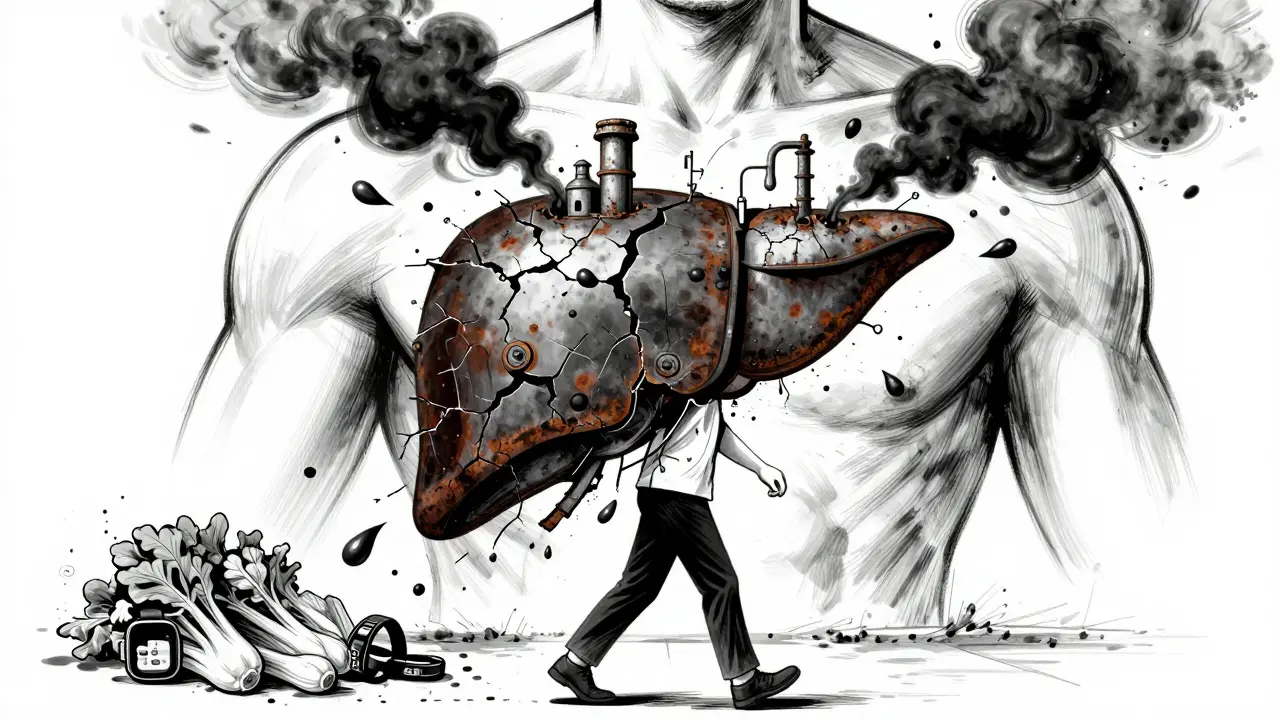
MASLD means too much fat is stored in liver cells - at least 5% of them. It’s not caused by heavy drinking, medications, or viruses. Instead, it’s tied to your metabolism. Think of your liver as a factory. When it’s overloaded with sugar and fat from your diet, it starts storing them instead of processing them. Over time, that buildup turns into inflammation. When inflammation kicks in, it becomes MASH - metabolic dysfunction-associated steatohepatitis - the more serious stage that can scar your liver.
What used to be called NAFLD (nonalcoholic fatty liver disease) is now MASLD because the focus shifted from what you’re not doing (drinking) to what you are doing - having metabolic issues. That includes carrying extra weight around your middle, having high blood sugar, or struggling with cholesterol. These aren’t just separate problems. They’re all parts of the same engine driving liver damage.
Who’s at risk? The hidden signs
You might think only obese people get this. But it’s sneakier than that. About 30-40% of U.S. adults have MASLD. Among people with type 2 diabetes, that number jumps to 70-90%. Even kids aren’t safe - 70% of obese children show signs of fatty liver. And while Hispanics have the highest rates (45%), it’s growing fast across all groups.
Here’s the problem: most people feel fine. Only about 1 in 5 report tiredness or mild discomfort under the right ribs. Blood tests might show slightly elevated liver enzymes - ALT above 30 for women, 40 for men - but doctors often dismiss it as "nothing serious." That’s why the average person waits over three years before getting a real diagnosis.
The real danger comes later. Around 15-25% of people with MASH will develop cirrhosis within 10 years. That’s when the liver turns hard and scarred, losing its ability to clean toxins, make proteins, or store energy. At that point, liver transplant becomes the only option. In fact, MASLD now causes 24% of all liver transplants in the U.S. - up from just 5% in 2000.
The metabolic trap: Why it happens
MASLD doesn’t just happen because you ate too many donuts. It’s a chain reaction. When you eat too much refined sugar and carbs, your body turns it into fat. Your liver gets overwhelmed. Insulin - the hormone that tells cells to take in sugar - stops working properly. This is called insulin resistance. Your pancreas pumps out more insulin to compensate, but your liver keeps making fat anyway. High triglycerides, high blood pressure, and belly fat all feed into this cycle.
Studies show 90% of people with MASLD have insulin resistance. Sixty percent have triglycerides over 150 mg/dL. Half have high blood pressure. These aren’t random. They’re your body screaming that your metabolism is stuck. And your liver is the first organ to pay the price.
Even people who aren’t overweight can get it. Some have a genetic tendency to store fat in the liver. Others have poor gut health or sleep apnea. That’s why the new MASLD definition requires at least one of 10 metabolic risk factors - not just obesity. It’s a systemic issue, not a liver issue.
How to prevent it - and reverse it
The best part? MASLD is reversible - at least in its early stages. A 5-7% drop in body weight can clear fat from the liver in over 80% of people. Lose 10%, and nearly half will see inflammation and scarring improve.
Here’s what actually works, backed by real studies:
- Weight loss: Target 7% of your body weight. That’s 14 pounds if you weigh 200. Don’t aim for drastic diets. Slow, steady loss works better long-term.
- Move more: 150 minutes a week of brisk walking - or 30 minutes five days a week - cuts liver fat by 30% in six months. You don’t need a gym. Just keep moving.
- Eat smarter: Focus on whole foods. Swap white bread, soda, and candy for vegetables, beans, whole grains, fish, and nuts. The Mediterranean diet has the strongest evidence - it reduces liver fat and inflammation.
- Drop sugary drinks: One soda a day increases your risk by 50%. Even diet sodas may worsen insulin resistance.
- Control blood sugar: If you have prediabetes or diabetes, managing it is the #1 thing you can do for your liver.
One patient on Reddit shared that after 12 months of daily 30-minute walks and an 8% weight loss, their FibroScan score - a non-invasive liver test - dropped from 9.8 to 5.2 kPa. That’s a huge improvement.
What doesn’t work
There’s no magic pill. No supplement has been proven to reverse MASLD. And while some weight-loss drugs show promise in trials, they’re not approved for this use yet. The only FDA-approved treatment, resmetirom, was approved in March 2024 - but it’s only for adults with MASH and advanced fibrosis. It’s not a cure, and it’s not for everyone.
Also, don’t rely on liver cleanses, herbal teas, or detoxes. They don’t touch the root cause. And while some people think cutting out all fat helps, that’s wrong. Healthy fats - like olive oil, avocado, and fatty fish - actually improve insulin sensitivity.
Exercise alone won’t fix it if your diet stays the same. And diet alone won’t fix it if you’re still sitting most of the day. You need both.
Getting tested - and staying on track
If you have belly fat, high blood pressure, or prediabetes, ask your doctor for a simple blood test: ALT and AST levels. If they’re elevated, ask about a FibroScan. It’s painless, non-invasive, and measures liver stiffness - a sign of scarring. Some insurance plans still won’t cover it, but AASLD recommends it for anyone with metabolic risk factors.
Track your progress. Weigh yourself weekly. Measure your waist monthly. Keep a food log for a few days every month. You don’t need perfection. You need consistency. Studies show people who stick with lifestyle changes for 12 months cut their risk of disease progression by two-thirds.
The bigger picture
MASLD isn’t just a liver problem. It’s a warning sign. People with this condition have a higher risk of heart disease, stroke, and kidney disease. Treating your liver means treating your whole body. That’s why the American Association for the Study of Liver Diseases calls it a multisystem disorder.
Workplaces are starting to notice. IBM’s employee wellness program reduced NAFLD cases by 37% over three years by offering personalized nutrition coaching and gym access. That’s proof that prevention works - when it’s supported.
The future is looking better. By 2025, new blood tests could replace biopsies for detecting advanced scarring. They’re already 89% accurate. But until then, the tools we have are simple: food, movement, and time.
It’s not about willpower. It’s about building habits that protect your liver - and your life.
Can you reverse fatty liver without losing weight?
It’s very unlikely. Studies show that even small weight loss - around 5-7% of body weight - is needed to reduce liver fat. People who don’t lose weight rarely see improvement in liver enzymes or fat buildup. Exercise helps, but without a calorie deficit, fat in the liver doesn’t go away. The good news? You don’t need to lose 50 pounds. Losing 10-15 pounds can make a big difference.
Is MASLD the same as NAFLD?
MASLD is the updated name for what was once called NAFLD. The change happened in June 2023 to reflect that the disease is driven by metabolic problems - like insulin resistance and belly fat - not just the absence of alcohol. The new name helps doctors focus on treating the root cause, not just avoiding drinking. The underlying condition is the same, but the understanding is better.
Do I need a liver biopsy to diagnose MASLD?
No, not usually. Liver biopsy is the gold standard but it’s invasive and carries small risks. Most doctors start with blood tests and imaging like FibroScan or ultrasound. FibroScan measures liver stiffness and fat content without needles. It’s accurate enough for most cases. Biopsies are only needed if the results are unclear or if advanced scarring is suspected.
Can children get MASLD?
Yes, and it’s growing fast. About 1 in 10 children in the U.S. have fatty liver, and nearly 7 in 10 obese children do. It’s often linked to sugary drinks, processed snacks, and lack of activity. The good news? Kids’ livers respond better to lifestyle changes than adults’. Weight loss, more movement, and cutting out soda can reverse it in many cases.
Is alcohol allowed if you have MASLD?
The safest answer is no. While some European guidelines allow small amounts (like one drink a day), the American Association for the Study of Liver Diseases recommends complete abstinence. Even moderate alcohol can speed up liver damage in people with MASLD. Since the liver is already under stress, adding alcohol increases the risk of scarring and cancer. Better to avoid it entirely.

William Minks
March 5, 2026 AT 23:39Just wanted to say this post hit different 🥹 I’ve been dealing with prediabetes for years and never connected it to my liver. My ALT was always "a little high" - docs just shrugged. Now I’m cutting out soda, walking after dinner, and eating more veggies. No magic pill, just small stuff. It’s working. 💪
Susan Purney Mark
March 7, 2026 AT 19:57This is such an important read. So many people think if they’re not obese, they’re fine. But I’ve seen it in my clinic - thin people with fatty livers because of sugar and stress. The metabolic piece is everything. Thank you for laying it out clearly. 🌿
Amina Aminkhuslen
March 8, 2026 AT 06:46Oh honey, you’re telling me the same thing I’ve been screaming into the void for five years. That ‘liver cleanse’ tea you bought last month? Yeah, that’s just fancy sugar water with a pretty label. Your liver doesn’t need detoxing - it needs you to stop feeding it liquid candy. 🍕🥤
Aaron Pace
March 9, 2026 AT 13:27Wait wait wait - so diet soda is bad too?? 😱 I’ve been drinking 3 a day thinking I was being healthy. Are you saying my Zero Coke is secretly killing my liver??
William Minks
March 10, 2026 AT 02:13Yeah. Studies show artificial sweeteners mess with your gut microbiome and insulin response. It’s not just calories - it’s signaling. Your body thinks it’s getting sugar, panics, and starts storing fat anyway. Swap it for sparkling water + lime. Trust me, you won’t miss it. 🍋
amber carrillo
March 12, 2026 AT 00:36Thank you for sharing this. I’ve been researching MASLD since my father was diagnosed. The shift from NAFLD to MASLD is crucial - it changes how we treat it. Prevention through lifestyle is far more effective than waiting for medication.
Adebayo Muhammad
March 12, 2026 AT 06:20Let us not forget: the liver is not a moral agent. It does not judge your choices. It metabolizes. It stores. It endures. The real tragedy is not the fat accumulation - but the societal refusal to acknowledge that metabolic dysfunction is a systemic failure of food policy, not personal failure. You cannot willpower your way out of a system designed to overfeed you. 🌍
Ferdinand Aton
March 13, 2026 AT 07:07Wait - so you’re saying exercise alone doesn’t fix it? But I’ve been doing 10K steps a day and still have high liver enzymes. What’s the point then?
Jeff Mirisola
March 15, 2026 AT 00:30It’s not about ‘fixing’ - it’s about reducing the burden. Exercise reduces inflammation, improves insulin sensitivity, and helps you sleep better. All of that helps the liver heal. You don’t need to lose 20 pounds to see improvement. Just keep moving - and cut the juice. It’s a team effort. 💪
phyllis bourassa
March 16, 2026 AT 12:06Ugh. I’m 38, not overweight, eat ‘clean,’ and still have fatty liver. Turns out my ‘clean’ diet was just organic granola and almond milk lattes - all sugar. My doctor said, ‘You’re not eating food. You’re eating marketing.’ I cried. Then I started cooking. Now I’m down 8% and my FibroScan improved. Don’t let anyone tell you it’s not possible. 💔➡️💪