

Preterm Medication Risk Estimator
Patient Profile & Factors
Risk Assessment Result
Clinical Insight:
Based on the inputs provided.
Imagine a baby born at just 26 weeks. Their lungs are barely developed, their skin is translucent, and their brain is still forming critical connections. Now imagine that this tiny patient needs pain relief after a procedure. You give them a standard dose of morphine. It sounds routine, but for a preterm infant, it’s a gamble. Their liver can’t process the drug like an adult’s, and their kidneys haven’t finished maturing. The result? The medication stays in their system longer, potentially causing breathing issues or long-term neurodevelopmental problems.
This isn’t a hypothetical scenario. It’s daily life in the Neonatal Intensive Care Unit (NICU). Preterm infants, defined as those born before 37 weeks’ gestation, represent one of the most vulnerable populations in medicine. They require specialized pharmacological management because their immature organ systems handle drugs very differently than older children or adults. If you’re a parent, a nurse, or a pharmacist working with these little ones, understanding these differences isn’t just academic-it’s a matter of safety.
The Unique Pharmacokinetics of Preterm Infants
To understand why medications behave so unpredictably in preemies, we have to look at pharmacokinetics-the way the body absorbs, distributes, metabolizes, and excretes drugs. In a full-term newborn, these processes are already functioning, albeit not fully mature. In a preterm infant, especially those born before 28 weeks, these systems are still under construction.
Absorption is the first hurdle. Preterm infants often have reduced gastric motility and higher stomach pH levels. This means oral medications might not be absorbed consistently. If a baby is receiving enteral feeds through a tube, the timing of the medication relative to feeding can drastically change how much drug enters the bloodstream.
Distribution is equally tricky. Preterm infants have a higher percentage of total body water-up to 85% compared to 60-70% in adults. Water-soluble drugs, like many antibiotics, spread out more widely in their bodies. This increases the volume of distribution (Vd). For example, research from the University of Florida noted that conditions like patent ductus arteriosus (PDA) can increase Vd by up to 80%. A study by Williams et al. found Vd values of 0.8 L/kg in neonates with PDA versus 0.45 L/kg in controls. This means you need a different dose to achieve the same therapeutic effect, but getting it wrong leads to toxicity.
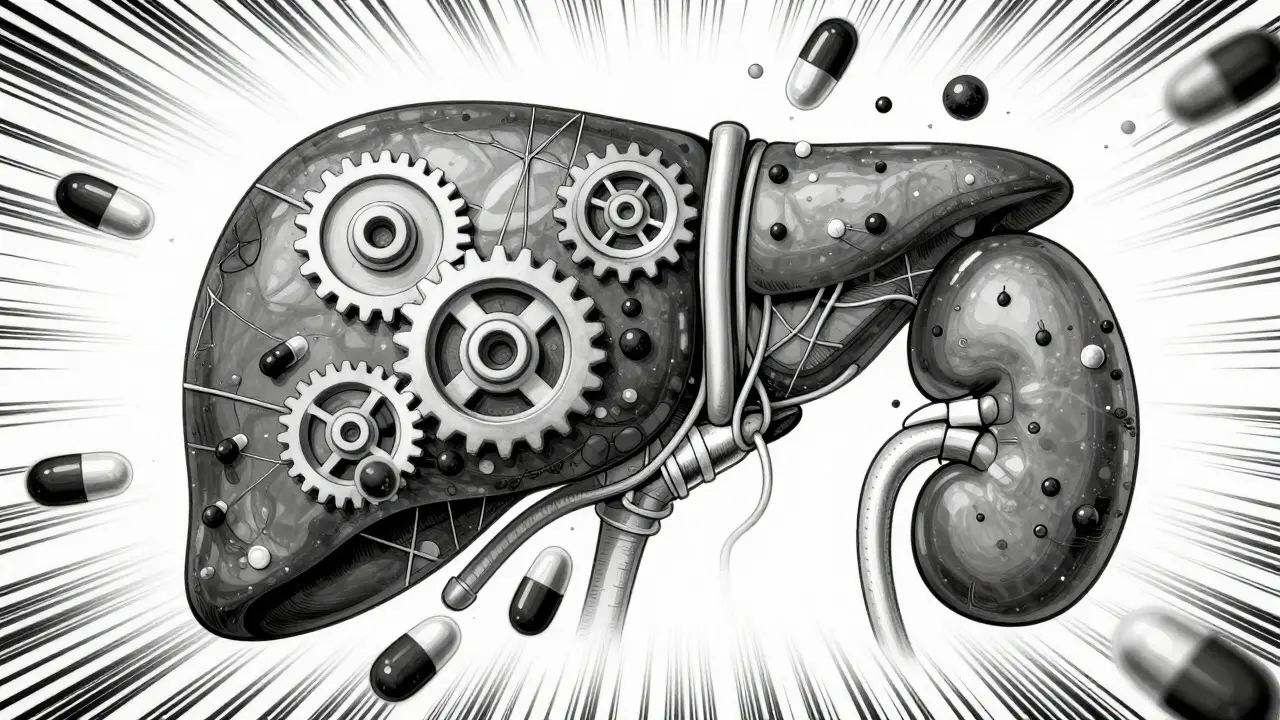
Metabolism is where things get really complex. The liver is responsible for breaking down most drugs using enzymes called cytochrome P450s. In a fetus at 32 weeks’ gestation, these enzymes operate at only about 30% of adult capacity. They don’t reach full maturity until around 12 months postnatal age. This creates a "critical window" where drug clearance is extremely slow. If you administer a drug based on adult dosing charts, even scaled down, the baby’s liver simply can’t keep up.
Excretion via the kidneys is also impaired. Glomerular filtration rate (GFR) in preterm infants is significantly lower than in term infants. Drugs that rely on renal clearance, such as gentamicin, can accumulate rapidly, leading to nephrotoxicity (kidney damage) or ototoxicity (hearing loss).
The Off-Label Reality in the NICU
Here’s a startling fact: only 35% of all medications used in NICUs have FDA approval for infant use, according to NIH research published in PMC (2021). This means the vast majority of drugs given to preterm babies are prescribed "off-label." Doctors aren’t guessing; they’re extrapolating data from older children or adults, adjusting doses based on weight and clinical judgment. But without specific pediatric trials, the safety margins are thin.
Respiratory medications are particularly concerning. They are prescribed off-label in 92% of cases involving former preterm infants. Caffeine citrate, commonly used for apnea of prematurity, is a prime example. While effective, Mayo Clinic documentation specifies that 18.7% of infants receiving standard doses (20 mg/kg loading, 5-10 mg/kg maintenance) develop tachycardia (rapid heart rate), and 7.3% experience feeding intolerance requiring dose adjustment. It’s a delicate balance between keeping the baby breathing and avoiding side effects.
High-Risk Medications and Their Side Effects
Not all drugs carry the same risk profile. Some classes of medications have been scrutinized heavily due to potential long-term consequences.
| Medication Class | Common Use | Key Side Effects/Risks | Evidence-Based Insight |
|---|---|---|---|
| Opioids & Benzodiazepines | Pain management, sedation | Respiratory depression, neurodevelopmental delays | 100% of extremely preterm infants receive some form; AAP now advises against routine use. |
| Antibiotics | Treating/preventing sepsis | Gut microbiome disruption, increased pathogenic bacteria | 47% more pathogenic bacteria and 2.8x more resistant genes in exposed preterms. |
| Proton Pump Inhibitors (PPIs) | Acid reflux management | Necrotizing enterocolitis (NEC), late-onset sepsis, fractures | 1.67x increased NEC risk; no proven benefit for reflux in preterms. |
| Magnesium Sulfate | Neuroprotection (antenatal) | Meconium-related ileus | Reduces cerebral palsy risk by 30%, but increases ileus risk in infants <26 weeks. |
Opioids and Benzodiazepines: Historically, these were staples for pain control. However, a 2021 JAMA Network Open study documented that 100% of extremely preterm infants received analgesia or sedation, with 42.7% receiving opioids and 28.3% benzodiazepines. The concern? Potential neurotoxicity. Current AAP guidelines (updated 2020) emphasize that while pain management is integral, *routine* administration is not recommended. We’ve shifted from the pre-1980s era of "no analgesia" to a more nuanced approach that minimizes exposure.
Antibiotics: These save lives by fighting sepsis, but they come with a heavy cost. Washington University School of Medicine research published in *Nature Microbiology* (September 9, 2021) showed that preterm infants exposed to antibiotics had gut microbiomes containing 47% more pathogenic bacteria (particularly Enterobacteriaceae) and 32% fewer beneficial species (like Bifidobacterium). Dr. Gautam Dantas, lead researcher, noted that "the makeup of your gut microbiome is pretty much set by age 3." Early antibiotic exposure can alter this foundation, potentially impacting immune function and metabolism for years. These differences persisted 18 months after NICU discharge.
Anti-Reflux Medications: Proton pump inhibitors (PPIs) are frequently prescribed for gastroesophageal reflux, yet evidence suggests they do more harm than good. NIH studies document a 1.67 times increased risk of necrotizing enterocolitis (NEC)-a devastating intestinal disease-in preterm infants taking PPIs. There’s also a 1.89 times higher rate of late-onset sepsis and a 2.3 times increased fracture risk. Despite this, 41% of NICU graduates were prescribed these meds. The 2022 Cochrane review found no significant benefit for acid-suppressing medications in preterms, leading to updated AAP guidelines recommending against their routine use.
Clinical Challenges and Human Error
Even with perfect knowledge, administering drugs to preterm infants is fraught with practical challenges. One major issue is polypharmacy-the simultaneous use of multiple medications. Preterm infants often suffer from multiple comorbidities (respiratory distress, PDA, anemia), leading to complex drug regimens. Drug-drug interactions become a real threat when metabolic pathways are already overwhelmed.
Human error is another factor. NICU nurses surveyed in the 2022 *American Journal of Perinatology* reported that 68.4% encountered at least one medication error per month related to weight-based dosing miscalculations. With babies weighing less than a pound, a decimal point error can mean the difference between therapeutic effect and overdose. Twenty-three percent of these errors resulted in adverse events.
Parents often express deep anxiety about these risks. In a 2023 March of Dimes support forum, one parent shared, "My son received 28 days of antibiotics for possible sepsis that was never confirmed, and now at age 2 he's had 5 ear infections and 2 rounds of antibiotics." This highlights the gap between acute NICU survival strategies and long-term health outcomes.

Best Practices for Safer Medication Management
So, how do we mitigate these risks? The answer lies in precision, protocol, and technology.
- Standardized Protocols: NICUs implementing standardized opioid and benzodiazepine weaning protocols reduced medication exposure duration by 14.3 days on average (from 28.7 to 14.4 days) without increasing pain scores, according to the 2021 JAMA study. Structured plans prevent ad-hoc prescribing.
- Pharmacokinetic Modeling Software: Tools like DoseMeRx are being adopted in 37.2% of Level IV NICUs. This software uses individual patient data (weight, gestational age, lab results) to predict drug concentrations, reducing dosing errors by 58.7% in infants under 28 weeks’ gestation.
- Gestational Age-Specific Adjustments: Clinical pharmacists report that 76.3% of NICU medication protocols require modification based on gestational age. For instance, fentanyl and morphine clearance rates vary dramatically between a 24-weeker and a 34-weeker. Dosing must reflect this developmental timeline.
- Microbiome-Sparing Strategies: Future directions include developing microbiome-sparing antibiotics currently in Phase II trials. Until then, clinicians are encouraged to limit antibiotic duration and spectrum whenever clinically safe.
Training is also crucial. The American College of Clinical Pharmacy’s 2022 competency framework states that mastering neonatal pharmacology requires 18-24 months of specialized training beyond standard residency. Understanding developmental pharmacology timelines and disease-state impacts on drug disposition is non-negotiable for staff caring for preemies.
Looking Ahead: Precision Medicine in the NICU
The field is evolving. The Eunice Kennedy Shriver National Institute of Child Health and Human Development launched the Neonatal Precision Medicine Initiative in 2023, aiming to develop gestational age-specific pharmacokinetic models for 25 high-risk medications by 2026. Regulatory initiatives like the FDA’s Best Pharmaceuticals for Children Act (BPCA) have generated 15 new pediatric labeling changes since 2002, though gaps remain. Only 12 of the 50 most commonly used NICU medications have specific neonatal dosing guidelines according to the WHO Essential Medicines List for Children.
We are moving toward a future where every dose is calculated not just by weight, but by genetic profile, gestational age, and real-time physiological data. Until then, vigilance is our best tool. Every medication administered to a preterm infant should be questioned: Is it necessary? Is the dose optimized? What are the long-term implications?
Why are preterm infants more susceptible to medication side effects?
Preterm infants have immature organ systems, including the liver and kidneys, which are responsible for metabolizing and excreting drugs. Enzyme activity, such as cytochrome P450, may be only 30% of adult levels at 32 weeks' gestation. Additionally, their higher body water content affects drug distribution, leading to altered pharmacokinetics and increased risk of toxicity or subtherapeutic effects.
What is the impact of antibiotics on a preterm infant's gut microbiome?
Research shows that antibiotic exposure in preterm infants leads to a gut microbiome with 47% more pathogenic bacteria and 32% fewer beneficial species like Bifidobacterium. This disruption can persist for over 18 months after NICU discharge and may increase the risk of long-term immune and metabolic issues, as the gut microbiome largely stabilizes by age 3.
Are anti-reflux medications safe for preterm infants?
Current evidence suggests limited safety. Studies indicate a 1.67 times increased risk of necrotizing enterocolitis (NEC), a 1.89 times higher rate of late-onset sepsis, and a 2.3 times increased fracture risk. Given the lack of proven efficacy for reflux in this population, recent AAP guidelines recommend against their routine use.
How common are medication errors in the NICU?
Medication errors are relatively frequent due to complex dosing requirements. A 2022 survey found that 68.4% of NICU nurses encountered at least one medication error per month, often related to weight-based dosing miscalculations. About 23.7% of these errors resulted in adverse events, highlighting the need for standardized protocols and technology assistance.
What role does pharmacokinetic modeling software play in NICU care?
Software like DoseMeRx helps calculate precise drug doses based on individual patient factors such as gestational age, weight, and lab results. Implemented in over a third of Level IV NICUs, it has been shown to reduce medication dosing errors by nearly 60% in infants under 28 weeks' gestation, improving safety and therapeutic outcomes.