

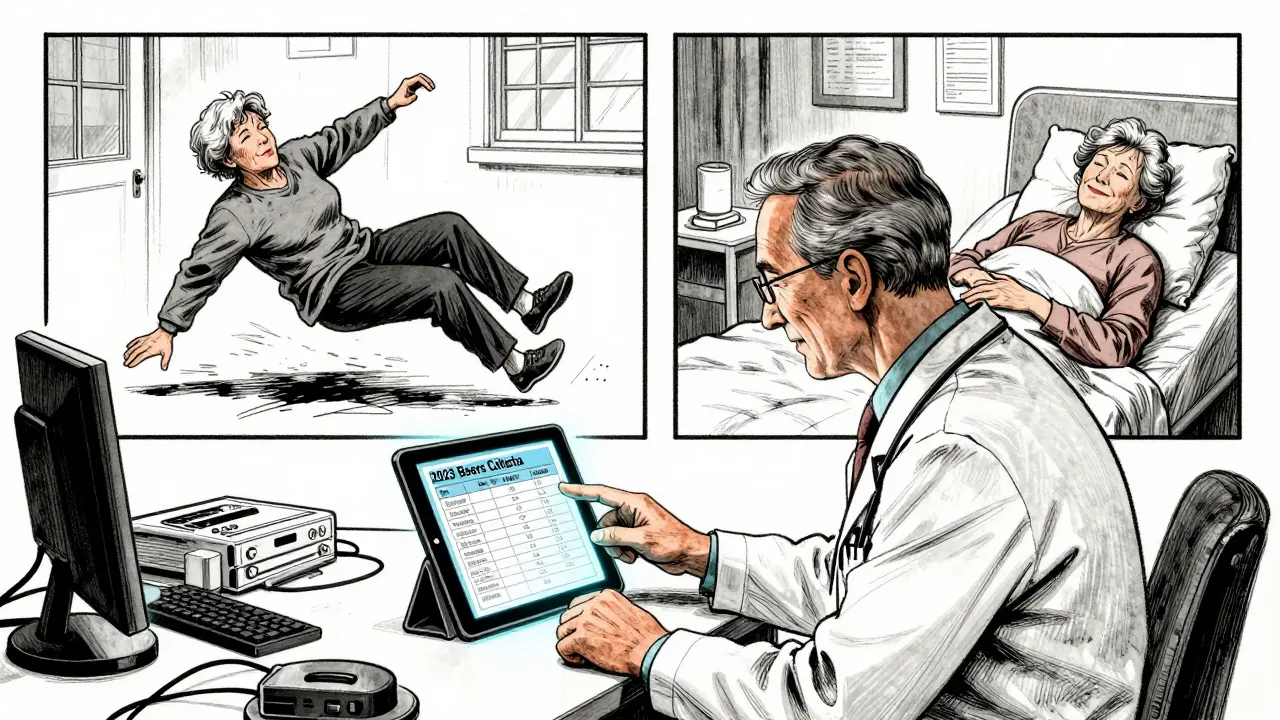
Every year, thousands of older adults end up in the hospital not because of a fall, infection, or heart issue-but because of a medication they were told to take. It sounds backwards, doesn’t it? Medications are supposed to help. But for seniors, some common prescriptions do more harm than good. That’s where the Beers Criteria comes in. It’s not a law. It’s not a suggestion. It’s a science-backed list that tells doctors which drugs to avoid in people 65 and older-and why.
What Exactly Is the Beers Criteria?
The Beers Criteria is a living document, updated every three years by the American Geriatrics Society. It started in 1991 as a simple list of drugs to avoid in nursing homes. Today, it’s a detailed, evidence-based guide used in hospitals, clinics, and pharmacies across the U.S. The latest version came out in May 2023, after experts reviewed over 7,000 studies. That’s more than 20% higher than the previous update. The goal? To cut down on dangerous prescriptions that don’t match the needs of older bodies.Why does this matter? Seniors make up just 13.5% of the U.S. population, but they take 34% of all prescription drugs. Many are on five, six, or even ten medications at once. That’s called polypharmacy. And with each new pill, the risk of side effects, bad interactions, and hospital stays goes up. The Beers Criteria helps cut through the noise. It doesn’t say every drug on the list is always wrong. It says: Here are the ones that often do more harm than good in older adults.
The Five Categories of Risk
The 2023 Beers Criteria breaks down risky medications into five clear groups. Knowing these helps both doctors and patients ask smarter questions.- Medications to avoid altogether-These are drugs with strong evidence that they cause more harm than benefit. Think first-generation antihistamines like diphenhydramine (Benadryl) and hydroxyzine. They’re often sold as sleep aids or allergy pills. But in seniors, they block a brain chemical called acetylcholine. That leads to confusion, memory lapses, dry mouth, constipation, and even falls. The evidence is so clear, the criteria gives them a strong recommendation to avoid.
- Medications to avoid with certain conditions-Some drugs are fine for most people but dangerous if you have another health issue. For example, NSAIDs like ibuprofen or naproxen are common for arthritis pain. But if you have heart failure, they can make it worse by causing fluid buildup. The Beers Criteria says: Don’t use these if you’re at risk.
- Medications to use with caution-These aren’t banned, but they need extra care. Dabigatran (Pradaxa), a blood thinner, is a good example. It’s safer than warfarin for many, but for seniors over 75 or those with reduced kidney function, it raises the risk of serious stomach bleeding. Doctors need to check kidney levels before prescribing.
- Drug-drug interactions to watch for-Some combinations are ticking time bombs. Taking an anticholinergic (like oxybutynin for overactive bladder) with an opioid (like oxycodone for pain) can cause extreme constipation, urinary retention, and mental fogginess. These interactions aren’t always obvious to patients or even some providers.
- Drugs needing kidney dose adjustments-As we age, kidneys slow down. Medications that leave the body through the kidneys can build up to toxic levels if the dose isn’t lowered. Gabapentin, used for nerve pain, is one. If your kidney function drops below 60 mL/min, the dose must be cut. Many prescribers forget this.
The 2023 update added 32 new medications to these lists and removed 18 that newer studies showed were safer than once thought. It’s not static. It evolves.
How It Compares to Other Tools
You might hear about STOPP/START, another tool used in Europe. It’s different. While Beers focuses on individual drugs to avoid, STOPP/START looks at the whole picture: Is this drug appropriate for the condition? Is something missing? Beers is simpler to use in EHRs, which is why 87% of U.S. healthcare systems have built it into their electronic records. STOPP/START is more detailed but harder to automate.But Beers isn’t perfect. It can flag a drug as inappropriate even when it’s the right choice. For example, antipsychotics like risperidone are listed as risky for dementia-related agitation. But if a senior is having violent outbursts or hallucinations that put them in danger, sometimes the risk of not treating is greater than the risk of the drug. That’s why experienced clinicians use Beers as a guide-not a rulebook.
Real Impact in Clinics
When hospitals and clinics use the Beers Criteria properly, results show up fast. One study found a 28% drop in adverse drug events after staff started using the list. Another found that when EHRs automatically flagged Beers-listed drugs during prescribing, inappropriate medication use dropped by 37% in just six months.Dr. Lisa Chen, a geriatrician in California, said after adding Beers alerts to her clinic’s system, benzodiazepine prescriptions for insomnia in patients over 75 fell by 43%. That’s huge. Benzodiazepines like lorazepam and zolpidem increase fall risk and confusion. Replacing them with non-drug options-like sleep hygiene routines or cognitive behavioral therapy-works better and safer.
But there’s a downside. Some doctors are overwhelmed. One survey found primary care providers get an average of 12 Beers alerts per patient visit. That’s alert fatigue. When every alert sounds like an emergency, you start ignoring them. The trick is smart integration: Only trigger alerts for high-risk drugs, and pair them with alternatives.
What’s Replacing the Risky Drugs?
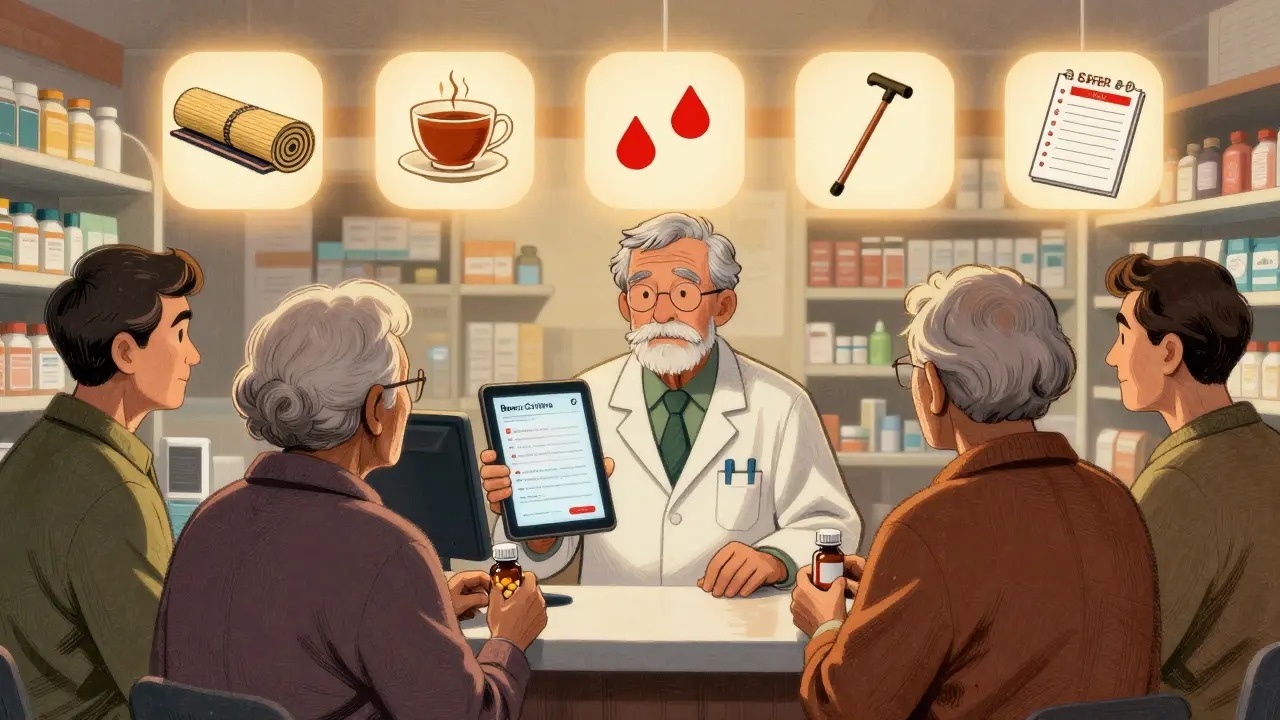
The 2025 update to the Beers Criteria went a step further. It didn’t just list bad drugs-it started listing good replacements. For insomnia, instead of diphenhydramine or zolpidem, try sleep hygiene, light therapy, or CBT-I (Cognitive Behavioral Therapy for Insomnia). For overactive bladder, physical therapy and timed voiding often work better than oxybutynin. For pain, non-drug options like exercise, acupuncture, or heat packs are first-line now. Even when drugs are needed, safer alternatives exist: duloxetine for nerve pain instead of gabapentin; citalopram instead of amitriptyline for depression.The American Geriatrics Society now offers a free mobile app and pocket guide with these alternatives. It’s been downloaded over 87,000 times. Clinicians report saving an average of 8.2 minutes per patient because they don’t have to look up alternatives separately.
Why So Many Seniors Still Get Risky Prescriptions
Despite the evidence, only 41% of primary care practices consistently use the Beers Criteria. Why? Several reasons:- Time-Doctors are rushed. A 15-minute visit doesn’t leave room for deep medication reviews.
- Lack of training-Many clinicians weren’t taught geriatric pharmacology in medical school.
- Cost-Some safer alternatives are more expensive. A senior on a fixed income might choose the cheaper, riskier drug.
- Assumptions-Doctors sometimes think, “They’ve been on this for years, it must be fine.” But older bodies change. What was safe at 70 isn’t always safe at 85.
And here’s a silent problem: Most seniors don’t know their meds are being evaluated against Beers. A 2023 survey found 61% of older adults had never heard of it. That means they’re not asking questions. They’re just taking pills.
What Patients Can Do
If you or a loved one is over 65 and on multiple medications, here’s what to do:- Ask your doctor: “Are any of my medications on the Beers Criteria list?”
- Request a full medication review with a pharmacist-especially if you take eight or more drugs.
- Don’t stop anything on your own. But do ask: “Is there a safer alternative?” or “Could this be stopped?”
- Use the free Beers Criteria app or print the list from the American Geriatrics Society website. Bring it to appointments.
Medicare Part D now requires drug plans to use the Beers Criteria for beneficiaries on eight or more medications. That means your plan’s pharmacist should already be reviewing your list. But if they don’t bring it up, ask.
The Bigger Picture
The Beers Criteria isn’t about taking away drugs. It’s about making sure seniors get the right ones. It’s about preventing hospital trips, falls, memory loss, and confusion caused by medicines meant to help. It’s about dignity, safety, and quality of life.Pharmaceutical companies are responding. Twenty-three new “senior-friendly” drugs have been developed to replace Beers-listed ones. The market for these is projected to hit $84 billion by 2027. The FDA has already required 17 Beers-listed drugs to add geriatric warnings to their labels.
But progress isn’t fast enough. In resource-limited settings, 63% of Beers-listed medications have no affordable alternative. That’s a global problem. In the U.S., we have tools. We just need to use them.
The Beers Criteria isn’t magic. It’s a tool. And like any tool, it only works if people know how to use it-and if they’re allowed to use it without being buried in alerts or pressured by cost.
What medications are most commonly flagged by the Beers Criteria?
The top medications flagged include first-generation antihistamines (diphenhydramine, hydroxyzine), benzodiazepines (lorazepam, diazepam), nonsteroidal anti-inflammatory drugs (NSAIDs like ibuprofen and naproxen) in patients with heart failure, antipsychotics for dementia-related behavior, and opioids for chronic non-cancer pain. Gabapentin and certain anticoagulants like dabigatran are also flagged for seniors with reduced kidney function.
Is the Beers Criteria only used in the U.S.?
No. While the Beers Criteria is most widely used in the U.S., it has been translated into 17 languages and adopted by healthcare systems in 28 countries. However, many European countries rely more on the STOPP/START criteria, which focuses on condition-specific prescribing rather than individual drug lists.
Can seniors still take Beers-listed drugs if needed?
Yes. The Beers Criteria is not a ban-it’s a warning. Sometimes, a flagged drug is still the best option, especially in palliative care or when no alternatives exist. The key is intentional use: The doctor must understand the risks, monitor closely, and document why the drug is still being used despite the warning.
How often is the Beers Criteria updated?
The American Geriatrics Society updates the Beers Criteria every three years. The most recent version was published in May 2023. A new update is expected in 2026, with expanded guidance on kidney dosing and AI-assisted risk prediction.
What should I do if my doctor prescribes a Beers-listed drug?
Ask: "Is this medication on the Beers Criteria list? If so, why are you recommending it over a safer alternative?" Request a medication review with a pharmacist. Bring a list of all your medications, including over-the-counter pills and supplements. Never stop a medication without talking to your provider first.


jared baker
March 20, 2026 AT 13:52I've seen this firsthand. My dad was on diphenhydramine for sleep for years. No one ever told us it was risky. One day he fell, broke his hip, and we found out the med was flagged since 2019. They switched him to melatonin and a strict bedtime routine. No more falls. Simple fix, but nobody asked.
Doctors get busy. Patients get silent. That's the real problem here.
Michelle Jackson
March 22, 2026 AT 02:51So let me get this straight. We're supposed to stop giving seniors Benadryl because it might make them confused, but we're fine with letting them take opioids for back pain? What a joke. This is just another way for big pharma to push their new $120/month 'senior-friendly' drugs while old people suffer through untreated symptoms.
My grandma took Benadryl for 20 years. She's 92 and still sharp. Maybe the problem isn't the drug, it's that doctors don't know how to treat aging anymore.
Suchi G.
March 23, 2026 AT 12:27I live in India and we don't have the luxury of Beers Criteria. My mother, 78, takes five different pills daily. Two are on the Beers list. We can't afford alternatives. The local clinic just says 'take it, it's what you've always taken.' I read this article and cried. Not because I'm emotional, but because I realize how deeply unfair this is. In the U.S., they have apps, alerts, guidelines. Here? We pray the pill doesn't kill her before the next doctor's visit.
The real issue isn't the list. It's that the list only exists where wealth exists. The rest of us are just trying to survive with whatever's left on the shelf.
becca roberts
March 24, 2026 AT 09:50Oh wow, a 2023 update? How revolutionary. I guess we forgot that seniors have been dying from bad prescriptions since the 1950s. But hey, at least now we have an app.
Meanwhile, my aunt’s doctor prescribed her gabapentin for ‘anxiety’ at 81. Kidney function? Not checked. Dose? Not adjusted. She ended up in the ER with falls and confusion. The Beers Criteria says ‘avoid.’ But the system? It’s still just hitting ‘confirm’ and moving on.
It’s not that we don’t know. It’s that we don’t care enough to change.
Andrew Muchmore
March 26, 2026 AT 04:10Beers Criteria is the only thing keeping my patients out of the hospital. I use it daily. The alerts are annoying but necessary. I’ve cut benzodiazepines by 60% in my clinic. No more falls. No more ER visits. Simple.
Stop complaining about alerts. Start listening to the data.
Paul Ratliff
March 26, 2026 AT 19:55benadryl for sleep? yeah i know that one. my uncle took it for 15 years. no one ever said anything. he finally stopped when his dr switched him to a sleep mask and a fan. weird but it worked. point is, sometimes the fix isnt a pill. its just a change in routine.
also why is gabapentin still everywhere? its basically candy for old folks. no wonder its flagged.
SNEHA GUPTA
March 28, 2026 AT 18:28What does it mean to age with dignity? Is it about avoiding drugs? Or is it about being seen as a whole person, not a list of risks? The Beers Criteria is a tool, yes, but it reduces human complexity to a checklist. A 79-year-old with chronic pain, loneliness, and insomnia isn't just a 'polypharmacy risk.' They're someone who once raised children, worked, loved, lost.
When we focus only on what to avoid, we forget to ask what they need to thrive. The real crisis isn't medication-it's that we treat the elderly as problems to be managed, not people to be honored.
Maybe the next update should include a question: 'What matters most to this person?' before we even open the list.
Laura Gabel
March 30, 2026 AT 02:35Another overeducated liberal list that ignores real life. My mom’s in a nursing home. She’s got arthritis, heart issues, and sleep problems. You want to take away everything? What’s left? Nothing. She’s not some lab rat. She’s a 76-year-old woman who needs to sleep without screaming. If Benadryl works and doesn’t kill her, why are we making this harder?
Stop pretending you know better than the people who live with this every day.