
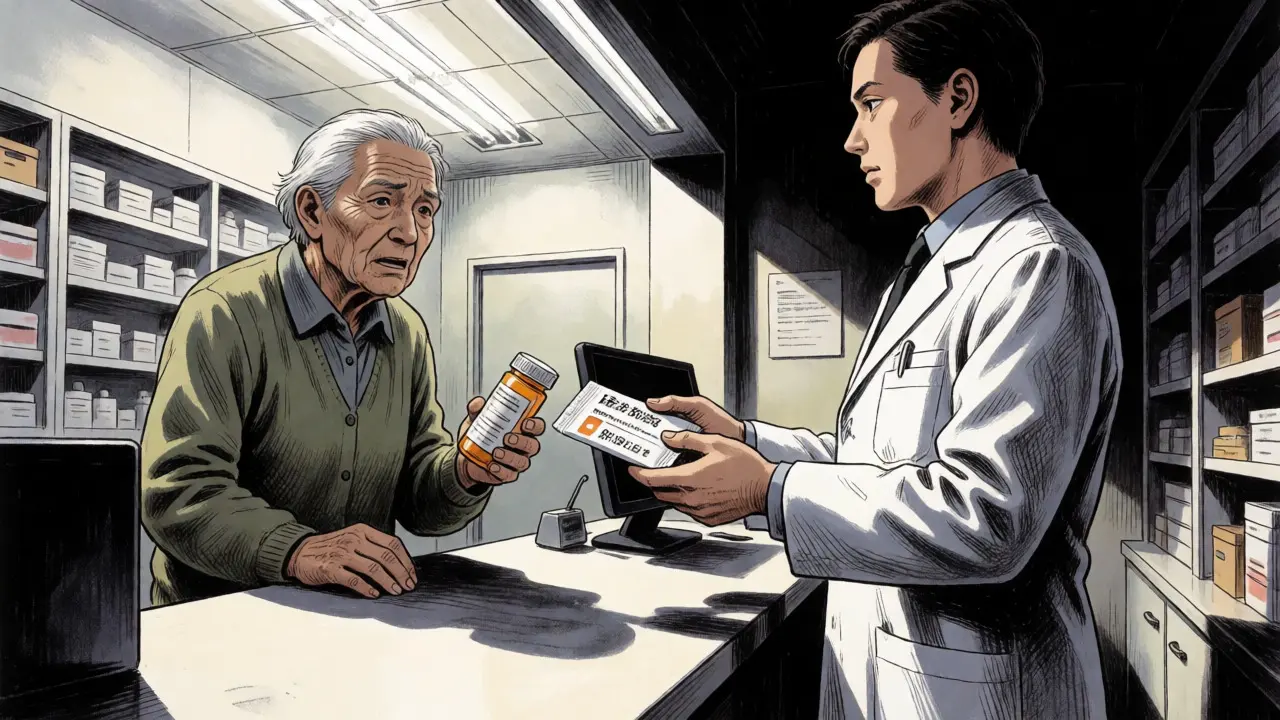
Imagine you’re at the pharmacy counter, ready to save money on your medication. The pharmacist tells you that the brand-name drug is gone, but there’s a new, slightly different version available for the same high price. You take it home, not realizing that a generic equivalent-which would have cost 80% less-was waiting in the wings, blocked by a legal maneuver known as product hopping. This isn’t just bad luck; it’s a calculated strategy by pharmaceutical companies to dodge state substitution laws. If you’ve ever wondered why some drugs stay expensive long after their patents expire, the answer often lies in the complex world of antitrust issues in generic substitution.
The Core Problem: Blocking Automatic Savings
Generic substitution is a legal mechanism allowing pharmacists to replace a brand-name prescription with a bioequivalent generic drug without needing a new doctor's order. It’s the backbone of affordable healthcare in the United States. However, when brand manufacturers anticipate patent expiration, they sometimes engage in practices that undermine this system. The central issue is that state laws require automatic substitution only if the original formulation is still available or prescribed. By withdrawing the old drug and introducing a minor variation, brands effectively sever the link between the patient’s history and the generic option.
This creates a bottleneck. Generics rely on state substitution laws because marketing directly to doctors is too expensive for them. When a brand removes the original product, generics lose their primary route to market. The Federal Trade Commission (FTC) has highlighted that these tactics impede competition on the merits, leaving patients paying monopoly prices for years longer than necessary.
How Product Hopping Undermines Competition
Product hopping comes in two main flavors: "soft" and "hard." Soft switching involves promoting a new version while keeping the old one on the shelf. Hard switching is more aggressive: the manufacturer withdraws the original formulation entirely before generics arrive. A classic example is the case of Namenda, an Alzheimer’s drug. Actavis introduced an extended-release version (Namenda XR) and pulled the immediate-release version (Namenda IR) from the market just 30 days before generic entry. Because patients rarely go back to change prescriptions due to the hassle and cost, the market for the generic IR was destroyed before it even began.
The financial stakes are massive. According to analyses by Drug Patent Watch, delayed generic entry through such tactics can cost consumers billions. For instance, Teva Pharmaceuticals’ switch for Copaxone resulted in estimated costs to consumers between $4.3 billion and $6.5 billion over just two and a half years. These aren’t abstract numbers; they represent real money out of patients’ pockets and insurance premiums.
Key Legal Precedents and Court Splits
Courts haven’t always agreed on how to handle these strategies. The landmark 2016 ruling in New York v. Actavis by the Second Circuit set a crucial precedent. The court found that Actavis’s withdrawal of Namenda IR was anticompetitive because it prevented generic manufacturers from using state substitution laws. The judges recognized that for generics, relying on automatic substitution is the only cost-efficient way to compete.
Contrast this with the 2009 In re Nexium Antitrust Litigation, where AstraZeneca switched patients from Prilosec to Nexium. In that case, the claims failed because AstraZeneca kept Prilosec available. Courts generally view adding a new product as procompetitive innovation. But when the old product vanishes, courts are more likely to see exclusionary conduct. This split creates uncertainty for both drug makers and regulators.
| Case Name | Strategy Used | Original Drug Status | Court Outcome |
|---|---|---|---|
| New York v. Actavis | Hard Switching (Withdrawal) | Withdrawn before generic entry | Anticompetitive; injunction granted |
| In re Nexium | Soft Switching (Promotion) | Remained available | Procompetitive; claims dismissed |
| Suboxone Cases | Disparagement + Withdrawal Threat | Threatened removal | Coercive; FTC settlements reached |
The REMS Bottleneck: Another Barrier to Entry
Beyond product hopping, another major antitrust concern involves Risk Evaluation and Mitigation Strategies (REMS). These are FDA-mandated safety programs designed to manage known serious side effects. While well-intentioned, brand companies have sometimes used REMS to deny generic competitors access to the drug samples needed for bioequivalence testing. Without these samples, generics cannot prove they work the same way as the brand, delaying approval for months or years.
A study cited in a 2017 Cornell Law Review analysis noted that more than 100 generic firms complained about lack of sample access. The inability to enter the market due to restricted access programs was estimated to cost over $5 billion annually. Professor Michael A. Carrier argued that denying samples makes no economic sense unless the goal is to harm generic competition, fitting the definition of monopolization under antitrust law.

Enforcement Actions and Regulatory Response
Regulators have taken notice. The FTC has been particularly active. In the Namenda case, they secured a preliminary injunction requiring Actavis to keep selling the older drug for 30 days after generic entry. In the Suboxone saga involving Reckitt Benckiser, the FTC settled with the company after finding that disparaging the tablet form while threatening its removal coerced patients into switching to the film formulation.
State attorneys general also play a role. New York successfully obtained an injunction against Actavis in 2014. Meanwhile, the Department of Justice (DOJ) has pursued criminal charges for price-fixing among generic manufacturers themselves, such as Teva’s $225 million penalty in 2023. This shows that antitrust scrutiny applies to both sides of the aisle: brands blocking entry and generics colluding on price.
Current Trends and Future Outlook
As of 2026, the regulatory landscape continues to evolve. The FTC’s October 2022 report on pharmaceutical product hopping signaled a renewed focus on these issues. Chair Lina Khan directed the agency to review past actions and strengthen advocacy for better substitution laws. Joint hearings held by the DOJ and FTC in 2023 addressed barriers to generic and biosimilar competition, highlighting that patent thickets and regulatory gamesmanship remain significant hurdles.
Experts predict increased scrutiny of REMS abuse and hard switching. Legislative reforms may soon clarify the boundaries of acceptable product launches. For now, the message to pharmaceutical companies is clear: you can innovate, but you cannot manipulate the market structure to exclude competitors who offer genuine value to consumers.
What is the difference between soft and hard switching?
Soft switching involves launching a new version of a drug while keeping the original formulation available. Hard switching occurs when the manufacturer withdraws the original formulation from the market entirely, usually shortly before generic entry. Hard switching is more likely to be considered anticompetitive because it prevents pharmacists from automatically substituting the generic for the original prescription.
Why do generic manufacturers rely on state substitution laws?
Generic manufacturers operate on thin margins and cannot afford extensive marketing campaigns to persuade doctors to prescribe their specific product. State substitution laws allow pharmacists to dispense the generic automatically when a brand-name drug is prescribed, provided it is bioequivalent. This ensures generics capture 80-90% of the market share quickly, which is essential for their business model.
How does the Hatch-Waxman Act relate to these issues?
The 1984 Hatch-Waxman Act established the modern framework for generic drug approval. It created a balance between encouraging innovation (through patent protections for brand drugs) and promoting competition (by allowing generic entry after patent expiration). Antitrust issues arise when brand companies exploit loopholes in this framework, such as making minor changes to extend patent life or withdrawing products to block substitution, thereby undermining the act's intent.
What is the role of REMS in antitrust disputes?
Risk Evaluation and Mitigation Strategies (REMS) are FDA-required safety programs. Brand companies have been accused of using REMS restrictions to deny generic manufacturers access to drug samples needed for bioequivalence testing. Without these samples, generics cannot get approved, delaying competition. Regulators argue this is an abuse of regulatory processes to stifle competition rather than enhance safety.
Can patients sue for damages caused by product hopping?
Yes, patients and payers have brought antitrust lawsuits alleging that product hopping deprived them of lower-cost alternatives. Success depends on proving that the brand's conduct was exclusionary and caused measurable harm. Cases like New York v. Actavis show that courts will grant relief when the original drug is withdrawn, preventing generic substitution.
Kimberley Odish
September 5, 2026 AT 02:56It is frankly infuriating that we allow these corporate entities to treat the healthcare system like their personal playground. The audacity of withdrawing a drug just to block a generic competitor is not just anticompetitive; it is morally bankrupt. We are talking about human lives here, not stock prices. The fact that the courts had to step in at all shows how broken our regulatory framework has become. I am exhausted by the sheer greed on display.
Adam Viruet
September 6, 2026 AT 11:01ehhh... i mean... sure?? but like... isn't innovation good??? if they make a better pill why should they be punished for it??? its not like they're forcing you to buy it... you can still get the old one usually... or whatever... anyway... big pharma bad... got it...
Jenn Bell
September 8, 2026 AT 02:58I really appreciate this breakdown! It's so important for patients to understand what's happening behind the scenes. Knowing about product hopping empowers us to ask better questions when we're at the pharmacy counter. Let's keep pushing for transparency and fair access to affordable medications. We've got this!
Eric Schultze
September 8, 2026 AT 08:14The narrative presented here is dangerously incomplete. While product hopping is indeed a tactic, it ignores the deeper conspiracy of regulatory capture. The FDA and FTC are not independent arbiters; they are revolving-door institutions staffed by the very executives who profit from these delays. This is not merely a legal issue but a systemic failure engineered to maintain oligopolistic control over essential medicines. One must question whether any enforcement action is genuine or merely theater to placate public outrage while the money continues to flow upward.
Jeremy Westcott
September 8, 2026 AT 12:08Dude, it’s straight-up racketeering with a white coat. They pull the rug out from under your prescription just as the cheap stuff hits the shelves. It’s like a shell game where the pea is your wallet and the cup is a patent lawsuit. Total scam job designed to bleed us dry until the next cycle starts.
Amanda SF
September 9, 2026 AT 03:24This analysis is fundamentally flawed in its scope. You focus heavily on the Actavis case, yet you neglect the broader implications of the Hatch-Waxman Act's unintended consequences. The distinction between 'hard' and 'soft' switching is legally significant, yes, but it fails to address the root cause: the incentive structure itself. Furthermore, the comparison to Nexium is misleading because the market dynamics were entirely different. To suggest that simple withdrawal is the sole metric for anticompetitive behavior ignores the complex web of patent thickets that precede the switch. This is not just about one drug; it is about the entire ecosystem of pharmaceutical innovation versus stagnation.
Neil Sahli
September 10, 2026 AT 14:33Wow, talk about a plot twist nobody saw coming! Oh wait, everyone saw it coming except the regulators? Hilarious. But hey, look on the bright side-at least now we know exactly which lever to pull to save some cash. Keep fighting the good fight, folks. The light at the end of the tunnel might just be another price hike, but we'll get there eventually!
Pramay Dattani
September 11, 2026 AT 02:23In India we have much better generci laws. Why US always complianing? Here govnt forces companies to lower prices fast. No such stupid games like product hopping allowed. Maybe US needs to learn from us instead of crying about billion dollars losses. Your system is too slow and corrupt for poor people.
Aurelio Haney
September 12, 2026 AT 21:16Finally, someone explains this without drowning us in legalese. 🙌 It’s crucial to remember that 'bioequivalence' doesn't always mean 'identical experience' for every patient, which adds another layer of complexity to the substitution argument. But overall, great insight into why our bills stay high. 👍
Evelyn Reed
September 14, 2026 AT 05:22the rems bottleneck is the real sleeper issue here
it’s less about the hop and more about the gatekeeping of samples
if generics cant test they cant enter period
simple as that
Somnath Thombre
September 14, 2026 AT 06:41Great post! Really opens up eyes. In my country also similar issues happen but slightly diff rules. Its hard for common man to understand these legal terms. Thanks for simplifying it. Hope govt takes strict action soon.
Neil Martin
September 15, 2026 AT 09:31While the emotional response is understandable, one must consider the economic reality of R&D amortization. If we penalize minor formulation changes, we disincentivize incremental improvements that actually benefit patient compliance. The Actavis ruling was correct in its specific context, but applying it broadly could stifle necessary pharmaceutical evolution. We need a nuanced approach, not a blanket condemnation of all product transitions. The consumer harm is real, but so is the innovation risk.
Kim Pender
September 17, 2026 AT 05:39my mom dealt with this exact thing last year.
brand name disappeared right before her refill.
had to pay full price for months.
so frustrating.