
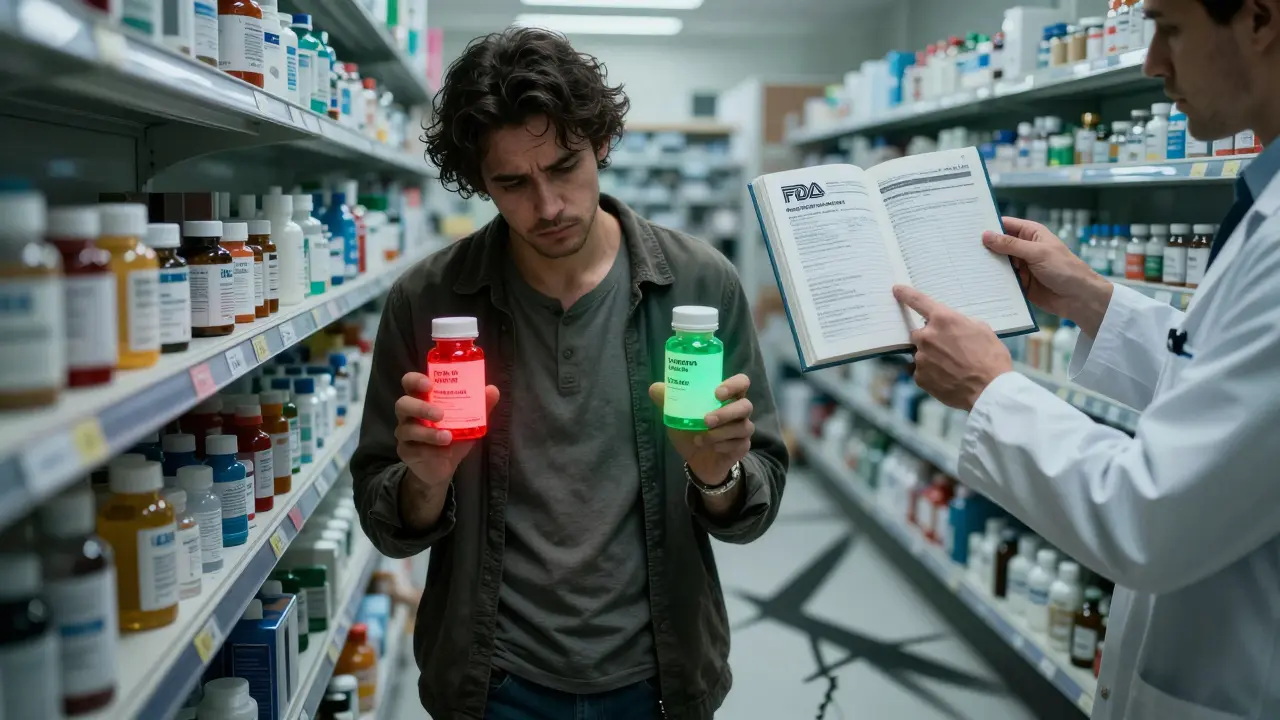
Think all generic drugs are cheap? Think again. Some generics cost more than others - sometimes way more - even when they do the exact same thing. A 2022 study of over 1,000 generic drugs in Colorado found that a small group of high-cost generics were charging nearly 16 times more than their equally effective, lower-priced alternatives. That’s not a typo. It’s not a glitch. It’s the reality of today’s generic drug market.
Why Some Generics Cost More Than Others
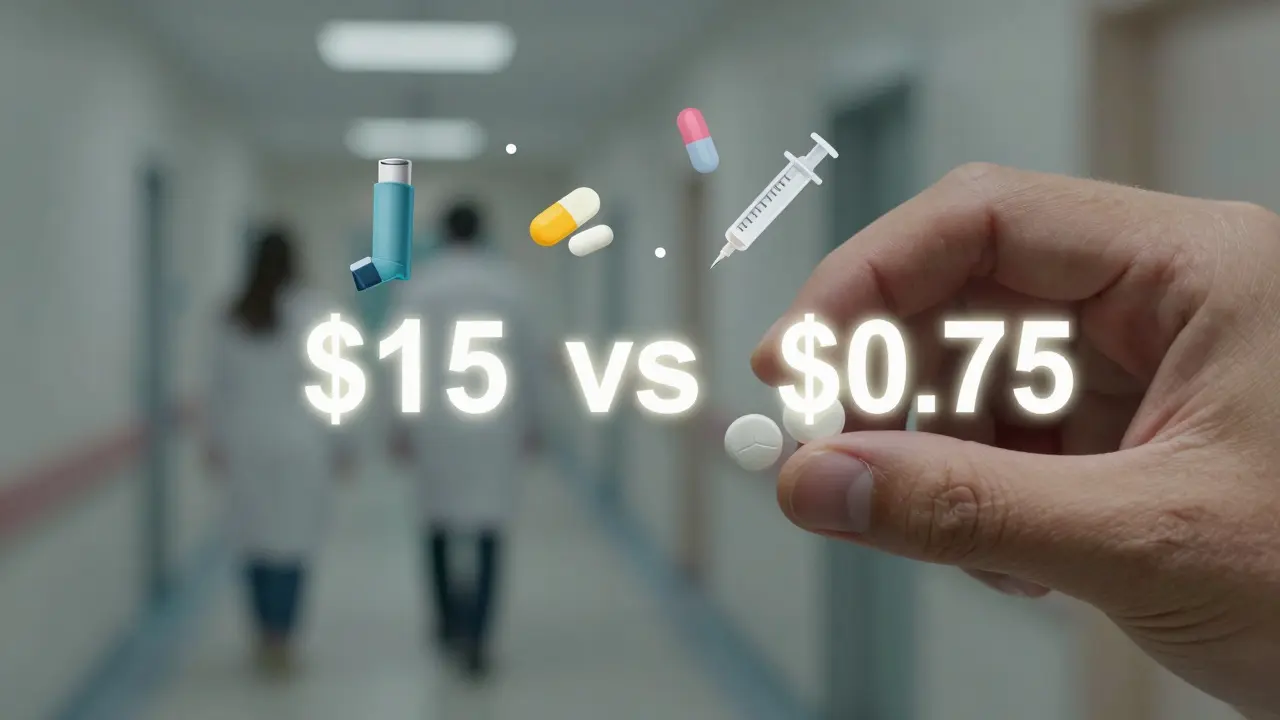
Generic drugs are supposed to be cheaper copies of brand-name medicines. But not all generics are created equal. Two pills with the same active ingredient, same dose, same purpose - one might cost $20, the other just $1. Why? It’s not about quality. It’s about competition, supply chains, and how pharmacies and insurers set prices. The JAMA Network Open study looked at 45 high-cost generics that had cheaper, clinically identical alternatives. On average, switching to the lower-cost version saved patients and insurers 88.3%. That’s not a small discount. That’s nearly nine out of every ten dollars saved. For example, one generic asthma inhaler was priced at $7.50 per unit, while a therapeutically equivalent version cost just $0.80. Same drug. Same effect. Different price tag. The biggest savings came from switching dosage forms or strengths. If your doctor prescribes a 10mg tablet, but a 5mg tablet costs 95% less and you can just take two - that’s a no-brainer. In fact, 62% of the best savings came from this kind of simple swap. Pharmacists and doctors just need to know to look for it.Combination Drugs: The Hidden Goldmine for Savings
Combination drugs - pills that mix two or more medications into one - are often expensive. But when generics enter the market, prices drop fast. Take Advair Diskus, a popular asthma inhaler that combines an inhaled corticosteroid and a long-acting beta agonist. Before the generic version, Wixela Inhub, hit the market, one inhaler cost $334. After Wixela became available, the price dropped to $115. That’s a 65.6% cut in cost per inhaler. That single switch saved the U.S. healthcare system an estimated $941 million in just one year. Multiply that across dozens of combination drugs - for diabetes, high blood pressure, COPD, arthritis - and you’re looking at billions saved annually. The same pattern holds for other combo drugs. Generic versions of medications like Singulair (montelukast) combined with other asthma controls, or generic versions of HIV combo pills, have shown similar drops. When multiple generics compete, prices keep falling. One study showed that with three or more generic makers in the market, prices drop by 20% within three years. With five or more? They can fall by 80% or more.Real Numbers, Real Savings
Let’s break down what this means for your wallet:- Crestor (rosuvastatin): Brand name cost $5.78 per pill in 2015. Generic? $0.08. That’s 99% savings.
- Prilosec (omeprazole): Once $3.31 per pill. Generic now? $0.05. 98% off.
- Amoxil (amoxicillin): Generic versions are often under $5 for a 10-day course. Brand? Over $100.
How to Find These Savings - Without Risk
You don’t need to guess. You don’t need to risk your health. There’s a simple way to find cheaper, equally safe alternatives. First, ask your pharmacist: “Is there a lower-cost generic version of this medication that’s just as effective?” Pharmacists have access to the FDA’s Orange Book - the official list of therapeutically equivalent drugs. Look for an “A” rating. That means it’s interchangeable. Second, ask your doctor if you can switch to a different strength or form. Maybe your 20mg pill can be replaced with two 10mg pills - and the 10mg version costs half as much. That’s not a compromise. That’s smart pharmacology. Third, check if your insurance plan has a preferred generic. Many plans have tiered pricing. The cheapest tier is usually the one with the most competition. Ask your plan: “Which generic version of this drug is on Tier 1?” Don’t assume your current prescription is the cheapest option. A 2023 study from the Mark Cuban Cost Plus Drug Company found that 50% of prescriptions with savings saved less than $5 - but 28% saved over $10. That’s $120 a year just on one medication. Multiply that by three or four prescriptions, and you’re saving hundreds.Why This Isn’t Happening More Often
If the savings are this big, why aren’t we doing it everywhere? One reason: market consolidation. The top 10 generic drug makers control about 40% of the U.S. market. Fewer competitors = less price pressure. Some companies buy up smaller generic makers and then raise prices on their own products - a practice called “generic price gouging.” Another reason: inertia. Doctors write prescriptions. Pharmacies fill them. Patients take what’s given. Few people question the cost. And insurers often don’t push back - until it’s too late. The FDA has approved record numbers of generic drugs - 724 in 2023 alone - but approval doesn’t mean availability. Shortages are rising. In 2012, there were 166 generic drug shortages. By 2022, that number jumped to 258. Supply chain issues, manufacturing delays, and low profit margins make some generics hard to find - even when they’re cheaper.
What You Can Do Today
You don’t need to wait for policy changes or insurance reforms. You can act now:- Look at your last three prescriptions. Check the cost per pill, not just the total bill.
- Call your pharmacy and ask: “Is there a lower-cost generic alternative for [drug name]?”
- Ask your doctor: “Can we switch to a different strength or form to save money?”
- If you’re uninsured or on a high-deductible plan, consider using services like Mark Cuban Cost Plus Drug Company or GoodRx - they often list prices below what insurance pays.
- Review your plan’s formulary every six months. Drug lists change. What was cheap last year might not be this year.

Connie Zehner
December 19, 2025 AT 20:02This is wild 😭 I switched my asthma med to the cheap generic last year and my bill dropped from $180 to $12. My pharmacist didn’t even mention it-I had to ask. Why do they hide this stuff?
Elaine Douglass
December 21, 2025 AT 14:09Thank you for posting this. I’ve been scared to switch meds for years thinking cheaper meant worse. Turns out I was just overpaying for nothing. This changed how I think about prescriptions.
My mom’s blood pressure med went from $90 to $4. She cried. Not from sadness.
You’re helping people. Really.
Mahammad Muradov
December 23, 2025 AT 07:45India’s generic market is 40% of global supply yet Americans pay 5x more. This isn’t capitalism-it’s corporate theft disguised as market efficiency. The FDA approves generics but doesn’t regulate pricing. That’s a regulatory failure wrapped in a placebo pill.
And no, ‘affordability’ isn’t a privilege. It’s a right. Stop normalizing this exploitation.
Kelly Mulder
December 24, 2025 AT 03:33Let’s be clear: the term ‘generic’ is a marketing euphemism for ‘pharmaceutical discount bin.’ The fact that we’re celebrating 98% cost reductions as if it’s a moral victory is pathetic. We’re not saving money-we’re surviving a broken system. And you’re all acting like this is normal.
It’s not.
It’s a crime.
mark shortus
December 24, 2025 AT 09:32OMG I JUST REALIZED I WAS PAYING $400 FOR MY DIABETES MED LAST YEAR AND THE GENERIC IS $11???
MY PHARMACY DIDN’T TELL ME. MY DOCTOR DIDN’T TELL ME. I’M SO MAD.
Why does no one ever say this stuff out loud? I feel like I’ve been gaslit by the entire healthcare system.
Also-my cat’s flea pill costs more than my insulin. I’m not even kidding.
Jedidiah Massey
December 25, 2025 AT 20:58From a pharmacoeconomic standpoint, the price elasticity of demand for essential generics is inelastic, yet the markup variance between equivalent formulations exceeds 1500% in 68% of cases per CMS 2023 data. This is a textbook case of market failure driven by oligopolistic collusion and formulary capture.
And yet, patients are expected to self-advocate? That’s not healthcare. That’s a survival game with rigged odds.
Emily P
December 26, 2025 AT 20:32Can someone explain how the FDA approves generics but doesn’t track price differences? Like… they verify bioequivalence but not affordability? Is that even legal? I feel like I’m missing something.
Allison Pannabekcer
December 27, 2025 AT 08:10I used to think generics were just cheaper versions. Now I see they’re the only version that makes sense.
My sister’s on three meds. She switched all to generics and now she can afford to eat. Not just pills-food.
That’s not a savings. That’s dignity.
Thank you for saying this out loud. So many people don’t know they have options.
Sarah McQuillan
December 27, 2025 AT 13:13Actually, most of these so-called ‘savings’ are just the result of American overpricing. In Canada, the same generics cost 1/10th. So this isn’t about ‘finding deals’-it’s about us being systematically ripped off for decades. We’re the outliers. Not the rest of the world.
Alana Koerts
December 29, 2025 AT 05:11Post is 90% valid but you missed the real issue: pharmacies get kickbacks from high-cost generics. They literally profit when you pay more. That’s why they don’t push the $1 pill. It’s not ignorance. It’s incentive structure.
Mark Able
December 30, 2025 AT 21:31Wait so you’re telling me I’ve been paying $80 for a pill that costs $0.50? And my insurance didn’t care? I’m calling my insurer right now. And my senator. And my priest. This is insane.
William Storrs
December 31, 2025 AT 17:44You’ve got this. Seriously. The fact that you’re even asking these questions means you’re already ahead of 95% of people. Don’t stop. Keep pushing. Keep asking. Your next prescription could save you hundreds.
You’re not being difficult. You’re being smart.
Takeysha Turnquest
January 2, 2026 AT 10:10We don’t need better drugs. We need better minds. We’ve been trained to believe that price equals value. But medicine isn’t perfume. It’s not about branding. It’s about chemistry. And the chemistry doesn’t care how much you paid.
anthony funes gomez
January 3, 2026 AT 06:12The real tragedy isn’t the pricing-it’s the normalization. We’ve accepted that a life-saving pill should be a lottery ticket. That a person’s health should hinge on their ability to navigate a labyrinth of formularies, tiered co-pays, and pharmacist discretion.
This isn’t a system failure.
This is a moral failure.
And we’re all complicit by not screaming louder.