

Skipping a pill here and there might seem harmless-until it’s not. If you’re managing a chronic condition like high blood pressure, diabetes, or arthritis, missing doses isn’t just inconvenient. It raises your risk of hospital visits, complications, and even life-threatening flare-ups. Research shows nearly half of people with long-term health conditions don’t take their meds as prescribed. The good news? You don’t need to be perfect. You just need a routine that fits your life-not the other way around.
Start with what you already do
The most reliable way to remember your meds is to tie them to something you already do every day. Brushing your teeth? Making coffee? Feeding your dog? These are your anchors. Stanford Medicine found that 78% of people who linked their medication to an existing habit stuck with it for months longer than those who relied on alarms alone.Try this: If you take a pill in the morning, do it right after you brush your teeth. If it’s at night, take it right before you turn off the light. Don’t overthink it. The goal isn’t to create a new habit-it’s to piggyback on one that’s already automatic.
Just make sure to check with your pharmacist or doctor first. Some meds need an empty stomach. Others work better with food. A quick call can save you from side effects or reduced effectiveness.
Pill organizers aren’t just for seniors
A weekly pill organizer with separate compartments for morning, afternoon, and evening doses cuts missed pills by up to 35%, according to the American Heart Association. You don’t need a fancy one. A simple plastic box with labeled sections works just fine.Set aside 20 minutes every Friday night to fill it. Make it part of your weekend ritual-like doing laundry or prepping meals. Fill one day at a time. Keep the box in a visible spot: next to your toothbrush, on the kitchen counter, or beside your coffee maker. Seeing it reminds you before you even think about forgetting.
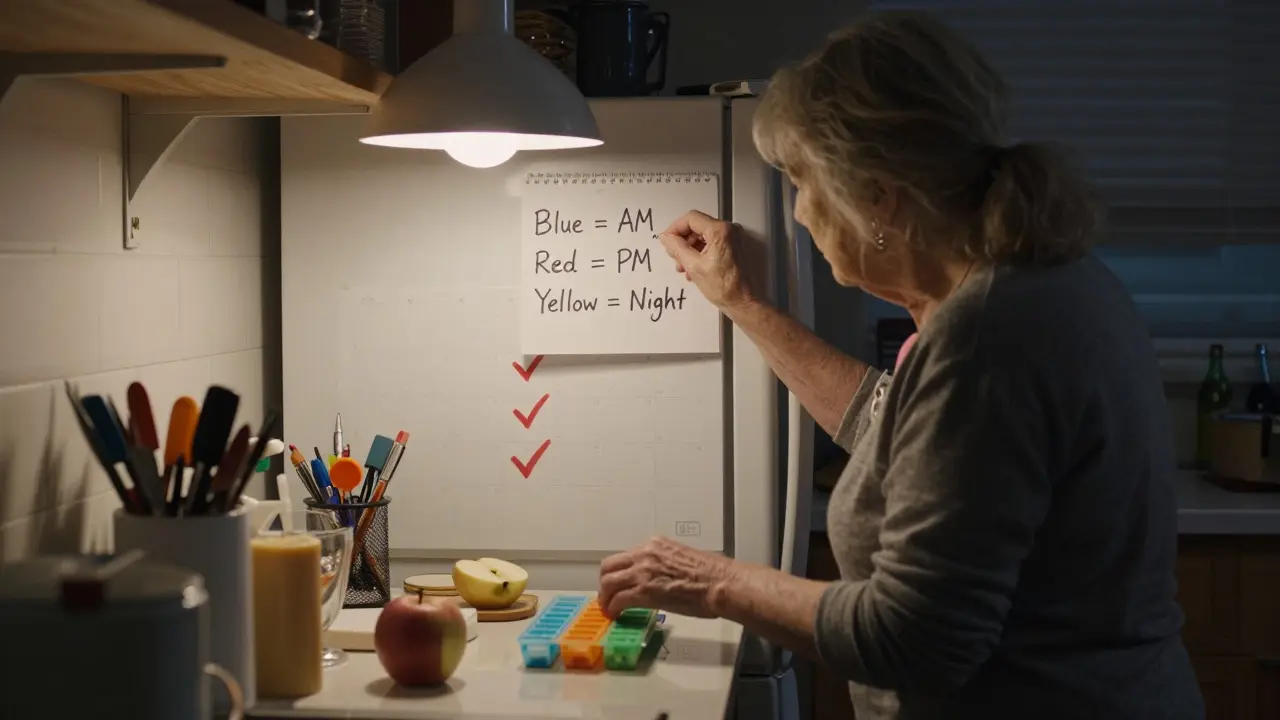
Pro tip: Use colored labels. Blue for morning, red for afternoon, yellow for night. A 2021 AHA study showed this simple trick improved correct dosing by 28%-especially for people who get overwhelmed by small print or too many pills.
Technology helps-but only if it works for you
Smartphone alarms are great-if you actually check your phone. A 2020 MedStar Health study found that 63% of people aged 50-75 improved adherence with phone reminders. But among those over 75, that number dropped to 45%. Why? Phones get silenced. Notifications get ignored. Batteries die.For older adults or anyone who finds tech frustrating, simpler tools often win. Timer caps that beep when it’s time to take your meds stay at 62% effectiveness across all ages. They don’t need Wi-Fi. No app to download. Just twist the cap, and it chirps when it’s time.
And if you’re comfortable with apps, try ones that send both a text and a voice call. Some even let you mark doses as taken with a single tap. The key? Pick one that doesn’t feel like another chore.
Track it visually
Writing things down works-but not in a notebook you’ll forget. A simple calendar on the fridge, with a big checkmark next to each dose, is surprisingly powerful. A 2011 study in the PMC journal found people who used visual trackers reduced missed doses by 32%.AdventHealth’s 2023 survey showed 76% of patients who used check-off calendars maintained 90%+ adherence. Those relying on memory? Only 52% stayed on track.
Make the calendar big. Use a marker, not a pencil. Put it where you’ll see it every day. Bonus: When you see a string of checkmarks, it feels good. That small win keeps you going.
Don’t ignore the real reasons people skip meds
Sometimes, it’s not about forgetting. It’s about feeling awful. Side effects like dizziness, nausea, or fatigue make people stop-intentionally. A ProMedica analysis found nearly half of patients skip doses because they don’t feel well after taking them.If this sounds familiar, don’t tough it out. Talk to your doctor. Maybe the dose can be lowered. Maybe a different medication works better. Or maybe you can take it with food to reduce stomach upset. You’re not being “difficult.” You’re giving your provider useful information.
Travel throws people off, too. 63% of patients report missed doses when away from home. Pack extra pills. Keep them in your carry-on. Bring a small pill organizer for the trip. And if you’re crossing time zones, ask your pharmacist how to adjust your schedule safely.

Simplify before you complicate
Taking five pills at three different times a day? That’s a recipe for confusion. Dr. Robert L. Page II, a leading medication expert, says the most effective routines are the simplest. When possible, switching from three daily doses to one reduces complexity by 40%.Ask your doctor if any of your meds can be combined or switched to long-acting versions. Many blood pressure pills, for example, now come in once-daily formulas. Even small reductions in pill count make a big difference in adherence.
Also, check your prescriptions. Hospital discharge papers often list meds clearly. Pharmacy labels? Not always. A 2022 study found hospital instructions were 85% complete. Retail pharmacy labels? Only 62%. If your pill bottle doesn’t say when to take it, call the pharmacy. Don’t guess.
Get support-but choose wisely
Having someone remind you can help. The “buddy system” works for 58% of people. But if your buddy moves, gets busy, or forgets themselves, your routine falls apart.Better option: Involve someone who’s already part of your daily life. Ask your partner to fill the pill box with you on Fridays. Let your adult child know your routine so they can check in when they call. Make it a shared habit, not a chore.
And if you’re managing memory issues, try the “flip bottle” trick: After you take your pill, turn the bottle upside down. It’s a physical cue that you’ve done it. ProMedica found this reduces double-dosing by 22%.
It’s about progress, not perfection
You’re not failing if you miss a dose once in a while. What matters is how you respond. Did you notice? Did you adjust? Did you talk to your doctor?The goal isn’t 100% adherence every day. It’s building a system that catches you when you slip. A pill organizer. A calendar. A phone alarm. A trusted person. One of these might be enough.
Medication routines aren’t about discipline. They’re about design. Find the tools and triggers that match your life. Not the other way around.
What if I forget my pills while traveling?
Pack extra pills in your carry-on, not checked luggage. Bring a small weekly pill organizer filled for your trip duration. If you’re crossing time zones, ask your pharmacist how to adjust your schedule. Never skip a dose without checking first.
Can I use my phone alarm instead of a pill organizer?
You can-but many people, especially over 75, find alarms easy to ignore or silence. A pill organizer gives you a visual cue you can’t miss. For best results, use both: set the alarm and fill the organizer weekly. The physical act of seeing your pills reduces forgetfulness.
Why do I keep missing doses even though I know they’re important?
Knowledge doesn’t always drive behavior. If your routine is too complex, confusing, or disconnected from your daily life, your brain will default to what’s easiest-skipping. Simplify. Tie it to a habit. Use visuals. Ask for help. Small changes beat willpower every time.
Are smart pill bottles worth it?
They track doses automatically and send alerts, which helps some people-especially those with caregivers. But they’re expensive, need charging, and require tech comfort. For most, a $10 plastic organizer works just as well. Only consider smart bottles if simpler tools haven’t worked and you have support to manage the tech.
What should I do if my meds make me feel worse?
Don’t stop taking them without talking to your doctor. Side effects are common, but they’re not always permanent. Your provider might adjust the dose, switch the timing, or change the medication. Keeping a short log of when you feel off and what you took helps them help you faster.
How long does it take to build a solid medication routine?
Most people see improvement within two weeks if they use consistent cues like brushing teeth or eating breakfast. Full habit formation takes about a month. Stick with it. Even if you slip once, reset the next day. Progress matters more than perfection.

Virginia Seitz
December 17, 2025 AT 03:41Salome Perez
December 18, 2025 AT 11:56Victoria Rogers
December 20, 2025 AT 03:50Nishant Desae
December 21, 2025 AT 20:03Patrick A. Ck. Trip
December 22, 2025 AT 03:42Kaylee Esdale
December 23, 2025 AT 16:01Martin Spedding
December 25, 2025 AT 08:51Evelyn Vélez Mejía
December 26, 2025 AT 14:10Sam Clark
December 27, 2025 AT 15:47Chris Van Horn
December 29, 2025 AT 15:25BETH VON KAUFFMANN
December 30, 2025 AT 11:48Erik J
December 31, 2025 AT 16:08Jody Patrick
January 1, 2026 AT 01:02Meghan O'Shaughnessy
January 2, 2026 AT 16:20