

When your kidneys fail completely, the clock starts ticking. End-stage renal disease (ESRD) isn't just a diagnosis; it's a life-altering event that forces you to choose between two very different paths: dialysis or a kidney transplant. One involves machines and strict schedules; the other offers freedom but comes with its own set of risks and lifelong medication requirements. Understanding these options is crucial because they dictate not just how long you live, but how well you live.
If you or a loved one has received this diagnosis, the medical jargon can feel overwhelming. You might hear terms like glomerular filtration rate (GFR), arteriovenous fistula, or immunosuppressants thrown around in rapid succession. But beneath the complexity lies a simple reality: without intervention, ESRD is fatal. The goal of treatment is to replace the filtering function your kidneys once performed naturally. Let’s break down what each path looks like, the hard numbers behind survival rates, and how these choices impact your daily life.
Understanding End-Stage Renal Disease
End-Stage Renal Disease (ESRD) is the final stage of chronic kidney disease where kidneys lose approximately 90% of their functional capacity. Medically, this is defined by a glomerular filtration rate (GFR) dropping below 15 mL/min/1.73 m². At this point, waste products and excess fluids build up in the bloodstream to toxic levels.
The leading causes are clear and prevalent. Diabetes mellitus accounts for about 44% of new cases, while hypertension contributes to another 28%. Other significant factors include glomerular diseases, lupus nephritis, polycystic kidney disease, and prolonged exposure to certain drugs or toxins. In the United States alone, approximately 786,000 people live with ESRD. Of these, 71% rely on dialysis, while 29% have received a functioning kidney transplant. This distribution highlights a critical gap: many patients who could benefit from transplantation remain on dialysis due to access barriers, late referrals, or misconceptions about eligibility.
It’s important to recognize that ESRD doesn’t happen overnight. It’s the culmination of years of declining kidney function. Early detection and management of underlying conditions like diabetes and high blood pressure can delay or even prevent progression to this stage. However, once ESRD is diagnosed, the focus shifts entirely to renal replacement therapy.
Dialysis Options: Hemodialysis vs. Peritoneal Dialysis
Dialysis acts as an artificial kidney, filtering blood to remove waste and balance fluids. There are two main types, each with distinct lifestyles implications.
| Feature | In-Center Hemodialysis | Peritoneal Dialysis |
|---|---|---|
| Treatment Frequency | 3 times per week | Daily (often overnight) |
| Time Commitment | 3-4 hours per session + travel | ~2 hours setup/cleanup + automated cycle |
| Location | Dialysis center | Home |
| Access Method | Arteriovenous (AV) fistula | Catheter in abdomen |
| Dietary Restrictions | Strict fluid and potassium limits | Moderate restrictions |
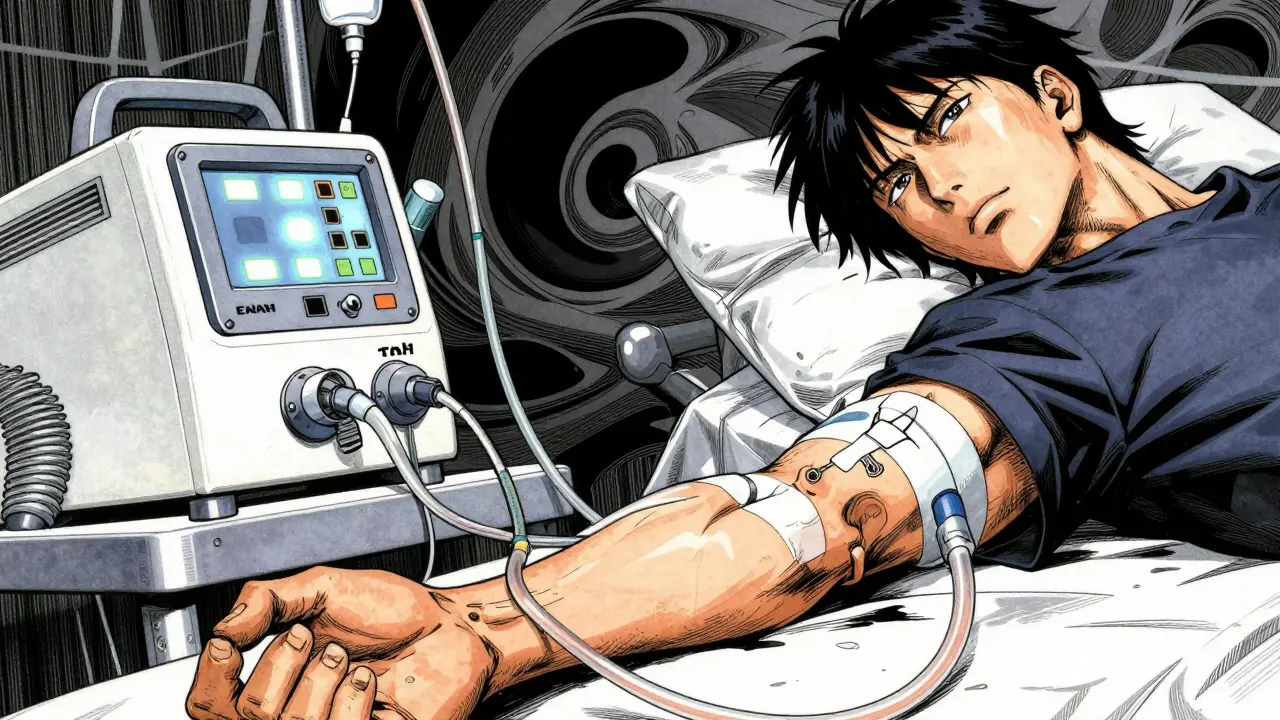
Hemodialysis is a process where blood is filtered through a machine outside the body. Most patients undergo in-center hemodialysis three times a week. Each session lasts 3 to 4 hours, plus travel time. This totals 12-16 hours per week dedicated solely to treatment. To facilitate this, doctors create an arteriovenous (AV) fistula, usually in the arm, ideally 6-12 months before dialysis begins to allow proper maturation. Technical parameters matter here: blood flow rates typically range from 300-500 mL/min, and adequacy is measured by Kt/V, which should be ≥1.4 per session.
Peritoneal Dialysis is a home-based therapy using the lining of the abdomen to filter blood. It offers more flexibility. Continuous Ambulatory Peritoneal Dialysis (CAPD) requires four manual exchanges daily, while Automated Peritoneal Dialysis (APD) uses a cycler machine overnight. APD is popular because it frees up daytime hours. The standardized Kt/V target for peritoneal dialysis is ≥1.7 per week. Home dialysis adoption has grown, rising from 8.3% of new patients in 2015 to 14.2% in 2022, reflecting increased support and patient preference for autonomy.
Both methods require strict monitoring of phosphate (3.5-5.5 mg/dL), calcium (<9.5 mg/dL), and parathyroid hormone (PTH) levels. Vitamin D analogs are often prescribed to manage mineral bone disorders. While dialysis sustains life, it rarely restores normal health. Patients often experience fatigue, dietary constraints, and frequent hospitalizations.
Kidney Transplantation: The Gold Standard
Despite the availability of dialysis, Kidney Transplantation is widely considered the optimal treatment for ESRD due to superior survival rates and quality of life. Receiving a healthy kidney from a living or deceased donor eliminates the need for dialysis and allows most recipients to return to work, exercise, and social activities with minimal restrictions.
The data supports this strongly. According to Mayo Clinic research, transplantation reduces the risk of death by 68% compared to dialysis. Five-year patient survival rates stand at 83% for transplant recipients versus just 35% for those on dialysis. Graft survival is also impressive: 95.5% at one year for living donor transplants and 93.7% for deceased donor transplants. Over five years, these figures drop to 86.0% and 78.5%, respectively.
However, transplantation isn’t automatic. Eligibility depends on overall health. Contraindications include severe heart disease (ejection fraction <25%), active cancer within the last 2-5 years, advanced age with multiple comorbidities, uncontrolled mental illness, or ongoing substance misuse. Early referral is key. Guidelines recommend evaluation when eGFR falls below 30 mL/min/1.73 m². Unfortunately, only 5% of patients starting dialysis are preemptively listed for transplant, leaving many to wait an average of four years on the waiting list. As of 2023, over 90,000 patients await kidneys in the U.S., with only 27,000 transplants performed annually.
Living donor transplants offer better outcomes than deceased donor ones. They can be scheduled electively, reducing cold ischemia time (the period the kidney is outside the body). Living donors undergo rigorous screening to ensure safety, and recovery typically takes 4-6 weeks. Family members, friends, or even altruistic strangers can donate. Since 2018, living donor transplants have increased by 18%, driven by awareness campaigns and paired exchange programs.
Quality of Life: Beyond Survival Statistics
Survival metrics tell part of the story, but quality of life defines daily existence. A 2021 study published in the *Clinical Journal of the American Society of Nephrology* revealed stark differences. Kidney transplant recipients scored 82.4 on the Kidney Disease Quality of Life (KDQOL-36) survey, compared to 53.7 for hemodialysis patients. Peritoneal dialysis patients fell in between at 67.2. These scores reflect physical comfort, emotional well-being, and social functioning.
Transplant recipients enjoy fewer dietary restrictions. They don’t face the rigid fluid limits or potassium bans that dialysis patients endure. Hospitalization rates are 50% lower among transplant recipients annually. Yet, transplantation introduces new challenges. Immunosuppressant medications-such as tacrolimus, mycophenolate mofetil, and corticosteroids-are required for life to prevent rejection. These drugs increase susceptibility to infections, raise cancer risk, and can cause side effects like tremors, high blood sugar, or weight gain. Monthly costs for immunosuppressants average $1,500-$2,500, though Medicare covers much of this for eligible beneficiaries.
Dialysis patients, meanwhile, battle the "dialysis hangover"-fatigue, cramps, and headaches following sessions. The time burden disrupts careers and family life. Travel becomes complicated. Many report feeling tethered to their schedule. Peritoneal dialysis offers more freedom but carries risks of peritonitis (abdominal infection) and catheter-related complications. Regular self-care and hygiene are non-negotiable.
Navigating Access and Disparities
Not everyone has equal access to care. Racial and socioeconomic disparities persist. African American patients, despite higher rates of ESRD, historically had lower referral rates for transplantation. The RaDIANT Community Study addressed this by training healthcare teams to proactively discuss transplant options. After intervention, referral rates for African American patients jumped from 8.5% to 12.0%, a 40% increase. Similar gains were seen in white patients, but the baseline disparity remained.
Policies are shifting. The CMS Kidney Care Choices Model incentivizes earlier transplant referrals through episode-based payments. The National Minority Organ Tissue Transplant Education Program (MOTTEP) operates 25 sites nationwide to educate underserved communities. Additionally, the 21st Century Cures Act expanded the use of "expanded criteria donors"-older donors or those with mild health issues-increasing the donor pool by 15% since 2017.
Financial navigation is another hurdle. Medicare covers ESRD care starting in the fourth month of dialysis, ending 36 months post-transplant. Private insurance varies widely. Out-of-pocket costs for co-pays, transportation, and specialized diets add up. Social workers play a vital role in connecting patients with resources, transportation assistance, and financial aid programs.

Practical Steps for Patients and Families
If you’re facing ESRD, take control early. Here’s what you can do:
- Evaluate all options promptly. Don’t assume dialysis is your only choice. Ask your nephrologist about transplant eligibility immediately upon diagnosis.
- Explore living donation. Talk to family and friends. Paired exchange programs can match incompatible donors with suitable recipients elsewhere.
- Prepare for dialysis if needed. Get your AV fistula created 6-12 months ahead. Learn about home dialysis options if you value independence.
- Manage comorbidities. Control blood pressure, blood sugar, and cholesterol. Protect your remaining kidney function and future graft.
- Build a support network. Join patient advocacy groups like the National Kidney Foundation. Share experiences with others who understand.
- Plan financially. Review insurance coverage, apply for disability benefits if necessary, and budget for out-of-pocket expenses.
Education empowers decision-making. Attend workshops, read reputable sources, and ask questions. Your care team should involve you in every step, from vascular access planning to transplant listing.
Future Directions in Kidney Care
Innovation continues to reshape ESRD management. The NIH’s Kidney Precision Medicine Project, funded with $157 million through 2026, aims to develop personalized treatments based on genetic profiles. Researchers are exploring bioartificial kidneys, wearable dialysis devices, and xenotransplantation (pig-to-human transplants) to address organ shortages. While still experimental, these advancements offer hope for reduced dependency on traditional dialysis and expanded donor pools.
Policy changes also promise improvement. Enhanced reimbursement models reward providers for keeping patients off dialysis longer through conservative management or timely transplantation. Telehealth platforms now support remote monitoring of dialysis adequacy and post-transplant labs, improving access for rural patients.
What is the life expectancy on dialysis versus transplant?
Five-year survival rates are significantly higher for transplant recipients (83%) compared to dialysis patients (35%). Transplantation reduces mortality risk by 68%. Individual outcomes vary based on age, comorbidities, and adherence to treatment.
Can I work while on dialysis?
Yes, many patients continue working. Home dialysis offers greater scheduling flexibility. In-center hemodialysis requires dedicating 12-16 hours weekly, including travel. Employers may offer accommodations under the ADA.
How long is the wait for a kidney transplant?
The median wait time is four years. Wait times depend on blood type, tissue match, geographic location, and urgency. Living donor transplants bypass the waiting list entirely.
What are the side effects of immunosuppressants?
Common side effects include increased infection risk, high blood pressure, elevated blood sugar, tremors, and weight gain. Regular monitoring helps manage these issues. Medication regimens are tailored to minimize adverse effects.
Is peritoneal dialysis safer than hemodialysis?
Both are safe when performed correctly. Peritoneal dialysis avoids needles and vascular access complications but carries a risk of peritonitis. Hemodialysis provides more consistent clearance but requires vascular access maintenance. Choice depends on lifestyle, dexterity, and home environment.

Lilith Stepanyan
July 31, 2026 AT 03:37the stats are nice but they ignore the systemic rot that keeps people on dialysis instead of getting transplanted. it is a logistical failure disguised as medical necessity.
Alli Crumley
August 1, 2026 AT 22:02You clearly lack the holistic understanding required to grasp the spiritual weight of this diagnosis. The body is merely a vessel, yet you cling to these mechanical solutions with such desperate ignorance. :/
The dichotomy between the sterile machine and the organic gift of another’s organ represents a fundamental dissonance in our modern existence. We trade autonomy for survival, a Faustian bargain that few truly comprehend until the needle pierces their skin. It is not merely about filtration rates or Kt/V adequacy; it is about the erosion of the self. When one becomes dependent on an external apparatus to cleanse their very blood, where does the individual end and the machine begin?
This pseudo-scientific reductionism ignores the metaphysical toll. The ‘quality of life’ mentioned in the title is a subjective construct, often manipulated by pharmaceutical interests to sell more immunosuppressants. True healing requires a surrender to the natural order, even if that order demands a painful reckoning. Most patients are too consumed by fear to see the deeper truth: that ESRD is a karmic reflection of a lifestyle out of alignment with universal principles. Until we address the root energetic imbalances, all this talk of AV fistulas is just noise.
Marc H
August 2, 2026 AT 17:35Oh, brilliant Alli, because nothing says 'healing' like telling someone with failing kidneys to check their chakras while they’re waiting for a three-hour slot at the dialysis center. 🙄
I’ve got a friend who’s been on hemo for five years. He doesn’t have time for your philosophical waxing about the ‘erosion of the self.’ He has time to sleep on the bus to the clinic, then spend four hours hooked up to a machine that makes him feel like garbage, then go home and eat rice cakes because his potassium levels are through the roof. It’s not a ‘Faustian bargain,’ it’s Tuesday.
The article is actually pretty spot-on about the logistics though. The gap between transplant availability and need is massive. It’s not just ‘systemic rot,’ it’s bureaucratic nightmare fuel. But hey, keep judging us from your high horse while we’re busy trying to stay alive.
Chris McQuaid
August 4, 2026 AT 12:27Look, Marc, you’re right about the suffering, but let’s not pretend the system is purely evil. It’s just inefficient. The real issue is that most people don’t understand the biology until it’s too late.
Here’s the thing nobody talks about: peritoneal dialysis isn’t just ‘more flexible,’ it’s fundamentally different in how it affects your vascular health. Hemodialysis puts a huge strain on the heart because of the rapid fluid shifts. If you can handle the discipline of daily exchanges, PD is often better for long-term cardiac outcomes. But yeah, it’s hard work. You become your own nurse. Some people thrive on that control; others crumble under the responsibility.
The data shows APD adoption is rising, which is good. It means fewer hospital visits and more normalcy. But don’t expect miracles. You’re still replacing kidney function, not restoring it. It’s a maintenance strategy, plain and simple. Stop romanticizing the struggle and start respecting the science.
sam howard
August 5, 2026 AT 06:10transplant is obviously superior why do people choose dialysis? ignorance mostly. also the waitlist is a joke. living donors exist but everyone is too scared to cut into themselves. selfishness kills.
Samuel Hershberger
August 7, 2026 AT 03:26Hey Sam, easy there! 😊 Not everyone has a willing or eligible living donor. It’s not just about fear; it’s about complex medical compatibility and emotional readiness. Many people want to donate but simply can’t due to age, health conditions, or family dynamics.
That said, you’re right that living donation offers the best outcomes. I worked with a patient who got a living donor kidney after two years on the deceased list. The difference was night and day. No more dialysis fatigue, no more strict fluid restrictions, just... life. It’s incredible what a transplant can do for quality of life.
If anyone here is considering being a donor, please reach out to a transplant center. You’d be amazed at how many healthy people think they’re ineligible when they’re actually perfect candidates. Don’t let assumptions stop you from potentially saving someone’s life!
Fenton Quinn
August 7, 2026 AT 08:40The concept of choice here is illusory. One chooses the path of least resistance, not necessarily the best outcome.
Josh Atkinson
August 8, 2026 AT 15:14Oh wow, Fenton, you really nailed it with that profound insight! :) Seriously though, the idea that patients are making rational choices is laughable. Most are terrified, confused, and overwhelmed by doctors who speak in acronyms. They pick what’s easiest, not what’s optimal.
And let’s talk about the ‘freedom’ of transplants. Sure, you’re not tied to a machine, but you’re chained to immunosuppressants for the rest of your life. One missed dose, one viral infection, and boom-rejection risk skyrockets. Plus, those drugs increase cancer risk and diabetes risk. It’s a trade-off, not a cure. People forget that every pill has a price tag written in side effects.
I’ve seen patients bounce back from dialysis only to crash harder post-transplant because they didn’t respect the meds. It’s not about freedom; it’s about managing a new chronic condition. The article glosses over this psychological burden. You’re never ‘cured,’ you’re just playing a different game with higher stakes. And honestly? That’s terrifying. But we keep smiling and nodding because society expects us to be grateful for any scrap of life we’re given. 😔