

Imagine your skin cells renewing themselves in just three or four days instead of the normal twenty-eight to thirty. That rapid turnover creates the thick, silvery scales and red patches that define psoriasis, a condition affecting up to 3.2% of people in the United States. It is not just a cosmetic issue; it is a chronic, inflammatory multisystem disease driven by an overactive immune system. If you are dealing with flare-ups that last weeks or months, you are likely looking for ways to regain control. The goal isn't necessarily a permanent cure-science hasn't cracked that code yet-but rather effective long-term management through smart skin care and targeted systemic therapies.
Understanding the Root Cause: More Than Just Dry Skin
Many people mistake psoriasis for severe dryness or eczema, but the mechanism is distinct. In a healthy body, T-cells help fight infection. In someone with psoriasis, these T-cells mistakenly attack healthy skin cells, triggering inflammation and speeding up cell production. This process is heavily influenced by genetics, with heritability estimates ranging from 60% to 90%. You might notice symptoms starting between ages 15 and 25, or later in life between 50 and 60.
The most common form, plaque psoriasis, accounts for 80-90% of cases. It typically shows up on elbows, knees, the scalp, and the lower back. But psoriasis is sneaky; it can also appear as inverse psoriasis in skin folds like the groin or under breasts, where friction makes it worse, or as pustular psoriasis, which presents with sterile white bumps. Understanding your specific subtype matters because it dictates how you treat it. For instance, what works on your elbow might be too harsh for your face or groin.
Daily Skin Care: Your First Line of Defense
Before jumping into heavy-duty medications, there is a foundation of daily care that supports every other treatment. The National Psoriasis Foundation emphasizes the importance of keeping the skin barrier intact. Think of emollients not as luxury moisturizers, but as medical necessities. Petrolatum-based products are often preferred because they lock in moisture effectively without irritating sensitive, inflamed areas.
- Bathing Habits: Stick to brief, lukewarm showers. Hot water strips natural oils and worsens itching. Use gentle, fragrance-free cleansers instead of harsh soaps.
- Immediate Moisturizing: Apply your emollient within three minutes of getting out of the shower while your skin is still damp. This traps hydration where it belongs.
- Trigger Tracking: Keep a simple journal. Note when flares happen. Did you have a stressful week? Did you catch a cold? Stress and infections are major triggers for many patients.
Adherence is tough. A survey of users on Reddit’s r/psoriasis found that nearly two-thirds struggled with applying topicals consistently because they were messy or time-consuming. Simplifying your routine helps. If you can switch from twice-daily applications to once-daily formulations, do it. Studies suggest adherence improves by 40% when regimens are simplified.
Topical Therapies: When Creams Aren't Enough
When moisturizers fail, doctors usually prescribe topical medications. These are applied directly to the plaques. The gold standard for moderate plaque psoriasis is often a combination of calcipotriol (a vitamin D analog) and betamethasone (a potent steroid). This combo encourages rapid improvement, though some guidelines recommend starting with individual components to minimize side effects.
Corticosteroids work well but come with risks. Using them for more than 12 weeks requires physician supervision because prolonged use can thin the skin (atrophy) or cause visible blood vessels (telangiectasia). High-impact areas need special attention. The scalp might require a foam formulation for easier application, while the face needs milder vitamin D analogs to avoid steroid-induced damage. Never apply potent steroids to thin-skinned areas like the eyelids or genitals unless explicitly directed by your dermatologist.

Systemic Therapy: Treating From the Inside Out
If topicals don't clear your skin, or if you have large surface area involvement, it is time to look at systemic therapies. These drugs work throughout your entire body to dampen the immune response. There are two main categories here: traditional oral/systemic agents and newer biologics.
Traditional options include methotrexate, cyclosporine, and acitretin. Methotrexate, taken weekly, has been a staple for decades. Cyclosporine is fast-acting and great for severe, recalcitrant cases, but it can affect kidney function, so monitoring is crucial. Acitretin is another option, though it is often avoided in women of childbearing age due to long-lasting teratogenic effects. Then there is apremilast, a PDE4 inhibitor. It is an oral pill that offers a middle ground for those who want to avoid injections but find topicals insufficient.
| Treatment Type | Mechanism | Administration | Key Considerations |
|---|---|---|---|
| Methotrexate | Immune suppression | Weekly pill or injection | Requires liver monitoring; effective and low cost. |
| Cyclosporine | Calcineurin inhibitor | Daily pills | Fast acting; monitor blood pressure and kidneys. |
| Apremilast | PDE4 inhibitor | Twice daily pill | No lab monitoring required; may cause nausea initially. |
| Biologics (e.g., IL-17 inhibitors) | Targeted immune blockage | Injection or IV infusion | High efficacy; higher cost; requires TB/hepatitis screening. |
The Biologic Revolution: Targeting Specific Pathways
Biologics have changed the landscape of psoriasis treatment. Unlike broad immunosuppressants, biologics target specific proteins in the immune system, such as TNF-alpha, IL-17, or IL-23. Drugs like adalimumab, secukinumab, and guselkumab fall into this category. They are designed to achieve high levels of clearance, often measured by PASI scores (Psoriasis Area and Severity Index). Modern standards aim for PASI90, meaning 90% improvement in skin appearance.
Patient satisfaction with biologics is generally high. On platforms like Healthgrades, users report significant improvements in quality of life. However, they aren't perfect. Cost is a massive barrier. Out-of-pocket expenses can range from $1,200 to $5,500 per month depending on insurance. Additionally, before starting a biologic, you must undergo screening for tuberculosis, hepatitis, and sometimes HIV, as these drugs can reactivate latent infections. Administration is usually subcutaneous (under the skin), which takes only 15-20 minutes after training, making it manageable for most patients.
Looking Beyond the Skin: Comorbidities Matter
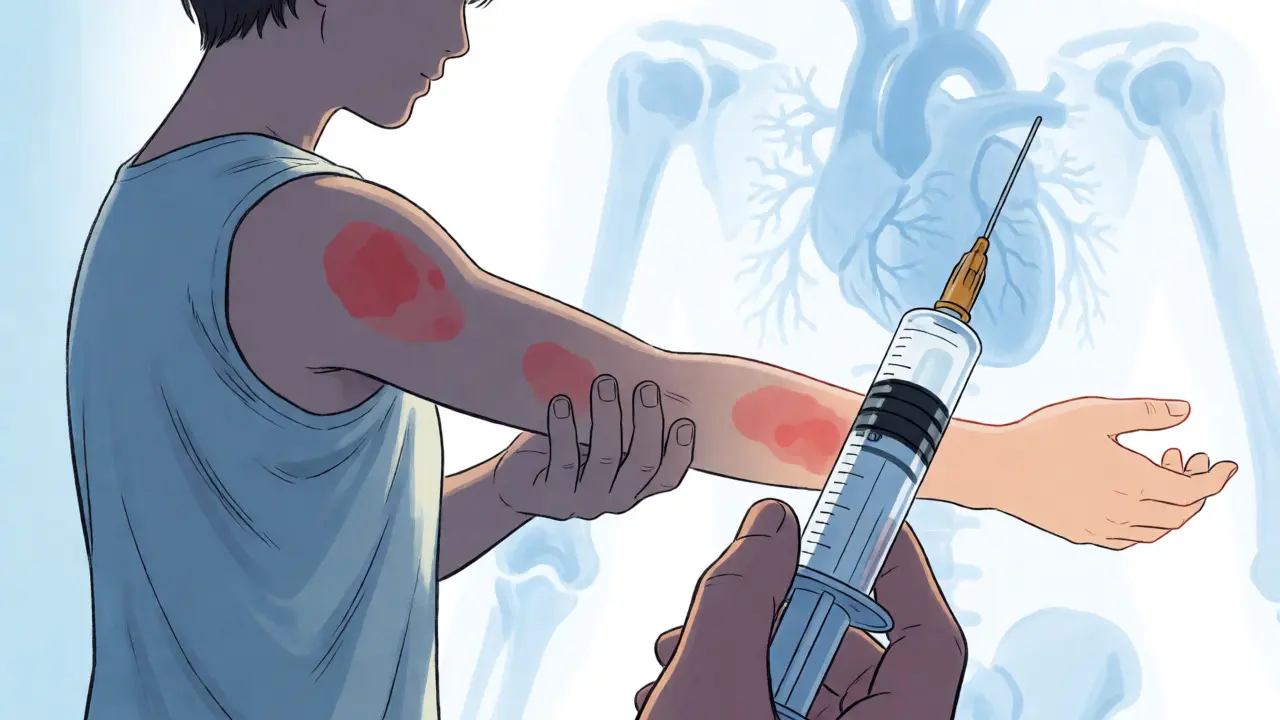
Here is the part many patients miss: psoriasis is a systemic inflammatory disease. It doesn't stay confined to your skin. Up to 30% of psoriasis patients develop psoriatic arthritis, which causes joint pain and stiffness. If you have nail changes or scalp psoriasis, you are at higher risk. Early detection is key to preventing permanent joint damage.
Cardiovascular health is another critical factor. Research published in the New England Journal of Medicine showed that patients under 50 with psoriasis have a 58% higher incidence of heart attacks compared to the general population. Metabolic syndrome-including obesity, high blood pressure, and diabetes-is also more common. Dr. Joel Gelfand from the University of Pennsylvania notes that the cardiovascular risk associated with psoriasis is equivalent to that of diabetes. This means managing psoriasis isn't just about clear skin; it's about protecting your heart and joints. Annual checks for blood pressure, lipids, and BMI should be part of your routine care.
Psychological Impact and Support
Living with a visible chronic condition takes a toll. Depression and anxiety rates among psoriasis patients are significantly higher than in the general population, ranging from 17% to 37%. The stress of managing treatments, hiding patches, and dealing with societal stigma can create a vicious cycle where stress triggers flares, and flares increase stress.
You don't have to navigate this alone. Resources like the National Psoriasis Foundation offer virtual support groups that connect thousands of people monthly. Apps like MyPsoriasisTeam allow you to track symptoms and treatments, helping you identify patterns. Connecting with others who understand the frustration of failed treatments or the joy of clear skin can provide emotional resilience that medication alone cannot.
Future Directions: Personalized Medicine
The field is moving toward precision dermatology. Newer therapies, like TYK2 inhibitors (e.g., deucravacitinib), show promise with oral administration and high efficacy rates. Oral RORγt inhibitors are also in development, potentially offering biologic-level results without injections. The American Academy of Dermatology is pushing for a "right-care-first" approach, matching treatment intensity to disease severity immediately rather than waiting for step-by-step failures. This shift aims to reduce the burden of disease faster and improve long-term outcomes.
Is psoriasis contagious?
No, psoriasis is not contagious. You cannot catch it from touching someone else, sharing towels, or swimming in the same pool. It is an autoimmune disorder driven by genetics and environmental triggers, not an infection.
Can I cure psoriasis permanently?
Currently, there is no permanent cure for psoriasis. However, modern treatments can induce long periods of remission where symptoms disappear completely. Management focuses on controlling flares and maintaining clear skin through consistent therapy and lifestyle adjustments.
What triggers a psoriasis flare-up?
Common triggers include stress, skin injuries (cuts, scrapes, sunburns), infections (like strep throat), cold weather, smoking, excessive alcohol consumption, and certain medications such as beta-blockers or lithium. Identifying personal triggers through journaling can help prevent flares.
Do I need to see a specialist for mild psoriasis?
Not always. Primary care providers can manage mild cases with topical treatments. However, if topicals fail, if you have joint pain suggesting psoriatic arthritis, or if the condition impacts your quality of life significantly, referral to a dermatologist is recommended for advanced therapies like phototherapy or biologics.
How much does biologic therapy cost?
Costs vary widely based on insurance coverage. Without insurance, biologics can cost between $1,200 and $5,500 per month. With insurance, out-of-pocket costs depend on deductibles and copays. Many pharmaceutical companies offer patient assistance programs to help eligible individuals afford these medications.