
ANDA Review: What It Means for Generic Drugs and Your Health
When you pick up a generic pill at the pharmacy, you might wonder if it’s really the same as the brand-name version. That’s where the ANDA review, a process used by the U.S. Food and Drug Administration to approve generic medications. Also known as Abbreviated New Drug Application, it’s the backbone of affordable medicine in the U.S. The FDA doesn’t repeat the same expensive clinical trials for generics. Instead, they use the ANDA review to prove the generic version delivers the same active ingredient, in the same amount, the same way — and works just as well.
This isn’t just paperwork. The ANDA review, a process used by the U.S. Food and Drug Administration to approve generic medications. Also known as Abbreviated New Drug Application, it’s the backbone of affordable medicine in the U.S. is how the FDA makes sure a generic version of your blood pressure pill, antidepressant, or antibiotic doesn’t just look like the brand name — it actually does the same job in your body. They test for bioequivalence, how quickly and completely a drug enters your bloodstream compared to the original. If the generic doesn’t match within strict limits, it gets rejected. No exceptions. That’s why you can trust a $5 generic version of a $100 brand drug — the science backs it up.
Behind every approved generic is a mountain of data: dissolution rates, stability tests, manufacturing controls, and purity checks. The FDA looks at every step — from how the tablet breaks down in your stomach to whether the pill coating affects absorption. They even audit the factories. This is why some generics fail the ANDA review and never hit the market. It’s not about cost. It’s about safety.
And it’s not just about saving money. When the ANDA review works right, it gives patients real choices. Millions rely on generics because they can’t afford brand names. A broken review system means people skip doses or go without. But when the system holds strong — like it does with most approved generics — it keeps people alive and healthy.
What you’ll find in this collection are real-world examples of how drugs go through this process — from how aspirin’s generic form is tested to how complex medications like biologics are evaluated. You’ll see how the ANDA review connects to things like drug interactions, side effects, and even why some medications cause dizziness or sun sensitivity. These aren’t abstract rules. They’re the invisible checks that make sure the pills you take every day are safe, effective, and truly interchangeable.
17
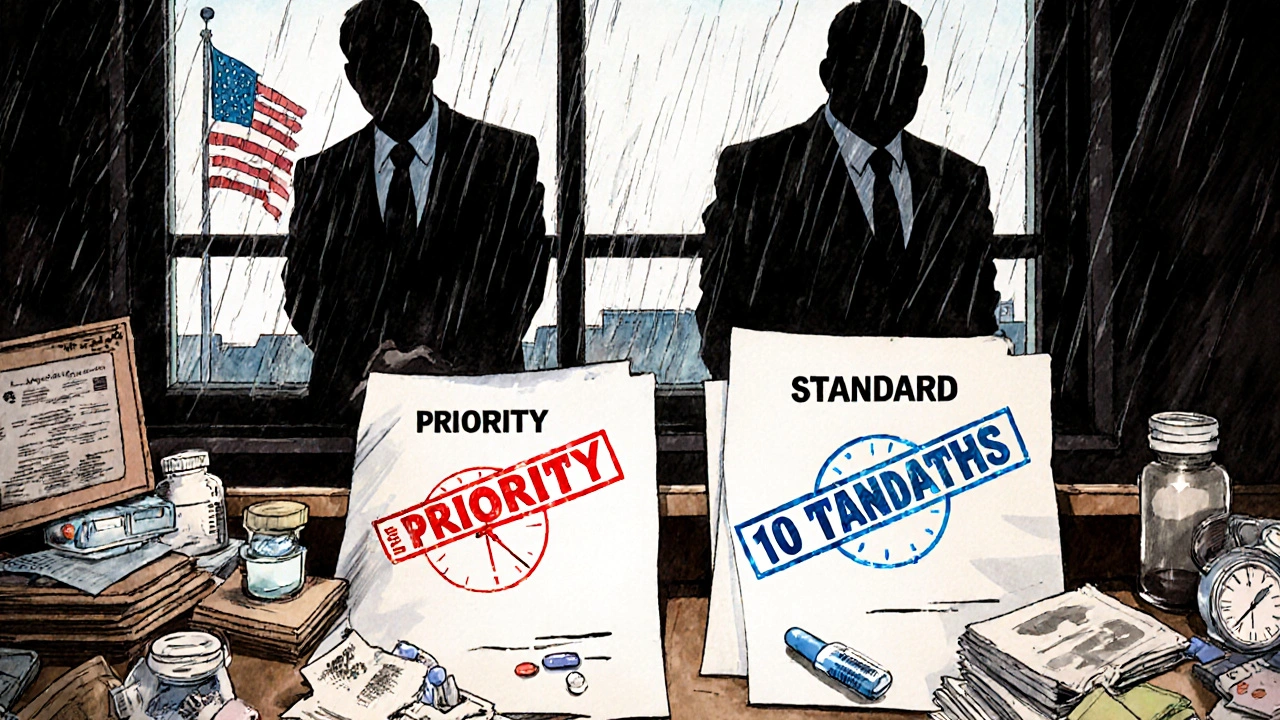
Priority vs Standard Review: How FDA Prioritizes Generic Drug Applications
The FDA uses priority and standard review tracks for generic drugs. Priority review, at 8 months, is reserved for first generics, drugs in shortage, or those with clinical advantages. A new pilot rewards U.S. manufacturing. Understanding these rules helps companies get approvals faster and patients get affordable drugs sooner.